The Radio Spectrum - UK Allocations
Latest revision : 12.feb.2012 (tidied up, many updates)
A guide from 0 Hz to 30 EHz (DC to Gamma rays). The main bands, all frequencies in MHz unless otherwise stated.
With grateful thanks to OFCOM (previously the UK Radiocomms Agency)
for so openly publishling all you need to know... even if actually tuning in to anything
other than Broadcasting/CB/Ham is not allowed, that's the rules, folks.
Which is why there are no details of Private systems here... this page details frequency ranges and channel schemes
that could be used for various services, but not actual, specific instances - unless the details
are so commonly available elsewhere that they can't be considered secret. OFCOM themselves are now making licence details public, so the PMR bands usage is now public domain.
As recommended by Short Wave Magazine (UK) - "Excellent... well worth a look"
DISCLAIMER: This page is provided for interest/curiosity only. Private services should remain that way, if you listen
without a licence (you can't get them) to anything other than licenced Broadcasting or Amateur Radio (& CB) you are
breaking the law.
Even having a private frequency stored in a receiver's memory channel is considered to be proof of intercepting messages that
are not intended for you. Penalties include heavy fines and/or imprisonment.
You have been warned.
Under Section 5(b) of the Wireless Telegraphy Act 1949 it is an offence to use radio equipment with intent to obtain
information as to the contents, sender or addressee of any messages, whether or not the information is passed on, which
the user has not been authorised to receive.
Eavesdropping is tempting because wide-area mobile comms are obviously designed to cover a large area
and so it really is quite easy to receive at least base stations and repeaters. If you say they deserve to
be heard if they don't encrypt their voice traffic in any way - I would say you need to consider the harsh
economic reality of replacing huge numbers of radios, but it will happen. You may think that the USA has things
right, as they may listen to their public services (but not cellphones) but you can't argue with our law unless
you can get it changed, and unprocessed bacon might fly. There may well be a large number of cases of the US
public assisting their law officers after having heard about incidents on their scanners, but I don't think
that justifies the personal details of victims of crime being known. If anything, maybe there should be a
clear channel in each area that the public MAY listen to, where the police actually ask the public for their
assistance. Could be tricky from a legal liability angle though! Please don't tell me you think you have a
right to listen to the movements of covert investigations...
PLEASE COPY THIS WEBPAGE TO YOUR PC FOR SAFEKEEPING, in case this website vanishes.
(c) Me, 1997-2012! However...
PLEASE FEEL FREE TO COPY ONTO YOUR OWN WEB-SPACE AND MAKE IT AVAILABLE TO THE PUBLIC.
(CONDITIONS Please
use the .JPG background,
KEEP THE FORMATTING THE SAME,
do not remove my comments,
use a fixed width font so that it all lines up still,
bolt in a replacement hits counter,
and do not claim it's all your own work!
Thank you)
Click
here for a white background "Windows-style" version
HINT: There is a glossary at the end of this page to explain all the funny acronyms!
So what's the point of this page? Personally, I've been fascinated by the magic of radio
all of my life, fiddling around with radios since primary school, and over the years having
read a fair bit about communication systems and the radio spectrum, I've now got a lot of radio information rattling around in my head.
I thought it would be nice to share it with the world, via the web, to show what a crowded resource the RF spectrum is;
how every nook and cranny is allocated to some service or other; how OFCOM has to balance the needs of various services when
they are asked for more spectrum. Also, with all that RF energy passing through your body, don't you think you
have a right to know exactly what sort of emissions are zapping through you? (I'm not saying you have a right to
know the content of the messages, only the nature of the delivery). Also, Amateurs should be aware of the services that
could be affected should their equipment not be up to the required standard. Likewise to anyone foolish enough to consider operating
an unlicenced pirate station - just don't - there really isn't any point is there? And lastly, because published books are often
out of date or plainly wrong in these matters.
This revision of the page may be the last major update you'll be getting for a while.
I'll keep things up to date if they change, but I'm happy with the layout and not much is changing these days.
Unless new channel plans or allocations come along, this is just about it. I'll keep
things as accurate as I can, but it's now too much work to go checking all the links.
I've researched all the topics that interest me and
I've done my best to share what I've found. If you want to know more, firstly
read the entire OFCOM site, then learn to use the major search engines effectively,
and join some of the many expert mailing lists.
Errors and Omissions are most likely to appear above the range of most scanners (1.3GHz),
as that is of little interest to most of us, and it's mostly digital these days.
Many thanks to those who have had the patience to keep replacing the page each
time I updated it. Thanks everyone, I hope it's been worthwhile - "The Author"
I think it has been VERY worthwhile, I've learnt a lot from this. I'd like
to thank The Author for all their hard work. It has been a pleasure hosting the
page. Thank you!! - RF-man
So if you've ever wondered what's beyond
the dial on your ordinary radio, this is the page for you. Just be aware that you shouldn't tune in to anything
private - if someone is talking loudly in the street and you can easily overhear, you still don't morally have the
right to listen do you? If the vast amount of broadcasts and ham radio conversations aren't enough to amuse you
(and the rest of what life in general has to offer) then that's quite sad. If I ever have time to switch on my
receiver (to see what the propagation's like) the only bands I need to go to are amateur ones. And good music is
much more satisfying. If you can find it.
In a decade or so there may not be all that much else to listen to anyway on current
scanners, as almost all radio users head towards digital systems, often secure ones too.
Maybe the spectrum will one day consist of just one system for mobile access to THE NET
which provides for all possible communication needs
- a load of buzzing noises wherever you tune, except for
the long-established amateur bands. Then you scanner owners can relax, you won't be able to do anything illegal
with them if you try - unless you decide to throw them through someone's window!
A scanner is already useless except for listening to the hams, airband, marine and a few businesses.
Those who were only into the naughty stuff will have to adjust to a world where shopwatch schemes and the occasional search and rescue mission provide the only interest - or find another hobby. Those who are genuinely interested in radio will have no choice but to go down the amateur route.
I would say that if you have an interest in these matters, devote your energies now to Amateur Radio PLEASE! We need more
activity in the bands. Amateur radio covers bands from Low Frequencies (with 2km wavelengths) to ultra-high
micro-wave bands (wavelengths in millimetres) with modes ranging from good old-fashioned morse code (CW) to
AM/FM speech (communications bandwidths) to advanced narrowband speech (Single Side Band) to Television
(slow scan like FAX through to full motion/definition FMW broadcast quality) to digital/data modes like
RTTY and Packet. Transmissions can be direct, fixed and mobile (and Maritime Mobile), via satellite, bent
through the troposphere, bounced off various layers of charged particles in the upper atmosphere, or even
bounced off the moon (EME), or shooting stars (MS)! And all for just 15 quid per year - bargain.
Go on, prove you know what you're talking about, get a callsign soon. Even if you don't ever
use it...
See the OFCOM web-page info, or the
Radio Society for Good Buddies
site for more details, or the
UK Ham Radio FAQ.
And the G7KPF Quick Links.
Join and support the RSGB too,
it's a good idea as they do tend to negotiate new bands for us.
Here then, is my quick tour of the spectrum of 2012, with links to other sites where appropriate.
All information sourced from freely published books, magazines and web-sites (RA,ERO),
without the need for a scanner, as part of an ongoing quest to figure out what lies beyond
the broadcasting bands...
Services
Broadcasting - LW,MW,SW, 87.5-108, DAB, TV, you're invited to listen (there's money in it, or a license fee to justify!).
Amateur & CB - HF, 50, 70, 144, 430 MHz etc. Can be good, can be dull - you decide. You may listen.
(The rules)
Aeronautical - "airband" - HF, 108-137 MHz. You may not listen, but it seems to be tolerated.
Maritime - HF, 156-163 MHz. Probably tolerated, but no listening unless licensed, and on-board.
...thou shalt NOT listen...
Low Power / Short Range Devices - Cordless telephones / headphones / microphones, remote control etc.
PMSE - SAB/SAP - when TV/radio/film/programme makers use radio. Managed by JFMG (2012 frequencies):
a) Radiomicrophones - carrying "programme audio" obviously,
b) Talkback - on-site comms (simplex or continous duplex) or wide-area comms back to base,
c) Links - mobile "programme audio" back to base, or Fixed links between sites.
Like the military and many low-power devices, they seem to crop up all over the spectrum! However, some of the
assignments in shared bands (mainly BBC) are to cease in 2000, leaving mostly primary bands.
As Bands I, III, IV and V are designated BROADCASTING it seems logical that broadcasters may also use these bands for
mics and comms either at UHF on locally unused "in-band" channels, or (also for links) in the VHF bands that are no longer used for broadcasting.
Around 174MHz is very popular for mics, as well as other parts of Band III
that coincide with French TV carriers and so are not used for PBR.
Note that JFMG also deal with Special Event short-term assignments for local comms, e.g. Ascot.
PMR - channels are allocated in all bands to different categories such as :
. National exclusive,
. Wide Area Shared "G3" - taxis "T1", despatch "H4" etc. - 30kms range,
. ...& Medical (ambulance service - high band)
. CBS (follow the link for Common Base channels),
. On-site shared - dual "C2" or single "O5" - 3km range max., why not use PMR446?!
. Suppliers Light (was Short Term Hire) (up to 1 year), demo (28 days), "parking" (3 months), Test&Dev,
. specific uses i.e. Road Construction
. Simple UK Light (was 'UK General') "U3" - mobile only, anywhere in UK, 5W ERP max -
Shared channels : 5 in low-band, 2 in mid-band, 5 in high-band, 3 at UHF.
(in 2002 the UHF channels changed and various conditions too. No time limit now, so it's a good LICENSED replacement for
SRBR and 446, 20 quid a year)
Which explains why that "spare channel" can't be used for anything else in your area!
Given that the number of users of PMR channels runs into tens of thousands
( 2003 report,
2000 report, and
1997 report)
, it would be quite
futile to attempt to list them all - it amazes me that publications even try.
Even worse, once a frequency/user tie-up makes it into print, no-one ever seems to doubt its
validity and it's often printed way after it ceased to be used!
Fair enough to list national allocations, the general type of use for a channel - but to try
and find EVERY assigment, EVERY taxi firm.... ho hum.
Military - various web pages will show that there is a world market for equipment operating in the
bands such as HF, 30-87.5 (25kHz FM), 116-155 & 225-400 (25kHz AM), 470-512 etc. Note that whilst the odd Combat Net
here and there may be "in the clear" any serious tactical use would be very hard to find. Frequency hopping and
scrambling are used - after all, would you want your country defended by forces that could be easily monitored?
Operational use (like PMR) for base security, training, Mil. Police, MOULD etc. involves fixed frequencies, and
various books show that Low VHF, Low Band, Mid Band, 406.1-420 and UHF1 are heavily used for these purposes. There is
currently a general move from VHF to UHF, and the use of a TETRA system is being considered.
This type of radio traffic is still not to be listened to!
...thou shalt definitely NOT listen...
(2009 update: and now everything is digital you can't anyway!)
Public Telecomms - paging, mobile telephone/data - the reason why scanner manufacturers HAD to include
coverage of the 900MHz band (! there's nowt else up there to listen to). Eavesdropping on analogue
mobile calls is quite rightly frowned upon.
Home Office for the Emergency Services - previous versions of this document did not mention these allocations,
but as the bands are shown on OFCOM pages, and in various books, some are now included for the sake of clarity.
Only the BANDS are shown, not actual frequencies in use. Do NOT listen in!
Notes
NOTE 1: Boundaries - a "equals" symbol (=) is used here to clarify a known boundary between two band sections, this usually
means no transmissions on the frequency itself, but that use of the band includes RF emissions up to that point. This could
be a point between two normal channels, such as the 165.04375 boundary between the last mid-band channel 165.0375 and the first
high band channel 165.050, or even a "wasted" channel giving "guard band" separation between two types of service.
As an example, Band II is bounded by 87.5 to 108, whereas I try wherever possible to specify bands by the first and last
channel centres, in this case 87.6 to 107.9 (in the USA, VOR tests are allowed on 108.0 just to confuse matters, so long as
no interference is caused). (Some aero DME channels are tuned by selecting 108.0 even though there's no signal on 108!)
One exception is the international marine 156.0 boundary - used for channel 0 uniquely in the UK, which isn't at odds with
the 154-156 use below I guess!
The RA/OFCOM usually specify bands as boundaries - hence I try here to show actual usage.
NOTE 2: Dots after a frequency signifies the start of a range, whereas a single spot frequency has no trailing dots
- although this doesn't apply in the two-column section.
Frequencies given relate to the center of the transmission (COFDM, FM, AM) (i.e. the
unmodulated carrier with carrier-based systems such as FM/AM), or the absent carrier for SSB.
NOTE 3: Scanner folk often use the terms Simplex and Duplex wrongly to describe Single and Dual frequency systems.
The term Simplex means taking turns to transmit, whether on one or more frequencies. The proper terms to use are S.F.S.
(Single Frequency Simplex) and D.F.S (Dual..). Duplex only applies on telephone style systems where one party can
interupt the other. Even TT (Talk-Through; repeaters) is still simplex. I use the abbrev.s Single and Dual. Any time I
specify "Split" generally implies D.F.S., and details are given as base freq.s, with the change in frequency in +/- MHz
needed to hear the mobile.
Even "Duplex" doesn't neccessarily mean two frequencies, new digital systems can rapidly take turns on the same freq. by
time-compressing the audio data-stream!
ASSUMING you have permission to listen...
S.F.S. and TT (repeaters) are obviously very easy to monitor with just one memory (or in manual mode) and "scan delay"
isn't a problem - the longer the delay the better, as many radio users seem to need a few seconds to think of a
reply (TT "over" pips are generally a waste of time, most dimwits wait for the squelch crunch). This means conventional
scanners are fine for monitoring amateur, CB, airband, ship-shore-ship, some PMR etc.
Private D.F.S is more tricky, depending on whether the base transmits pips to let other mobiles know the channel is busy.
True D.F.S. with no "busy signal" just requires two scan memories and no scan-delay, which not all scanners allow. With
"busy-pips" you'll need to be just a little smarter to catch all the action, should you have permission. Dare
I suggest investing in a cheap-n-cheerful second receiver to take care of just the strong base freq.s while using
the better set/antenna for the mobile side...
These difficulties could be quite easily overcome if the manufacturers thought just a teensy bit harder about the operation
of their receivers. By the time they DO get such advances implemented, everything will be digital anyway!
NOTES: FM deviation and bandwidth :
Bandwidth = 2(PeakDeviation+HighestModulationFreq) ... this is Carson's Rule - a rule of thumb, but very close.
For 3kHz maximum speech frequency comms :
BW= 2(5+3) = 16kHz (for 5kHz dev)
BW= 2(2.5+3) = 11kHz (for 2.5kHz dev)
"The -60 or -70dBc bandwidth is approximately twice the Carson bandwidth."
The modulation index is defined as the peak deviation divided by the highest
modulating frequncy. "This would be 5/3 for NBFM and 2.5/3 for the really narrow
stuff. Modulation indexes under 1 don't really work that well, 5/3 is almost 2,
and broadcast FM uses 75/15 or 5. It depends on the type of Signal-to-Noise Ratio you need."
Note also that true FM uses pre-emphasis per octave from 300 to 3000Hz - which matches the
effect of Phase Modulation.
 deviation v. bandwidth (not accounting for frequency accuracy)

   kHz    kHz   max  band   mod
 spacing  dev   mod  width  index
    6.25   1     2     6    0.5      narrowband experimental
   10      2     3    10    0.66     CB/10m/6m
   12.5    2.5   3    11    0.833    PMR/2m
   15      3     3    12    1        (USA)
   20      4     3    14    1.33     (some amateur)
   25      5     3    16    1.66     70cm/marine
  WEFAX    9     4    26    2.25     137MHz etc
   WFM    75    15   180    5        Band II

"Analog FM doesn't perform as well in narrowband channels as it does in 25kHz
channels. If narrowband analog is deployed, there is a 6dB degradation in
performance from reduced deviation coupled with a 3dB improvement in receiver
noise performance due to the narrower IF filter, resulting in a 3dB overall
degradation. High-signal performance is reduced and a high SINAD cannot be
achieved because some FM sideband information is lost passing through the
narrow IF filter. Also, narrowband analog becomes more susceptible to noise
pops, giving up the advantage that normal analog FM enjoys." - in other words
a wider bandwidth system enjoys a higher S/N ratio due to increased deviation,
overcoming the additional noise getting through the wider receive filter.

But, enjoy your analogue FM while you can, because everything is heading towards
digital. Currently it seems that PBR in the UK is all heading towards a couple of
competing systems using the same voice codec (AMBE+2 at 3.6kbit/s), and both
modulate the RF with 4 level FSK. These two ETSI Euro standards vary by
bandwidth and channel sharing (timeslots) :

DMR Tier II (TDMA)
  Pulsed due to Time Division with 2 slots in a 12.5kHz channel
  Motorola's MotoTRBO is DMR-II
  DMR tier 1 is used on the 8 wider channels on digital 446 at 446.1-446.2
  DMR tier 3 is a trunked system under development.

NXDN (FDMA)
  Continuous with no timeslots, narrowband (6.25kHz)
  Kenwood's NEXEDGE and Icom's IDAS
  dPMR on the 16 narrow channels on digital 446

In the amateur world, VHF/UHF digital voice comms are mostly D-Star, which is an earlier
version of the AMBE codec at the same bitrate as the above, and continuous (FDMA) like NXDN
but FM modulated as GMSK.

I expect future scanners to decode all 3 open standards if the AMBE codec is licenced.
Electromagnetic spectrum... (Radiocomms Agency allocations page) try the glossary at the end for abbreviations
MHz
0 Hz No cycles per second - let's call it DC!
The planet Earth itself hums accoustically (apparently) with around 50 persistent notes
between 2 and 7 milliHertz. We are talking of cycle lengths of several minutes here.
--0.000001--(1Hz, 1 per sec.)---
Hz Brainwaves... (Electrical activity in your thinking-gear)
0.1... Delta - Sleep
3... Theta - Sluggish, day-dreaming
7... Alpha - Relaxed and receptive
13... Beta - Very alert
30... High Beta - Paranormal powers!
--0.00002=--(20Hz)--------------
Audible if converted to soundwaves (like with, er, speakers)
ELF,ILF,VLF Atmo-"sferics", "chorus", "tweeks" (1.5-5kHz), "whistlers" - natural phenomena
mainly from lightening pulses trapped in "waveguides" between ion. layers
0.000050 UK mains AC electricity (50Hz, 240V) - 6000 km wavelength
0.000067... CTCSS (Tone squelch) tones, background
(non standard 33 35.4 36.6 37.9 39.6 44.4 47.5 49.2 51.2 53 54.9 56.8 58.8 63)
67 69.3/69.4 71.9 74.4 77 79.7 82.5 85.4 88.5 91.5 94.8 97.4 100 103.5 107.2 110.9 114.8 118.8
123 127.3 131.8 136.5 141.3 146.2 151.4 156.7 159.8 162.2 165.5 167.9 171.3 173.8 177.3
179.9 183.5 186.2 189.9 192.8 196.6 199.5 203.5 206.5 210.7 218.1 225.7 229.1 233.6 241.8
250.3 254.1 Hz (150 Hz is a military standard) (DCS uses 134.4 baud rate)
--sound--------- known as: Headphones
0 - 32 Hz Extreme bass
20 - 40 Hz Low bass, bottom octave
40 - 80 Hz Mid bass
80 - 160 Hz Upper bass
160 - 320 Hz Lower midrange
0.32 - 2.56 kHz Midrange
2.56 - 5.12 kKz Upper midrange
5.12 - 10.24 kHz Highs
10.24 - 20 kHz Extreme highs, top octave
---music---
0.000016,35 C-1 nice and bass-y (16Hz)
0.000261,63 C3 note "middle C" (see Piano Tuning)
277.18 C# (these in Hz)
293.66 D
311.13 D# To double a frequency in 12 equal steps (semi-tones) to complete
329.63 E one octave, multiply a note by 2 to the power of 1/12th to obtain
349.23 F the next note. 440 (A) x 1.059463094 = 466.16 (A#)
369.99 F#
392.0 G
415.3 G#
440.0 A used for main reference
466.16 A#
493.88 B
0.000523,25 C4 the note C again. Only an octave higher. (x2, yeah?)
4186.00 C7 a really annoying 4kHz note C
7902.13 B7
0.012543,85 G8 highest midi note
0.002700.. above 2.7 kHz not neccessary for comms speech, phones etc, and so for
phones it's filtered out. Hence too the 3kHz channel spacings on HF.
0.015... FM broadcast audio is filtered out above 15kHz
0.019 FM stereo "pilot tone"
0.020 approx. limit of human hearing (location : Bats 30k-80k, Whales 50k-200k)
--0.003=-----(3kHz)-------------
VLF,LF: Mobile, Fixed, Navigation, DGPS, Time Signals (20,25,50,60,66.6,75kHz)
Enormous wavelengths are very useful for penetrating rock (cave to surface - molephones) and
the oceans (for submarines) but the antennas need to be rather large, or magnetic loops.
See LW enthusiasts site http://www.lwca.org
0.009 UK Thunderstorm detection system, airborne and ground based
0.0102 ex Omega hyperbolic fix Nav. (& 11.05 & 11.33 & 13.6 kHz) ** ceased sep.97 **
0.016 ex GBR, Rugby. A BT service, closed 31.mar.2003
0.060 MSF British Time signal
0.070...ex Decca Nav. purple slaves, to 72kHz (5f) Llancarfan
0.073 ex UK Ham 4km band ( 71.6= - 74.4= kHz) ** UK only, 1996 until 30.jun.2003 **
0.084=..ex Decca Nav. masters, to 86= kHz (6f) Bolberry Down (f=14.046666.)
0.100 NELS Loran-C Navigation. 4MW pulsed. Loophead,Lessay,Sylt,Soustons (90 - 110)
0.112...ex Decca Nav. red slaves, to 117.6kHz (8f) Jersey
0.126...ex Decca Nav. green slaves, to 129kHz (9f) St.Marys
0.13347 Mobile data service (& 146.705 kHz)
0.13675 Ham 2km band (135.7= - 137.8= kHz) ** new Euro band, 1998 **
Decca involved a non-radiated fundamental freq around 14kHz, and a "chain" used
freq.s that were 5,6,8 and 9 times that of the fundamental. Ended 31.mar.2000
--0.1485=----------------------- [checked 2012 - wiki link added]
0.153.. LW Long Wave AM Broadcasting, to 0.279 - 9kHz channels (ITU Region1) + some Nav. (NDB)
See wikipedia.org/wiki/Longwave
153 Germany, Romania, Algeria
162 France (FSK data), Turkey 165 to 190kHz is 1800m band in NZ (5W ERP max)
171 Russia, Morocco (ex possible future Dutch "Delta 171")
177 Germany
180 Turkey, Russia
183 Germany
189 Iceland, Russia ex Italy
198 UK BBC Radio 4 (FSK data) Droitwich, Burghead & Westerglen
used to be 200kHz(1500m) until Feb 1st 1988... ex BBC R2 ex Light Programme ex National Prog.
For as long as the remaining few valves last, then it will go silent!
207 Germany, Morocco
216 RMC Monaco, ex Norway
225 Poland, Turkey, Russia spare UK INR allocation
234 Luxembourg, Russia
243 Denmark, Russia
252 EIRE RTE R1 (ex TeamTalk 25/2/02) ex Atlantic 252, Algeria
261 Moscow
270 Czech
279 Belarus, ex planned MusicMann 279 (Isle of Man)
On old radios, French GO=Grandes Ondes (LW), PO=Petites Ondes (MW), OC=Ondes Courtes (SW)
A conference in Prague in 1929 provided for the 9-khz channels (then called kilocycles) in the
Europeen Broadcasting Area for LW and MW ... "a few hadn't moved even by 1964 (MW)"
"LW .. built around 200 Khz being a frequency check by Droitwich, so went 200,209, 218,
..etc and 191, 182...etc the other way. A lot later when PLL and synthesised tuning came in,
the channels were changed to be multiples of 9, so the LW all moved down 2 Khz.
Before that, the MW had moved (November 1978) UP freq by just 1 khz for the same reason,
thus 908 (then the BBC Radio 4) became 909 (now 5 live)"
LW : " lower freqs (up to 177 kHz?) moved in late 1987, the middle section (180-225) in
February 1988 and the top end in Feb 1990. Atlantic 252 launched on 254 kHz in Sept 1989"
"Before November 1978 the arrangement on Medium Wave was like this:
Most channels were 9 kHz spaced, on a frequency which was a multiple of 9 kHz, minus 1 kHz.
For example, London Radio 4 was 908 kHz, Radio 3 was 647 kHz, and Radio 1 was 1214 kHz.
There was one 10 kHz spacing at the bottom end: 539 kHz (normal pattern), then 529 kHz.
At the top end there were 8 channel spacings of 8 kHz. I assume this must have been done to
get one extra channel when the top end of the band was extended from around 1550 kHz to 1606.5 kHz.
The frequencies were 1538 kHz (normal pattern), then 1546, 1554, 1562, 1570, 1578, 1586, 1594, 1602."
1967, 30th Sept : BBC Radio 1 launched, and BBC Light (29.jul.1945), Third (sept 1946) and Home (sept 1939)
are reorganised as Radios 2,3 & 4 (timeline)
Light Prog was Forces Prog (1940) renamed for peacetime.
Home Service was merger of old National Prog (1930, previously 2LO (May 1922)) and Regional Prog (1930)
BBC services moved on 23.nov.1978 :
R1 from 1214kHz/247m to 1089/275 and 1053/285
R2 from 200/1500 to 693 and 909 kHz
R3 from 647kHz to 1215/247 "3rd Programme was on 464m (647kHz) from 1951"
R4 from 908kHz (and others) to 200/1500
R5 took over R2's 693/909 on 27.aug.1990
INR1 : Classic FM (1992)
INR2 : Virgin took over R3's 1215, launched 30.apr.1993 - Virgin became Absolute in 2008 (sold)
INR3 : Talk Radio took over R1's 1053/1089 in Feb 1995
R6 Music : (digital) 11 Mar 2002
R1 Xtra : (digital) 16 Aug 2002
BBC7 : (digital) 15 Dec 2002 - relaunched as Radio 4 Extra on 2 April 2011
More history from frequencyfinder.org.uk [2012]
1922: BBC opened the first regular public broacasting station in the world on 14th November, London.
MW was 600 - 1000 kHz
1926: 25kW LW station opened at Daventry on 187.5 kHz (1600 metres), October.
1926: On 14.Nov.1926, first of many international re-plans, extending to 1200 kHz, with 10kHz spacing.
1929: 2 re-plans, 13.Jan & 30.June - extended to 1500 kHz and abandoned 10kHz channel spacing.
Frequencies allocated to countries instead of to individual stations.
1934: 15.Jan plan, included UK LW moving to 200 kHz. This plan lasted until...
1950: March, new plan extended MW from 530 to 1600 kHz.
1978: 9kHz plan introduced.
--0.2835=-----------------------
Marine/Aero Navigation (NDB beacons) + Maritime Mobile (CW)
0.472 472-479 Amateur 630m band (WRC-12) - worldwide secondary, limit of 1 W EIRP, likely to start 2013
(followed experimental CW/PSK 600m band 0.495-0.510)
0.500 Calling, Distress (CW) from 1906 until near turn of 21st century. WRC-12 reallocated to nav use.
0.518 Navtex, (& 490 & 4209.5 kHz)
--0.5265=-MF--------------------
0.531.. MW Medium Wave AM Broadcasting, to 1.602 - 9 kHz channels (to 1.700 in USA, 10kHz ch)
See the British DX Club's Lists.
Channels internationally assigned to countries with maximum power levels specified.
Hence the terms "national clear channel" etc. A country's channel will thus be used
for either national networks or for lower powered local stations. If the international
plan (Geneva, 22.11.1975) exists anywhere on the web, do let us know!
(update: thanks Adam G1 ZHD )
--kHz-- UK band plan: [checked 2012] see mediumwaveradio.com & mediumwave.de, Wikipedia
558 ILR Spectrum (London), ex Pirates e.g. Laser 558
585 BBC regional (Scotland)
603 local (BBC/ILR)
630 BBC local (2)
648 UK: ex National BBC World Service (ceased 2011)
657 BBC local (2)
666 local (BBC/ILR)
693 National BBC R5 Live
720 some BBC R4
729 BBC local (1)
738 BBC local (low power)
756 local (1)
765 BBC local (1)
774 local (mainly BBC - some R4)
792 local (BBC/ILR) (2)
801 BBC local (1)
810 BBC regional (Scotland)
819 local (BBC/ILR)
828 local (BBC/ILR)
837 BBC local
855 local (BBC/ILR)
873 BBC local
882 BBC regional (Wales)
909 National BBC 5 Live
936 ILR (2)
945 ILR (2), University inductive loops
954 ILR (2)
963 ILR (2), University inductive loops
972 ILR (1)
990 local (BBC/ILR)
999 ILR + University/Hospital Radio loops
1017 ILR
1026 local (BBC/ILR)
1035 local (BBC/ILR)
1053 INR3 Talk Radio UK
1089 INR3 Talk Radio UK
1107 ILR + INR3 Talk Radio
1116 local (BBC/ILR)
1125 BBC regional (Wales)
1134 RSL low power
1143 CFA tests, 11/2000, Wooferton
1152 ILR
1161 local (BBC/ILR)
1170 ILR
1197 fill-in INR2 Virgin / Absolute
1215 INR2 Virgin (once "Virgin 1215") / Absolute
1233 fill-in INR2 Virgin / Absolute
1242 local (ILR/INR2 Virgin / Absolute)
1251 ILR (1)
1260 local (BBC/ILR/INR2 Virgin / Absolute)
1269 RSL Brands Hatch
1278 ILR + RSL
1287 RSL
1296 National BBC World Service
1305 ILR
1323 local (BBC/ILR) + ex RSL
1332 local (BBC/ILR)
1341 BBC regional (Ulster)
1350 RSL (Hospital RSL)
1359 local (BBC/ILR)
1368 local (BBC/ILR)
1377 ILR (1)
1386 RSL
1395 the new 'Big L' bigl.co.uk (3 December 2009 to 25 January 2011)
1404 RSL
1413 local (BBC/ILR/RSL)
1431 ILR, RSL
1440 ex The Great 208 - Radio Luxembourg (MW closed 30.dec.1991) started 1933, LW, moved 1439 2.jul.1951
1449 BBC local (some BBC R4), RSL
1458 local BBC/ILR)
1476 ILR
1485 local (BBC/BBC R4/ILR)
1494 RSL Tooting
1503 local (BBC/RSL)
1521 local (BBC/ILR) 1520 was Radio Caroline (started 28 Mar 1964)
1530 local (BBC/ILR)
1548 local (BBC/ILR)
1557 local (BBC/ILR)
1566 ILR
1575 RSL
1584 local (BBC/ILR)
1602 local (BBC/ILR), RSL (top channel of Geneva Plan)
1611 used elsewhere, but out-of-band
--1.6065=------------------------
MF "Fixed & Mobile" - Maritime / Land / Aero(OR)
1.642...Cordless phones (CT0 base), to 1782 (8x 20kHz FM),
handsets duplex at 47.456-47.543 MHz (12.5kHz spacing, 6.25 offsets)
Channel 7 (1762) may use 47.531 or 47.444
To be phased out. No new equipment after apr.2005
Handsets on 1690, 1710, 1730, 1750, 1770 may be unapproved USA gear (base 49.86-49.93)
Amateur Radio 160m "Top Band" (1.81-2.0) shared (SSB used is mainly LSB below 10MHz)
1.6 to 3.8MHz mostly known for maritime use (intership, trawler chat etc)
(3kHz SSB channels 1635-1797 and 2053-2153?)
UK "Fishphone" Coastal Radio Stations (BT) all closed by 30.jun.2000
used 25 paired channels :
Alpha 2751 2006 Shetland via Wick ex Norwick
Bravo 2841 2277 Shetland via Wick, ex Norwick
Charlie 2604 2013 Shetland via Wick, ex Norwick
Delta 1659 2084 Shetland via Wick, ex Norwick
Echo 2705 2524 Wick
Foxtrot 1797 2060 Wick
Golf 1755 2099 Wick
Hotel 2625 2108 Wick
India 1856 2555 Stonehaven
Juliet 1650 2075 Stonehaven
Kilo 1946 2566 Stonehaven
Lima 2607 1999 Stonehaven
Mike 3617 3249 Stonehaven
November 1731 2527 Cullercoats
Oscar 2828 1953 Cullercoats
Papa 3750 2123 Cullercoats
Quebec 1925 2105 Humber
Romeo 2684 2002 Humber
Sierra 2810 2562 Humber
Tango 2698 2016 Stonehaven
Uniform 2628 2009 Niton
Victor - Not Assigned
Whisky 2782 2111 Land's End
X-Ray 3610 2120 Land's End
Yankee 1710 2135 Portpatrick
Zulu 1866 2534 Hebrides via Stonehaven
Coastguards working channels & Maritime Safety Info Broadcasts - cruising.org.uk/RYA
1641, 1743, 1767, 1770, 1869, 1880, 1883, 1925, 2226, 2596, 2670, 2691, 2719
2.182 Calling, Distress (Coastguards)
"...UK, where anyone could hear the Met police on CW - the operator sat next to the driver with
a Morse key and he would send 'coded' messages to Scotland Yard, like 'X231 Marble Arch to Oxford
Circus' which didn't take a lot of imagination to decipher. These were the Wolsley saloons with
the bell on the front. Frequency again was around 2 megs and it is the 1930s.
"The ground transmitter was GWW (?) at West Wickham, SE of London, which later became the Interpol
link with France (FSB) and other continental countries, still using Morse and equally obvious
'X-codes' well into the 1980's."
--2.85=---HF-------------------- the "real shortwave bands"!
mobile, fixed, military, ISM, SRD, and... "numbers stations"/more Guide/Newer SGC Guide PDF
o AM Broadcasting
Tropical bands around 2.4 MHz (120 metres), 3.3 MHz (90 metres) and 5 MHz (60 metres)
kHz Bands (as used by the BBC) :
3950= - 4000= 75 metres
5900= - 6200= 49 metres +5875
7100= - 7350= 41 metres (7200-7450 from 29.mar.2009)
9400= - 9900= 31 metres +9915
11600= - 12050= 25 metres +12095
13570= - 13870= 22 metres
15100= - 15800= 19 metres +15070
17480= - 17900= 16 metres
( 18900= - 19020 15 metres SSB broadcasting after 2007 )
21450= - 21850= 13 metres
25600= - 26100= 11 metres
Band boundaries are often ignored by broadcasters trying to get a clear channel
Pirates, typically abused areas :
3880 - 4000 76 metres
5700 - 5900 52 metres
6200 - 6400..48 metres (very popular)
6940 - 6955 43 metres (USA main - SSB)
7395 - 7555 42 metres
9180 - 9400 32 metres (experimental)
11400 - 11600 25 metres
15025 - 15835 19 metres
o Amateur Radio - Current [2012] RSGB Band Plans
160m ( 1.81- 2.0) shared (SSB mainly LSB) (1920s)
80m ( 3.5 - 3.8) shared (SSB mainly LSB) (1920s)
60m ( 5.1 - 5.405) various arrangements worldwide since 2002
40m ( 7.0 - 7.1) primary (SSB mainly LSB) (1920s)
& ( 7.1 - 7.2) primary (SSB mainly LSB) (WRC-03. Shared from 31.oct.2004, primary 29.mar.2009)
30m (10.1 - 10.15) shared (SSB not recommended) (WARC 1979)
20m (14.0 - 14.35) primary (1920s)
16.5m (18.068-18.168) primary (WARC 1979)
15m (21.0 - 21.45) primary (1940s)
12m (24.89- 24.99) primary (WARC 1979)
10m (28.0 - 29.7) primary (1920s)
Note: the original bands were harmonically related 1.8, 3.6, 7, 14, 28 (ex 56 band!) etc
UK 'Fivemegs' NoV experiments (Aug 2002, for 4 years) 3kHz channels centered:
5260 1st Working Ch FA speech USB: 5258.5
5280 2nd Working Ch FB cw / narrow data
5290 3rd Working Ch FC wide data / speech
5368 (new 1 Aug 2006 - 30 Jun 2010)
5373 (new 2006)
5400 Primary Calling Channel FE nets/calling
5405 Secondary Calling Channel FM calling only
o Standard Frequency references, and Time signals
at 2.5, 5.0 (Rugby), 10.0 (Rugby), 15.0, 20.0, 25.0 etc.
o Maritime more
Bands :
4063= - 4438= kHz
6200= - 6525=
8195= - 8815=
12230= - 13200=
16360= - 17410=
18780= - 18900=
19680= - 19800=
22000= - 22855=
25070= - 25210=
26100= - 26175=
Note the "even MHz" 2,4,6,8,12,16,18 etc (& 0.5 is a quarter of 2!)
whereas Aero has the "odd MHz" 3,5,9,11,13,15 etc.
SSB (3kHz SSB channels) :
kHz
2182 Calling, Distress
2046+ 2049 intership
2053+ 2056 intership
2241 British intership
2246 British intership
2301 British intership
4000- 4060 shared with Fixed Service chs 1-21
4146+ 4149 intership 4B & 4C (4125=4A)
4357- 4435 shore chs 401- 427 ( -292kHz split: 4065- 4143) 4417/ 4125 calling
6224- 6230 intership 6A,6B,6C
6501- 6522 shore chs 601- 608 ( -301kHz split: 6200- 6221) 6516/ 6215 calling
8101- 8191 shared with Fixed Service chs 1-31
8291 ch 833 GMDSS
8294+ 8297 intership 8A & 8B
8364 SAR
8707- 8716 chs 834-837
8719- 8812 shore chs 801- 832 ( -524kHz split: 8195- 8288) 8779/ 8255 calling
12353-12365 intership
13077-13197 shore chs 1201-1241 ( -847kHz split: 12230-12350) 13137/12290 calling
16528-16546 intership
17242-17407 shore chs 1601-1656 ( -882kHz split: 16360-16525) 17302/16420 calling
18825-18843 intership
19755-19797 shore chs 1801-1815 ( -975kHz split: 18780-18822) 19770/18795 calling
22159-22177 intership
22696-22852 shore chs 2201-2253 ( -696kHz split: 22000-22156) 22756/22060 calling
25100-25118 intership
26145-26172 shore chs 2501-2510 (-1075kHz split: 25070-25097) 26172/25097 calling
12359 Herb VAX498 (nr Toronto) 20:00 - 22:00 UTC
o Aeronautical R or ER (En-Route on fixed airways; so mainly civil) (3kHz SSB channels) more
kHz
2851- 3019 NATS: 2872, 2899, 2971, 3016 (Ireland)
3401- 3497 NATS: 3413 (VolMet), 3476 BT: 3482
4651- 4696 NATS: 4675
5481- 5676 NATS: 5505 (VolMet), 5598, 5616, 5649 BT: 5610, 5670 (Rugby) Speedwing: 5535 (Cove)
6526- 6682 NATS: 6622 BT: 6634 +EC!
8816- 8960 NATS: 8831, 8864, 8879, 8891, 8906, 8957 (VolMet) BT: 8960
10006-10096
11276-11396 NATS: 11279, 11336 BT: 11306
13261-13357 NATS: 13264 (VolMet), 13291, 13306
17901-17967 NATS: 17946
21925-21997
o Aeronautical OR (Off-Route; so mainly military) (3kHz SSB channels) GHFS
Watch for "Airfield colour states" every hour at the same minutes past the hour.
Volmet weather info broadcasts are easy to find...
kHz
3023 - 3152 3023 SAR (night) and up to 3230= ?
3800 - 3950
4700= -4995= +CCF
5450= -5480= 5450 RAF VolMet
5680 GMDSS SAR (day)
5684 - 5726 5711
6685 - 6763 6739
8965 - 9037 9031 "On-the-hour" and H+30 "Architect"
11175 -11271 11175 is the "triple 1" calling channel 11253 RAF VolMet
13200 -13257
15010 -15097
17970 -18027
21870=-21924= Fixed
23200=-23350=
o Sounding - investigating the ionospheric conditions by sweeping 2 to 30MHz every
5 minutes (100kHz per second). A chirp hits 7MHz at about 2:28 into each 5 minute segment
o In the remaining parts of HF, you'd be forgiven for thinking anything goes :o)
I presume "fixed" on its own means mobile so long as one station is fixed!
kHz
3155= -3400= Fixed + Land & Sea Mobile
4000= -4063= Fixed + Sea Mobile (4000-4060 USB, ch1-21)
4438= -4650= Fixed + all Mobile +CCF
5005= -5450= Fixed + Land & Sea Mobile +CCF
5730= -5950= Fixed + Land & Sea Mobile
6765= -7000= Fixed + Land Mobile (6.78 ISM : 6.765-6.795, half of 13.56)
7300= -8100= Fixed + Land Mobile
8100= -8195= Fixed + Maritime Mobile (8101-8191 USB, ch1-31)
9040= -9500= Fixed
9900= -9995= Fixed
10150=-11175= Fixed + Land & Sea Mobile
11400=-11700= Fixed
12050=-12230= Fixed
13360=-13600= Fixed + all Mobile (13.56 ISM : 13.533-13.587)
13800=-14000= Fixed + all Mobile + EC!
14350=-14990= Fixed + all Mobile
15600=-16360= Fixed
17410=-17550= Fixed
18030=-18068= Fixed
18168=-18780= Fixed + Land & Sea Mobile
18900=-19680= Fixed (18.9 to 19.02 broadcasting after 2007)
19800=-19990= Fixed
20010=-21000= Fixed + all Mobile
21750=-21870= Fixed
22855=-23000= Fixed
23000=-23200= Fixed + all Mobile
23350=-24890= Fixed + Land Mobile
25010=-25070= Fixed + Land Mobile
25210=-25550= Fixed + Land & Sea Mobile
25550=-25600= Radio Astronomy
o Cadets - CCF etc.
CCF (Combined Cadet Force)
Equipment they use tends to read 2kHz higher - 5330 etc.
2273
2413
2768
3848
4029 ?
4363 ?middle of a Maritime SSB channels section
4443
4453 - 4498 4478 4953
4918 - 4995 4973 calling, 4918 4921 4953
5300 - 5346 5328 5343 calling
6913
7708
7751 data
Sea Cadets (Sunday mornings)
6992 RL25 and RL22 6806
RAF Cadets (Sunday 10-13 hrs, Tues & Fri 1930)
3236 B3
3615 A7,B7 3678 A6 3715 B6 3752 C6
4610 A1 4782 B2 4925 B1
5245 C1 5770 A2,C2 5792 C4
7450 A5 7740 A4,B4
o Unlicensed pirate pseudo-hams.
"Echo Charlie" band at 6.6MHz (please let me know what EC means!) has been around for decades.
They argue that little real harm is done on the unused civil aero channels, but a lot of
channels ARE used, especially between 6600 and 6635. Of the hundreds of stations active,
some do venture down as far as 6530 but "most don't really go below 6635" has been heard.
International flight control may be affected. There may be a dozen or more QSOs at any time!
kHz (approx)
3430 - 3500 86 or 85m, LSB/USB calling 3475 LSB much aero use... SAR on 3488 etc.
6530 - 6700 45 metres, LSB/USB calling 6670 LSB Italy 6660 Sweden 6685 military above 6682!
12105 -12256 22 metres, USB 12.105 12.13 12.16
13630 -14000 21 metres, USB/LSB calling 13970 USB 13995? much data use, but not all the time
18010 -18050 16 metres, USB/LSB calling 18030 USB stay above 18030, it's military aero below!
20900 -20980 14 metres, USB/LSB calling 20930 USB I'd stay below 20960, if I were you.
I hesitate to include the following because the whole approach is subtly different...
26185 -28000 11 metres, USB/LSB calling 27555 USB CB "Freeband"
--26.175=-------------------------
Fixed & Mobile (not aero)
The use of HF spectrum as we know it changes near 26.1MHz, where usage becomes more
like VHF/6 metres - services intended to be local, rather than long-distance.
26 (25?!!) to 28 MHz littered with freeband unofficial CB channels. (+Callsigns) more
Very nicely operated SSB DX, putting Amateur radio to shame!
26.185..CB freeband Lo-Lo channels 11-40, to 26.505 (mid band - 2 x 450kHz) 26285 calling
26.3125.unapproved French cordless phones 15 x 25kHz, to 26.4875 (handsets +15: 41.3125-41.4875)
26.330..New Zealand CB 1-40, to 26.770 (mid band -635kHz) calling 26.5 (ch 15)
26.225=.Paging, to 26.9325= 25kHz STH Paging 26.835 & 26.92
26.25 JFMG talkback (simp) 12.5kHz 20W, and 26.35, 26.45
26.515..CB freeband Lo channels 1-40, to 26.955 (mid band - 1 x 450kHz)
Allowed in Hungary AM/FM 4W mobile, 1W base - and SSB 12 or 3W
26.565..German CB ch.s 41-80, to 26.955 (straight 10kHz sequence)
26.87 ..future SSB CB, to 26.96 (provisional plans - 1999)
"The UK indicted their willingness to participate in this work, although they indicated
that they would be opposed to introducing AM/SSB CB operation."
EU 40
26.965..CB, to 27.405 (PR27) 40 FM CEPT "EURO" channels 10kHz spacings with gaps (+/-2kHz FM deviation)
Allowed in the UK since 1988, this is now a Euro band as agreed by an ERC decision
in 1996. These CEPT channels are the original USA freqs, known as the "mid" channels, or EU.
Shared with ISM, and up to 27.28= with SRD (models - AM on colour coded channels) (USA models)
26.965 01
26.975 02 +"Black" (Models code)
26.985 03
26.995 "Brown" / 3A
27.005 04
27.015 05 +27.020 "Brown/Red" (5a)
27.025 06
27.035 07
27.045 "Red" +Test/Dev / 7A
27.055 08
27.065 09 +27.070 "Red/Orange" (9a)
27.075 10
27.085 11
27.095 "Orange" +Railway SRDs / 11A
27.105 12
27.115 13 +27.120 "Orange/Yellow" (13a), +ISM (2x13.56!), ex Paging (Test/Dev.), & 27.162
27.125 14
27.135 15
27.145 "Yellow" / 15A
27.155 16
27.165 17 +27.170 "Yellow/Green" (17a)
27.175 18
27.185 19
27.195 "Green" / 19A
27.205 20 from 20 to 40 channel num = first two decimals except 23 to 25...
27.215 21 +27.220 "Green/Blue" (21a)
27.225 22
27.235 24 ! ex 22A
27.245 25 ! +"Blue (UK)" ex 22B before 1977
27.255 23 ! +"Blue (US)" ex top channel until 1977
27.265 26 +27.270 "Blue/Grey" or sometimes "White" (26a) or even purple!
to
27.405 40 27.315 31 Calling?
Packet (AX25) allowed 20.dec.2002 on channels 24,25 & 32
pre-1958 : USA Ham band at 26.96-27.23 very underused, and there was little business/military
use up to 28MHz. Model control on 27.255 was inadequate and shared with all sorts of paging.
11.sep.1958 : CB starts, on 22 new 10kHz channels in the old ham band, fitted around 5 new model
channels later known as 3A, 7A, 11A, 15A and 19A. The old model channel was allocated to CB as channel
23 as well as remaining as the sixth model channel. The two-channel gap between 22 and 23 gave rise
to pirate channels 22A and 22B in the Business Band that couldn't yet be used for CB.
1.jan.1977 : more CB channels added - there had been plans for 99 channels up to 27.995 but it was
decided not to allow a span of more than 440kHz - to prevent intermod breakthrough to any 455kHz
receiver Intermediate Frequency stages. The business band lost 27.23 to 27.41 to CB, the new channels
(24 onwards) filled in the reclaimed gap between 22 and 23, and then continued up to 27.405 to make 40
channels in all. The five newer model freqs (50kHz apart) are now part of an allocation up to 27.28= in the
UK with channel 25 now being "Blue" (27.245) and channel 02 now "Black", amongst other interleaved channels.
The mid channels are transposed up and down the spectrum by multiples of 450kHz to create
extra sets of 40 channels such as "hi" and "lo", including the gaps and sequence jumps!
26.957 to 27.283 is still an 11m Amateur band in New Zealand!
Around 2000 I wrote: "CB should be license-free! Wakey wakey, UK!
Very commendable, I'm sure, but licensing is really needed as a mechanism to stop idiots using
it - licenses can be revoked. Interesting issue. Maybe a license should be for life... (unless forfeited)."
Then OFCOM announced 23.nov.06 "measures to remove the need for users of CB radio, of which there are
currently 20,000, to obtain a licence from Ofcom" - effective 8.dec.2006
2012 UPDATE :
ECC Decision (11)03 of 24 June 2011 paves the way for the use of 27 MHz SSB CB across the British Isles
and Europe, permitting SSB equipment (12W PEP) within band 26.96-27.41 MHz (the EU 40 channels).
Preferred date for implementation by national administrations is October 1, 2011.
OFCOM have said they are likely to work on this after 2012 Olympics.
main 11m 'freeband'
27.415..CB freeband Hi channels 1-40, to 27.855 (mid band + 1 x 450kHz)
27.41=... Alarms (27.45 12.5kHz 0.5mW)
27.41=... once considered for future Digital CB, to 27.51
CB in Roumanie, to 27.66
27.5= ... Mobile, to 28 Weather balloons (sondes)
27.555 International "Freeband" calling, USB, hi channel 12
Callers announce the freq they'll move to, usually between 27.41 and 28MHz in 5kHz chs. Very civilised!
UK 40
27.601..CB, to 27.99125 (27/81) UK ONLY - 40 FM 10kHz channels allocated 2.nov.1981
27.60125 ch 1 MHz = (channel x 0.01) + 27.59125 Ch = first two decimals -60 +1
to
27.99125 ch 40 (09 was emergency monitored) 14 some calling 19 mobile (27.78125)
27.865..CB freeband Hi-hi channels 1-11a, to 27.995 (mid band + 2 x 450kHz)
CB can be fairly useful (when you want to speak to normal people, not just radio
nutters), but what a pity we're stuck with an HF allocation clogged up with
foreign SSB rather too often... We need a system that allows silent monitoring,
like CTCSS, or (even better) a 460 MHz system as they do in the USA, Australia etc.
NOTE: (oct98) it looks like PMR 446 will do nicely, apart from the low power.
For the unlicensed, or simply licensed, there are three main types of radio use:
1) Low-power handheld - now well served by PMR 446
2) Base/mobile use that is well served by CB SOME OF THE TIME
3) DX-ing - wasn't well served at all, leading to the 27MHz SSB and 6.6MHz problems,
although getting onto HF legally is now far more simple.
6.6MHz SSB should eventually ease off, and to make matters bearable for FM
users of 27MHz I would say CTCSS is needed. I can't see 11m SSB stopping yet!
There is a need for the kind of local service that allows a low-powered
service with roof-mounted antennas to acheive local CB-like ranges WITHOUT any
possibility of SSB interference (i.e. above 30MHz) preferably using CTCSS/DCS as
with PMR 446. With CTCSS, and given the current demand, I would imagine 20 channels
or less would meet the demand. A 200kHz section of spectrum allocated throughout
Europe somewhere between 30 and 217 is hardly asking too much is it? The same
bandwidth as ONE radio mic channel? Or extend PMR 446 with 8 more channels,
all available to handhelds with captive antennas, but the new channels available
to base/mobile sets with external antennas and a couple of Watts of power.
--28.0=------------------------- [checked and updated 2012]
28=... Amateur 10m band, to 29.7= primary CW,USB,Satellite,FM (RSGB Bandplan 2012)
28.32.. Voice... (and other modes 2.7kHz or less), to 29.1=
29.00.. AM usually found here, to 29.1.. maybe 29.2 ...
29.00
29.01
29.02
to
29.10
29.11.. FM simplex (new from 2011, officially) - still "all modes" allowing AM
29.11
29.12
to
29.20
29.21.. All modes - automatically controlled data stations (unattended) ...
29.21 UK Internet voice gateway - unattended
29.22 FM...
to
29.28
29.29 UK Internet voice gateway - unattended
29.3=.. Satellite, to 29.5= (Not much remaining satellite use! So it gets used for FM DX)
Current operational frequencies (AMSAT) [updated 2012]
(29.30-29.34 probably won't annoy anyone)
29.35-29.40 RS-15 (Semi-Operational 2012)
29.40-29.50 Oscar 7 (Semi-Operational 2012) & 29.502
29.51.. FM (6kHz), to 29.69 10kHz steps simplex or Repeaters (split: -0.1) 10 or 20kHz
Various parts of these channels used for repeaters in different regions
with the remaining channels used for simplex.
29.51.. repeater inputs or simplex, to 29.59
29.6 simplex calling
Repeaters shift -0.1 MHz (10 x 10kHz :29.51-29.59)
Region 1 Region 2 Region 3
EU/Africa/CIS Americas Australia/East
29.61 simplex 1
29.62 simplex 2 1 (20kHz)
29.63 simplex 3
29.64 simplex * 4 2 (20kHz) * GB3CJ (20kHz)
29.65 simplex 5
29.66 RH1 6 3 (20kHz)
29.67 RH2 7
29.68 RH3 8 4 (20kHz)
29.69 RH4 9
--29.7=---VHF------------------- (30.0 for the pedantic. I'm going by use)
Mobile
military (30.3-30.5 and 32.15-32.45 EU1 harmonised) Combat Net Radio, etc
+ SRD, mics, R/C Models, Cordless Phones, Alarms, Hospital Paging
Military SINCGARS 2320 x 25kHz channels 30-88 MHz, Frequency Hopped (about 100x per second over
portions of the band - typically 1200ch)
or Single Channel (AM/FM voice/data) with +/- 5 or 10 kHz shift - effectively 5kHz steps.
USA :
30-40 MHz allocated for private land mobile use in 1947
25-30 MHz and 44-50 MHz bands allocated for private land mobile use in 1949
20kHz channels were introduced in the 25-50 MHz band in 1957
Parts of 25-50 MHz allocated to Highway Maintenance, Police and Special Emergency Radio Services in 1960
On rare occasions ion layer conditions allow the reception of these signals over the Atlantic into Europe.
31.0375.Cordless phone base, to 31.2125 (duplex, split +8.9: 39.9375-40.1125) 8 x 25kHz channels MPT1384
new in 1997 10mW (4 more channels in Europe(Netherlands), up to 40.2125)
Some countries (i.e. Spain) use 31.025-31.325, 12 x 25kHz channels (+8.9)
Australia has 30.075-30.3, 10 x 25kHz channels (+9.7: 39.775-40.0)
31.725..Hospital Paging, to 31.775
Speech in emergency only. Returns at 161/164
34.25... unapproved New Zealand cordless phones 25kHz ch11-20, to 34.475 (handsets +6: 40.25-40.475)
34.925 Alarms for elderly/infirm & 34.95 & 34.975 500uW
34.95.. Model aircraft, to 35.3 (26x 10kHz) 100mW channels 55 to 90 EU
(was originally 35.0 to 35.25 in 1987 - changed when? 1999?)
34.995=.. Euro Harmonised, to 35.225= (35.00-35.20) ERC/DEC/(01)11: ERC Decision 12 March 2001
34.5=...Marine databuoys, to 34.995=
35.225=.Marine databuoys, to 35.5= 25kHz, 250mW
36.5.. Prefered band for use by visiting foreigners for temporary mics use, to 38.5 (espec. 36.7, 37.1, 37.9)
36.7 Cordless domestic audio devices, & 37.1 (18kHz bandwidth each)
commonly stereo left/right, deregulated, 10 micro-Watts max
39.0= MBC Meteor Burst Comms, to 39.2= (8x 25kHz : 39.0125 to 39.1875) 500-1600km range
now changed their minds to (7x 25kHz : 39.025 to 39.175)
Proposed wideband systems at 37MHz
39.9375...phone handsets, to 40.1125 - see 31.0375
40.050 GB3RAL Beacon
40.500 Distress, Rescue (often wrongly listed as 40.050) 40.5 x 3 = 121.5
40.66=..ISM, to 40.7= (40.68 +/- 20kHz; = 3 x 13.56) DEC(01)03 SRD ** proposed new Euro amateur beacons band **
40.665, 40.675, 40.685, 40.695 Baby Alarms, etc.
40.665..Surface models, to 40.995 (34x 10kHz) 100mW cars and boats channels 665 to 995
40MHz, 41MHz (France)
41= ... Harmonised Military Band (EU1)
46·5=.. meteor burst communications, to 47= UK 46.4, 46.95, 46.975
--47=--------------------------
Band I - TV Broadcasting (405 lines b/w BBC1 until 1984 - so, great for TV DXing now it's clear!)
UK: Mobile - SRD, Radio Mics, Alarms
Euro TV 7MHz ch.: E2 47-54, E3 54-61, E4 61-68
Old UK 5MHz ch.: B1 41.25-46.25, B2 48-53, B3 53-58, B4 58-63, B5 63-68 (snd. @ +0.25, vis. @ +3.75)
DAB, if implemented here: 2A 47.936 to 2D 53.072, 3A 54.928 to 3D 60.064, 4A 61.936 to 4D 67.072
There was a pre-war (1928) 56MHz ham band, and the 5m band (58.5-60) for three years post-war.
Many imported (UK unapproved) cordless telephones... base channels :
43.72...US(25ch) & Dutch, to 46.97 (handsets 48.76-49.99) more
45.25...Chinese 10 x 25kHz, to 45.475 (handsets +3: 48.25-48.475)
46.51...Korean 15ch, to 46.97 (handsets 49.67-49.99)
47.64...Dutch to 49.99 (handsets 67.55-71.805)
48.99..."Supaphones" to 49.82 (handsets 67.55-71.745)
47.0 ... Future Euro-harmonised Paging band, to 47.25
47.3=...Alarms & Cordless phones, to 47.55=
47.310 Security alarms, & 47.319, 47.331, 47.356
47.4 Vehicle alarms
47.419 CT0 base, & 47.431 - duplex, see 77.5125 to be phased out. None new after April 2005
47.443...CT0 mobile, to 47.544 - duplex, see 1642-1782 kHz to be phased out
47.550=.JFMG, to 48.880= - talkback (base - split to 52MHz) + links
48.3 links - 200kHz stereo, 2/30/365 days
48.4=... also used for low power conference/touring, to 48.55=
48.425 links - 50kHz mono, + 48.475, 48.525 ( 2/30/365 days, directional TX antenna, 10W max ERP)
48.880=.Paging - 12.5kHz - 48.975 to 49.4875 one-way only
48.975 STH
48.9875 STH
49.2625 SRBR
49.2875 SRBR
49.425...Hospitals, to 49.475 (speech only in emergencies) returns at 161/164
49.5= ...
49.82...SRD, to 49.98 baby alarms etc. 10mW max
6m [checked and updated 2012] (RSGB Bandplan 2012)
50=... Amateur Radio 6m band, to 52= (varies in other countries). Primary (51-52 secondary).
Synchronised Beacon Project (others to move by Aug 2014), Telegraphy...
50.10...SSB/Telegraphy - International Preferred, to 50.2
50.11 Inter-continental SSB DX
50.15 SSB centre-of-activity
50.2.. SSB/Telegraphy - General Usage, to 50.3
50.285 Crossband centre-of-activity
50.3=.. MGM/Narrowband/Telegraphy, to 50.4 (MGM=Machine Generated Mode)
50.305 PSK Centre of Activity
50.31-50.32 EME
50.32-50.38 MS
50.4=.. Propagation Beacons Only...
50.5=.. ALL MODES...
(railway track to train video over 'leaky feeders' on 50.5)
(50·5-51·0 Ocean Surface Current Radars. Short-term, NIB)
50.51 SSTV (AFSK)
50.52.. Internet voice gateway (10 kHz channels), (IARU common channel), & 50.53 & 50.54
50.55 Image/Fax working frequency
50.60 RTTY (FSK)
50.62.. Digital communications, to 50.7=
50.63 Digital Voice (DV) calling
50.71.. FM/DV Repeater Outputs (10kHz spacing), to 50.89 (split: +0.5) R50-1 to R50-17
50.9=.. general use, to 51.2= ( secondary from 51= )
50.91.. UK gateways, to 50.95
51.21.. repeater inputs, to 51.39 (both UK and Euro systems)
51.41.. FM simplex, to 51.59 (20kHz channels)
51.51 FM calling channel
51.53 GB2RS news broadcast and slow morse
51.6=.. general use, to 51.8=
51.65 Emergency and Community Events, & 51.75 (25kHz aligned), also 51.77 & 51.79
51.81.. Euro. repeaters, to 51.99 (split: -0.6) RF81 to RF99 - 20kHz spaced
51.91.. Internet voice gateways, to 51.94
USA 6m band is 2x the size, 50-54! (ARRL Bandplans 2012)
52.0=.. JFMG, to 52.95= - talkback (mobile - split to 48Hz) + links
52.75 links - 200kHz stereo - TX antenna directional
52.85=.also used for low power conference/touring, to 52.95=
52.875 links - 50kHz mono + short term OB, + 52.925
52.95=... ?
53.75=..JFMG, to 55.75= - links (5W)
53.8 low power (10mW) 50kHz conference/touring, and 54.1 54.3 54.7 55.4 55.5
Band I 55.75000 - 68.00000 MHz ... channels will be made available to CBS & PBR services...
... No assignments at present... 380 dual channels
Here is an early plan, more recently 62.75-67.75 is one block with -7 split
55.75=... PBR, see 62.75
ITT Industries Ltd (0787664) 25kHz
56.2125 56.2625 56.3125 56.3625
57.5=...CBS (planned), to 60.75= (split +7: 64.5 -67.75)
60.050 GB3RAL Beacon
60.75=..JFMG links (5W)
61.2 Audio Distribution & 61.7, 62.3, 62.7
62.75=..PBR (planned), to 64.5= (split -7: 55.75-57.50)
64.5=... CBS, see 57.5=
67.00625
to PBR Tech. Assigned (split -7) CSS Spectrum Management Services Ltd (0784033)
67.19375
67.75... Land Mobile, single, to 68=
some JFMG (BBC) :
67.75625 (split +6.94375 : 74.7)
67.76875 (split +6.94375 : 74.7125)
67.78125 (spilt +7.4875 : 75.26875)
67.79375 (split +7.4875 : 75.28125)
67.80625
67.81875
67.83125 (split +7.4625 : 75.29375)
69.15625-69.18125 JFMG mobile :
69.1625 : 82.6625
69.175 : 82.675
Tech. Assigned (on-site data/speech) i.e. for Primex GPS sync Wireless clock system
67.94375 67.95625 67.96875 67.98125
Euro Recommendation T/R 75-03 (Nice 1985) set 67.5-68 as a prefered band for UK use by visiting foreigners for
temporary PMR use by "ITINERANT ENTERPRISES AND SPORTING EVENTS", but 75-03 has not been implemented by the UK
There is a Euro plan (25-08) to re-organise 54-68:
61.0125 ... Base, to 67.9875 (split -7: 54.0125-60.9875)
--68=-----Low Band-------------
Mobile, military, emergency services (French splits -4.05, -5, -3)
Military PTARMIGAN access links
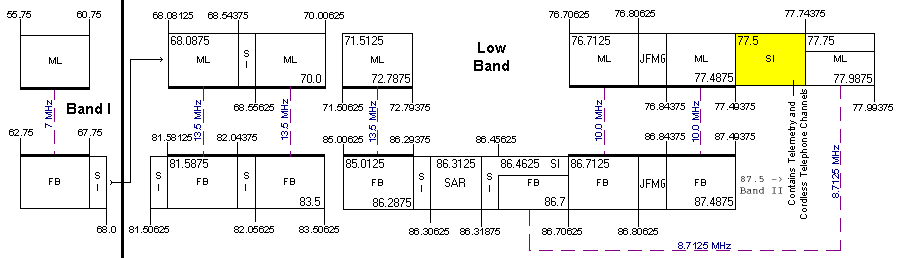 There is a Euro plan (TR 25-08) to re-organise this band:
77.8125 ... Base, to 87.4875 (split -9.8: 68.0125-77.6875) single: 77.7-77.8 and 74.8-75.2 & 84.6-85
Various countries overseas allow FM broadcasting from 65-74 and 76-87.5 (eg OIRT), this often reaches us.
68.08125= start of VHF Low for PBR, boundary
68.0875.PBR, to 69.9875 single, dual: see 81.5875
68.55 OFCOM plan says this is single (unpaired)
68.625 demo/parking
(68.816=.. JFMG, to 69.904= - Talkback base (12.5kHz - split to 75MHz) to cease in 2000)
4m [checked and updated 2012] (RSGB Bandplan 2012)
-70=--...Amateur 4m band, to 70.5= (since 1956; when 70.2-70.4) Countries
Secondary (Full/Intermediate Classes only).
started as UK (G/M/2) only, with British Gibraltar (ZB) and Cyprus (5B), and Eire (EI)
now with South Africa (ZS/ZR), and Slovenia (S5)
Denmark (OZ) now allows (July 2003) 70.025, 70.05 and 70.1 (max 25W, 10 kHz)
Faroes (OY) CW on 70.1
Greenland (OX) (Sept 2003)
Croatia (9A) (2003) 70-70.45 (10W)
70.0... Beacons...
-70.10= -Narrowband - CW/SSB
70.185 Cross-band centre-of-activity
70.2 SSB/CW calling
-70.25= -all modes---
70.25 Meteor Scatter calling
70.26 old calling frequency (from 1950s) still in use - AM/FM
70.270 MGM centre of activity (MGM=Machine Generated Mode)
70.2875
-70.294= --FM simplex--- (12.5 kHz channels) ---
70.3 RTTY/FAX
70.3125 data/digital
70.325 DX Cluster
70.3375 data/digital
70.350 (Emergency priority)
70.3625 data/digital
70.375 (Emergency priority)
70.3875 data/digital - gateways
70.4 (Emergency priority)
70.4125 data/digital - gateways
70.4250 (some use by GB2RS)
70.4375 data/digital
70.45 FM Calling channel
70.4625 data/digital
70.4750
70.4875 data/digital
-70.5=---
70.5125.H.O.
ex Fire Service mainscheme (post WARC 79), base, to 71.5= 12.5kHz AM/FM (mobile 80-81.5)
Migrated to Airwave TETRA by July 2010
71.5125.PBR, to 72.7875 single, dual: see 85.0125
72.375 STH/demo/parking
72.8... Land Mobile: MoD, to 76.7 (73.3-74.1 EU1 harmonised) Helicopters allowed 72.8-74.8
74.6875... JFMG, to 74.7125 - Talkback
75.0 CAA ILS runway marker beacons (Guard band 74.8-75.2) 200ft, 1 & 3.5 miles from touchdown. From 1950s.
75.2625=.. JFMG, to 75.3= - Talkback mobile (split to 69MHz) (airborne to be phased out)
76.7125.PBR, to 77.4875 single, dual: see 86.7125 ...
77.5... PBR, to 77.9875 single (used to be paired with 87.5 to 88)
77.5 PBR, and standard telemetry channel
77.5125 CT0 extended Cordless phones, & 77.55 (mobile; base at 47.431 & 47.419) to be phased out
77.625 once mobile paired with 82.8 base
77.6875 Simple UK Light (was UK General)
Four channels between 77.75 and 77.9875 were once mobile paired with base at +8.7125/8.7
in the 86MHz single section, between 86.4625 and 86.6875
A new plan now shows 86.4625 - 86.7 split -8.7125 : 77.75 - 77.9875
77.725 well used, and 77.7375, nothing between here and 81.575 on OFCOM WTR
78=... Land Mobile: MoD (79-79.7 EU1 harmonised) Helicopters allowed 78-80
(Thailand yellow CB at 78.0 - 78.9875)
(78.18375=... JFMG, to 78.25875= - wide area or location talkback - 12.5kHz)
(78.190 78.2025 78.215 78.227 78.240 78.2525)
80... H.O. (Fire) mobile, to 81.5= (and 83.5-84) - see 70.5
Some vehicle-vehicle use (Eng & Wales - not Herts)
80-85 (mobile) and 95-100 (base) AM - used by Police starting from 1942-50 until move to 143-156 MHz
in 1987-89. Before that, MF regional schemes at 1.6-1.8 MHz from 1940 using telegraphy,
later telephony - until VHF move, 1947.
80.25-80.3875 used by ROC/WMO in 1980s, fairly clear ever since?
(81.5 Radio Astronomy - Interplanetary Scintillation - Cambridge +/- 1MHz?)
81.5=...PBR / CBS - new for the late 1980s
Lxxx = (freq - 78.2) / 0.0125 freq = (Lnumber x 0.0125) + 78.2
81.5125.PBR Single, to 81.575 (nothing on WTR except RAC Motor Sports Assoc Ltd)
81.5125 L265
81.575 L270 MSA, Rallies (from June 2003. Was 86.4375 AM from 1976)
81.5875.PBR, to 83.5 (split -13.5: 68.0875-70.0) or Single
81.6625.Data only (IR2008), to 81.8875 (ch 358-360?!)
81.8 L288 CBS predominantly (
82.05 OFCOM plan says this is single (unpaired)
82.125 L314 Demo/"parking" (temporary use) (:68.625)
82.25 L324 Data Dominant, to 82.275 L326
82.2875 L327 Data only (IR2008)
82.3 L328 CBS predominantly, to 82.3375 L331
82.35 L332 Data only (IR2008)
82.3625 L333 Data only (IR2008)
Somewhere around 82.5 OFCOM's channel numbering seems to miss 0.2MHz :
Now Lxxx = (freq - 78.0) / 0.0125 freq = (Lnumber x 0.0125) + 78.0
82.5125 L361 Data only (IR2008)
82.5875.L367 Data only (IR2008), to 82.6125 L369
82.625 L370 Data Dominant
82.6375 DGPS - from autumn 2000
82.65 L372 Data Dominant
82.6625 JFMG Location TalkBack (base) :69.1625
82.675 JFMG Location TalkBack (base) :69.175
82.825 L386 Data Dominant
82.8375 L387 Data Dominant
82.8625 L389 Data Dominant
82.875 L390 CBS
to CBS "predominantly" in 25kHz steps - and 83.0125 too
83.050 L404 CBS
83.1 highest PBR in this band on WTR
83.4 Humberside Fire Brigade (0129242)
83.5... H.O.
84 ... MoD, to 85= - RAF, Mil.Police (ISM at 84.0 +/- 4kHz)
84.3 mountain rescue
85
85= ... Private Business Radio, to 87.5=
PBR listed so that you can avoid tuning in by accident.
(same info can be found on Radiocomms Agency site anyway)
Was the main place to find Water co.s, councils, AA/RAC, forestry, customs, taxis etc.
12.5kHz channels.
Pre WWII VHF AM was in 200kHz channels, 100kHz in 1947, 50kHz late 40s, 25kHz 1956-1960, 12.5kHz 1969
- first Pye demonstration of 12.5kHz in 1957. Initial Pye gear 77-83 & 94-100 MHz.
85.1375-85.2 ex GPO/BT
Lxxx = (freq - 85) / 0.0125 freq = (Lnumber x 0.0125) + 85
85.0125.PBR, to 86.2875 (split -13.5: 71.5125-72.7875)
85.0125 ch L001
85.875 STH (:72.375) or either, singly Also used for demos and parking
86.2875 ch L103
86.3....PBR single, to 86.7
86.3125 Land SAR
86.325 Land SAR, secondary, some areas
86.3375 Simple UK Light (was UK General), to 86.375 (4 ch)
86.675 JFMG, Talkback (12.5kHz) Wales and west.
86.4625 PBR, to 86.7 (split -8.7125: 77.75 - 77.9875) new plan
86.7125.PBR, to 87.4875 (split -10: 76.7125-77.4875) no longer extends to 87.9875 (or starts from 86.9625)
86.8125.JFMG, to 86.8375 - wide area duplex Talkback (12.5kHz) (+airborne)
The 86.7= to 86.95= section used to be used for 10 x 25kHz links, same -10 split.
87.34.. Eurosignal paging, to 87.415 (4 x 25kHz channels A-D) heard in UK from Europe. info.
Used to be a constant AM tone with pips and doodle-doo noises, as featured in the song
Professionnels by Air (Premiers Symptomes), and could be heard on tuners at 87.5
Changed in March 1998 to bursts of FM data. French channel is 87.39 (C)
87.4875 L199 (highest freq. Low-Band channel)
87.49375= boundary (above 87.4875 by 6.25 kHz - half a 12.5 kHz channel)
--87.5=------------------------
Band II - FM Broadcasting (100 kHz channels) 87.6-107.9 RDS Field Strength
Independent Radio managed by the Radio Authority.
See the British DX Club's Lists. Tuners. SBS. FM DX.
1937 : High HF USA 'Apex' wide-bandwidth AM stations at 25 to 44 MHz, 117 MHz
1939 : Band I Pioneering USA FM, from around 40 MHz up to 49.9 (100kHz steps) 42.1=ch21 49.9=ch99
1945 : Band II FCC allocates 88-108 for FM, June 27th. ch 201 88.1 to ch 300 107.9 (0.2MHz steps)
1946 : Band II FM moves from Band I in the USA - allocations in Sept 1945, moves complete by end of 1948
1955 : 88-94.6 3 BBC Programmes start, from Wrotham, Kent (Home Service, Light & 3rd Prog.)
1961 : Stockholm conference plans 87.5-100. Proposals for Bands I to V by Research Department
1962 : Aug 28 : Zenith-GE stereophonic system tests on the Wrotham transmitter (3rd Prog.)
1967 : 94.6-97.6 sub band opened (was mobile services). BBC services renamed R2,R3,R4
1969 : 105-108 JRC start to use (mobile services) - and other PMR (split: 138-141)
1970 : BBC local radio introduced in London in 1970, in the new sub band
1973 : Independent radio follows, Capital and LBC (later News Direct) same sub band
1979 : 100-108 allocated (WARC) but not all cleared for some time
1981 : Mixed polarisation introduced (Wrotham)
1984 : 104-108 Broadcasting is now the primary user
1985 : Sept 85 to Jul 87 : use of some (relatively unusual) 50kHz steps ends (i.e. 95.85)
1980s: 87.5-88 (end of) : end of use for base PMR (split -10: 77.5-77.9875)
1987 : August: UK tests of RDS
1988 : October: RDS launched at Earls Court Radio Show
1989 : 97-102 (end of) : permit ends for use by 999 Services AM RT base, 25kHz ch (split: 80-85)
1990s: 105-108 (early) : JRC mobile services complete move to 139/148MHz
1995 : 104-108 permit ends to use the sub band for PMR
2006 : Dec 8 : 'micro transmitters' legalised (50nW max ERP = -43dBm, 70dB less than PMR446!)
"BBC sub-bands employ a "standard (2.2/5.2 MHz) spacing."
87.6... RSLs (87.7 primary) more
88.0=
88.1... BBC Radio 2 - used to share with R1 after 10pm, Saturday afternoons and Sunday evenings from 5pm
90.2... BBC Radio 3
92.4... BBC Radio 4, BBC Wales/Scotland
94.6... BBC Local, Radio 4, ILR (lower local sub-band, to 97.6)
96.1... ILR, some BBC
97.7... BBC Radio 1 (sub band used from 1988)
99.8... INR1 - Classic FM (+RDS DCI DGPS - Focus FM), ILR. Classic launched 7.sep.1992
102.0... ILR (upper local sub-band, to 108=)
103.5... BBC Local, Radio 4, ILR
105.0... ILR, regional, RSLs
107.0... RSLs, Small-scale and other low power broadcasting, to 107.9
The FM modulation has its own spectrum -
0-15kHz : Mono audio (L+R)
19kHz : "Pilot tone" to indicate if stereo present
23-53kHz : Stereo "difference" signal (L-R) consisting of lower and upper
sidebands resulting from balanced AM modulation of a 38kHz carrier
(phase locked to the 19kHz tone at half the freq.)
57kHz : (3 times 19kHz) RDS data carrier (data rate of 1187.5 bps) 4.8kHz b.width
60-99kHz : Subcarriers used in the USA for SCA Subsidiary Communications Authorization (Aus: ACS)
typically FM on 67kHz and 92kHz (14kHz bandwidth) (sometimes 41,76,78.67 kHz)
CCIR recommends only up to 76kHz
Some history above was based on Overview of UK VHF radio planning. Would-be pirates should read this!
...although : "the current standards work well in practice, but they do not appear to reflect the way in
which the majority of listening is done, and may be unnecessarily conservative." :o)
Also, receiver standards are based upon current equipment, which may be very poor. I say to heck with that,
assume decent equipment and let the cheapskates upgrade!
Wenvoe R1/2 was 89.95, R3 92.125 . R4SW Oxford was 95.85;
"All 50kHz offsets in Europe were removed by a Geneva Conference 7.12.1984 which reorganised the FM bands
throughout Europe. The new frequencies were implemented about 2 or three years later. That was when BBC
and ILR locals moved into their separate FM sub-bands and many UK transmitters were changed from horizontal
to mixed polarisation. Note that almost all of the high power FM transmissions in the UK are actually on
200 kHz spacings (odd integers). Lower power ones use the 100 kHz offsets."
Near 107.8 was used for Local Authority Alarms until the end of 1995, now on 160.55-160.575
and 168.2875 & 168.9375. Some old lists show freqs as 107.79375, 107.80625, 107.81875
Long distance reception is more common via the troposphere here, rather than the ionosphere...
i.e a "lift" rather than "sporadic-E". "Tropo" tends to improve the higher the frequency, and lower
frequencies are not affected; whereas ionospheric "skip" builds up from HF, maybe reaching as high as
150 MHz rarely - but leaves higher bands unaffected.
DSI2 recommends that by 2020 when DAB is established, the band may be reduced to 97.5-108 for local and
community broadcasting only.
Polish DAB uses 105.008MHz
-108=--------------------------
Aero. Navigation
108.05.. ILS/VOR/ATIS, to 117.95 (50 kHz channels)
ILS within 108-112
There was a ham band at 112MHz (USA Amateur history), 2.5 metres, from 1938 to 1945
mil comms are sometimes reported here, usually 117-118. & Illegal WFM bugs, sometimes.
-117.975=----------------------
118 Air Band
Aero. Mobile "Civil Air Band" - NATS National Air Traffic Services, Volmet
See Javiation's list. RTCA. ICAO. Reporting Points
Used by the military too, of course.
118.0... AM comms, to 136.99166 (2280 x 8.33 kHz channels) (USA Plan 2001-2010)
118-132 from 1947, extended to 117.975-136 in 1959 (most private ch WERE at the top, 129.7-132)
The use of 136 - 137 dates from 1990, shared with satellite services until 1.1.2002
National (or wide area) channels :
118.675 Paragliding (below 5000ft)
119.7 'Civ / Mil Guard' (on Jeppesen charts)
121.5 Guard, Distress, EPIRBs (100mW) (?120.875 Distress, discrete?) satellite monitoring ceased 1.feb.2009
121.6 airfield Fire Services
121.65 ELT training (121.775 & others : US equipment)
121.7... common Ground frequencies, to 121.95
122.1 'Mil TWR'
122.475 Balloons primary, and Hangliders (1984)
122.95 Helicopter Common 'blind calls when landing/departing uncontrolled sites'
123.1 SAR
123.45 Air-Air (now allowed since 17.jun.2010)
123.5 'Air / Air (aerodromes without ATS/AFIS)'
129.825 Microlights
129.9 Gliders/Balloons - ground-ground and recovery only, Parachute aircraft-to-DZ
129.975 Gliders - local airfield air-ground only (within 10nm and below 3000 ft). (BGA, 1986)
130.0 'Air / Air (aerodromes without ATS/AFIS) - mountain airfields'
130.1 Gliders - "Primary: Competition start/finish lines;local flying Secondary: Training"
130.125 Gliders - "Primary: Training;cross-country locations Secondary: Local flying;competition lines"
130.4 Gliders - "cloud flying and relaying cross-country location messages only"
130.525 Parachute-DZ comms
131.725 ACARS Packet data (Europe & USA) & 131.525 [Hear it here!]
132.0... 8.33 sub-band, to 134.8 - for over FL245 (24,500ft/7.5km) - FL195 (6km) France (waived at present)
Maastricht 132.635, 136.465 Brest 132.765, 133.635, 132.415, 132.510
France has some 8.33 channels outside of this range (noted in 2002 at least)
135.375 London VOLMET (main)
135.475 SAFETYCOM (from Nov 2004)
136.9... data only, to 136.975
Private channels (mostly shared) for Airline "company ops", Servisair and other organisations
such as coastguards, air ambulances etc :
122.05, 122.3-122.375, 122.95, 123.65, 129.025,
129.7-130.75 (not all ch), 131.075,
131.375-131.975 (many 8.33 now), 132.65 (HMCG-SAR), 134.5, 136.65, 136.675
136.8-136.875
Unofficial air-air chat is sometimes heard on the first channel 118.0 and the "old" last 135.975
and "new" last 136.975 ... 125.125 is also sometimes used... or 122.22... it has to be a "neat" number!
CAA short-term : (displays, events etc.)
121.175, 130.500 Air/Gnd
130.675, 132.900 App/Twr
121.925 Gnd
25kHz channels: "Climax" offsets may be used when two or more transmitters use the same ch. at once.
2 sites: +5 & -5 kHz
3 sites: 1 site on nominal, others +7.5 & -7.5 kHz
4 sites: +7.5, -7.5, +2.5 & -2.5 kHz
In 1999 the 760 x 25kHz channels were each split into 3, with a new 8.33kHz spacing (more/N)
(2000 in the UK). Given that the first 25kHz channel is 118.0 and the band boundary is therefore
117.975, why wasn't the new first 8.33 channel 117.983? Radios still start at 118.0 :)
UPDATE - Current (2012) situation:
Effective 24 Nov 2005, new procedures requiring all VHF voice communication channels to be indicated by the
use of all 6 digits of 8.33 channels, and also for 25 kHz channels (say 118.025, 118.050, 118.075 etc) -
EXCEPT 25kHz channels ending in two zeros (say 118.0, 118.1, etc)
- 118.005 specified as "ONE ONE EIGHT DECIMAL ZERO ZERO FIVE" (8.33)
- 118.050 specified as "ONE ONE EIGHT DECIMAL ZERO FIVE ZERO" (25)
- 118.1 specified as "ONE ONE EIGHT DECIMAL ONE" (25 channel - in 8.33 mode it would be 118.105)
The use of the term "CHANNEL" for 8.33 kHz channels is discontinued.
Original plans for on-air use :
100kHz spacing (orig-1949?) - 1 decimal place 118.0, 118.1 etc. on air : still 1 decimal (25 mode)
50kHz spacing (1954) - 2 decimals, new 118.05, 118.15 etc. on air : was 2 decimals
25kHz spacing (1974) - 3 decimals, new 118.025, 118.075 etc. on air : was 2 decimals
8.33 spacing (1999/2000) - infinite decimals! new 118.00833. etc on air : was 3 decimal 'NAME'
The newer 25kHz spaced channels were (pre 2005) rounded to only 2 decimal places when referred to,
i.e. 118.02 or 118.07 because the second decimal is only ever 2 or 7 and so there was no ambiguity.
When saying an 8.33 channel on air, the word "channel" followed by a rounded 3 decimal place Channel Name
SHOULD BE used (pre 2005) (although sometimes it is just treated as a normal frequency, with trailing zeros
ommitted, such as One Three Two Decimal Two Four) :
--NAME-- -step- -MHz--- --rounded--
(1xx.x) 25 1xx.x00 \
"1xx.x05" 8.33 1xx.x00 / up 5
"1xx.x10" 8.33 1xx.x08333 NEW up
"1xx.x15" 8.33 1xx.x16667 NEW down
"1xx.x2" 25 1xx.x25 \ down 5
"1xx.x30" 8.33 1xx.x25 / up 5
"1xx.x35" 8.33 1xx.x33333 NEW up
"1xx.x40" 8.33 1xx.x41667 NEW down
(1xx.x5) 25 1xx.x50 \
"1xx.x55" 8.33 1xx.x50 / up 5
"1xx.x60" 8.33 1xx.x58333 NEW up
"1xx.x65" 8.33 1xx.x66667 NEW down
"1xx.x7" 25 1xx.x75 \ down 5
"1xx.x80" 8.33 1xx.x75 / up 5
"1xx.x85" 8.33 1xx.x83333 NEW up
"1xx.x90" 8.33 1xx.x91667 NEW down
Any 8.33 NAME just 5kHz higher than a normal 25kHz channel is the same freq.,
otherwise tune to the NAMED freq. in 5kHz steps and you'll only be 1.666kHz off...
... then :
If a NEW channel name is 10kHz ABOVE an old 25kHz channel, tune DOWN 1.666
If a NEW channel name is 10kHz BELOW an old 25kHz channel, tune UP 1.666
"..introduction of Mandatory Carriage of 8.33 kHz .. capable radio equipment was 7th October 1999"
- AUSTRIA BELGIUM FRANCE GERMANY LUXEMBOURG NETHERLANDS SWITZERLAND
"22 States (incl. UK) will start implementating 8.33 kHz .. from the 31 October 2002"
However, don't panic about needing new equipment, 8.33 is only used in a small segment of the band,
and not for local traffic. You'll be able to enter frequencies using 5 or 10kHz steps and not be more than
1.66 kHz out, and likewise you'll still be able to search in 10kHz steps and that will be faster then 8.33!
It's no more likely than now that two adjacent channels will be strongly in use at any one location.
In any case, the great thing about airband as far as searching goes, is that the controllers TELL the pilots
what frequency to go to next - so finding any new channels isn't really that hard!
The ITU's VDL-3, "VHF Data Link - Mode 3", solution is for digital TDMA on existing 25kHz channels.
The USA FCC adopted this as NexCom (not yet in use). VDL-3 retains AM capability, but also uses 8-phase
shift keying, giving 4 time slots within 120ms frames, providing for a mix of digital voice and data.
Coverage of 112-117.975 is included in the spec.s - and they haven't decided about the UHF band yet.
Due to Earth curvature, an aircraft :
at 1,000ft is level with you when it is 62.3km away (38.7 miles)
at 3,000ft / 914m when it is 107.9km away (67.0 miles)
at 10,000ft / FL100 / 3048m when it is 197.0km away (122.4 miles)
at 20,000ft / FL200 / 6096m when it is 278.5km away (173.0 miles)
at 35,500ft / FL355 / 10.82km when it is 370.9km away (230.5 miles)
at 50,000ft / FL500 / 15.24km when it is 440 km away (273.4 miles)
an e.g. shuttle orb. 240km when it is 1721 km away *
* i.e. 'directly overhead a point on the ground that is X km away'
Line of sight range to the horizon (miles) = the square root of ( 1.5 x the_altitude_in_feet )
( Thanks to Wikipedia: Horizon )
"According to ICAO Annex 10, all enroute & approach VHF Tx's are limited to 50 watts output power;
in the aerodrome no figure is stated but TX's must be able to be received at 4,000 ft above
aerodrome elev at 25nm from the AD ARP (Aerodrome Reference Point)" - "designated operational
coverage (DOC) for an approach service 25nm 10,000ft."
-137=-----Mid Band-------------
Mobile, military, Aero OR, emergency services (French splits +/-4.6)
Military PTARMIGAN access links
137=... Aero (OR) to 144=
137=... Satellite, to 138=
Weather Satellites, 137.3, 137.4, 137.5, 137.62, 137.85 etc. Tracking.
FM picture data not only too wide for most scanners (50kHz best) but mind the Doppler shift too!
More. Good AmSat Keplers tutorial.
LEO MSS Sat. downlinks, to 138= (up at 148-149.9) Orbcomm (4800 bps FSK)
137.000= - 137.025= Primary
137.025= - 137.175= Secondary
137.175= - 137.825= Primary
137.825= - 138.000= Secondary
Orbcomm 25kHz 12dBW RHCP channels, 1 per sat.
137.200 S1
137.225 S2
137.250 S3
137.2875 S11
137.3125 S12
137.435 S4
137.460 S5
137.560 Gateway (50kHz)
137.6625 S6
137.678 S7
137.7125 S8
137.7375 S9
137.800 S10
138=... MoD, to 143 ( Euro harmonised military band to 144= )
Some FM at 142, split +7.1
137.975..Paging, to 138.2 (25kHz channels) Vodafone and Pageone except 138.05 and 138.1
Police: had 4 x FM air-ground-air ch.s at +/- 6.25kHz around 138.1 & 138.3
138.2=...future Euro. SRD band, to 138.45=
138.7 SAR secondary
139.5125=PBR, to 140.4875= (split +8.5: 148.01875-148.98125) Trunked.
Some remaining use in Fuel/Power industry, recently also used by Transport (buses).
139.51875---148.01875
to
140.48125---148.98125
"J Band" still exclusively managed by JRC :
was Elec. (up to J57 139.95625) and Gas (J59 139.98125 upwards) industries. MPT1327 spec. Phased in, 1989-95
139.51875-140.48125 J22-J99, 76 main ch 12.5kHz spaced (no J01-J21) 6.25kHz offsets (RA's M802-M879)
139.525 -140.475 K22-K98, interleaved (J+6.25kHz) (RA's M902-M978)
JRC paging in channel K90/M884/M887 140.375/148.875 (single at J90/M883/M886 below & J91/M885/M888 above)
9 sets of 8 channels for cellular plan :
---Elec---- ----Gas---- plan (final page) (14MB file!)
1 2 3 4 5 6 7 8
A 22 31 40 49 64 74 84 94
B 23 32 41 50 65 75 85 95
C 24 33 42 51 66 76 86 96
D 25 34 43 52 67 77 87 97
E 26 35 44 53 59 69 79 89
F 27 36 45 54 60 70 80 98
G 28 37 46 55 61 71 81 99
H 29 38 47 56 62 72 82 92
K 30 39 48 57 63 73 83 93
58 68 78 88 -- Coal
Disused by most of the gas industry by 2004, and some elec. too
1969 to early 90s (by 1995) : 138-141 MHz and the top of Band II was used for PMR; JRC (84 ch), rail
138.01875.. Middle Band, to 140.94375 (split -33: 105.01875-107.94375) AM, 12.5kHz channels (6.25kHz offsets)
(channel 122 at 139.51875 became J22 by replacing the 1 with a J)
Channel 1 at 138.00625 was never used
(old 140.96875 STH channel no longer used)
Some JFMG (Base) in the Channel Islands at 139.55 (GU) & 139.575 (GJ), and simplex at 139.65
Common freq.s used for illegal NFM bugs 140.0 (B), 139.97 (A), 139.94 (C)
141=... JFMG, wide area Talkback (75kHz max), to 141.5= (previously 141.9=) 6.25 kHz offsets
Simplex and duplex (split: mobiles at 212MHz). +airborne. Not in Channel Islands.
(140.993 London only)
141.006..ILR, to 141.193
141.206..BBC radio, to 141.256
141.268 not available to BBC - & 141.281
141.293..BBC radio, to 141.318 (.318 BBC News)
141.375 BBC 75kHz wideband
141.418 BBC
141.4625 BBC 75kHz wideband
"142·5-143·0 MHz is for Mobile services and not restricted to Land Mobile"
143.0=... H.O., to 144= - see 152 (143.975 Air-ground-air alloc., not known if used)
143.625 Space - ISS station (143.6-143.65) - also 121.75 & 130.165 FM (ex MIR)
143.75.. unauthorised use by Hang gliders and para gliders, to 143.95 (calling 143.95)
2m [checked and updated 2012] (RSGB Bandplan 2012)
144=... Amateur 2m band, to 146= (1947) Primary - IARU Bandplan: range
144.0... CW,MGM incl. EME CW,MGM (Moonbounce)...
144.138 PSK31
144.15.. SSB,CW,MGM (no Machine Generated Modes 144.18-144.36)
144.175 Microwave talk-back
144.2 MS calling
144.25 GB2RS/Slow Morse
144.3 SSB calling
144.370 MGM calling
144.4... Beacons...
144.5... All modes
144.5 SSTV calling
144.525 SSB ATV Talkback
144.6 RTTY
144.6125 Digital Voice (single) - D-Star
144.625 Emergency/Events priority, to 144.675
144.7 FAX
144.725 in the south - you'll appear on F5ZBF (Caen 145.325) when there's a lift!
144.75 ATV Talkback
144.775 Emergency/Events priority, to 144.7875
144.794= Digital, Gateways, to 144.99
144.8 APRS, other digital
144.825 Internet Voice Gateways & 144.8375
144.85 AX25,Nodes,TCP/IP, to 144.975
145.0... Repeater inputs, to 145.1875
145.2... FM Simplex, to 145.5875 (12.5 kHz channels - +/-2.5kHz maximum FM deviation, 11kHz b/w)
Are V channel numbers supposed to make life easier?!
(These originated from the Tel Aviv conference in 1996)
Oh yes, 145.7375, let's see... 7.375 times 8... 59 of course.
We can all do that in our heads, can't we?
If it's not simple and intuitive (for telling a contact to QSY)
then what IS the point? Saying "decimal 73" will do the job better.
List of mostly the old S channels (from 1970s, 25kHz spaced, +/-5kHz deviation, 16kHz bandwidth) :
145.2 S8, V16 Raynet priority, MIR (with 145.8)
145.2125 V17 internet voice gateways, and 145.2375, 145.2875, 145.3375 (ex 145.2625)
145.225 S9, V18 Raynet priority
145.25 S10, V20 Slow Morse
145.275 S11, V22
145.3 S12, V24 RTTY Local
145.325 S13, V26 + French R8b F5ZBF repeater Caen (split: normal -0.6) French Repeaters map/info
145.35 S14, V28 + French R9b
145.375 S15, V30 + French R10b
145.4 S16, V32 + French R11b
145.425 S17, V34 + French R12b
145.45 S18, V36
145.475 S19, V38
145.5 S20, V40 FM calling channel
145.525 S21, V42 GB2RS news, Sundays
145.55 S22, V44 Rally talk-in
145.575 S23, V46 Future RV46 repeaters
145.5875 V47 Future RV47 repeaters
(Repeaters 145.6 - 145.7875, split: -0.6) - UK repeaters started in 1972
145.600 R0, RV48
145.6125 R0x, RV49
145.625 R1, RV50
145.6375 R1x, RV51
145.650 R2, RV52
145.6625 R2x, RV53
145.675 R3, RV54
145.6875 R3x, RV55
145.700 R4, RV56
145.7125 R4x, RV57
145.725 R5, RV58
145.7375 R5x, RV59
145.750 R6, RV60
145.7625 R6x, RV61
145.775 R7, RV62
145.7875 R7x, RV63 (was proposed 16kHz data links in 1998, on 145.790)
UK FM Repeater callsigns start with GB3 --· -··· ···--
Sometimes CW IDs start with totally pointless and confusing DE ('from') -·· ·
CTCSS access mandatory for new repeaters since 2004, replacing 1750Hz tone burst.
European repeaters use CTCSS up to 141.3 Hz or more.
UK Tones & Morse :
A 67 ·- B 71.9 -··· C 77 -·-· D 82.5 -·· E 88.5 · F 94.8 ··-· G 103.5 --· H 110.9 ···· J 118.8 ·---
"the main reason for establishing a Repeater is for the purpose of providing improved communications for
those operating mobile stations and fixed stations in difficult terrain." - OFCOM Guide To Repeater Licensing
Repeater DX : Belgium Denmark France Germany Nederland [2012]
145.8=...Satellite Service, to 146= [updated 2012 with current links]
Current operational frequencies (AMSAT) & AMSAT News
Typical doppler shifts : 300-2000km Low Earth Orbit +/-3.5kHz at 2m, +/-10kHz at 70cm
( Radius of the Earth = 6370km, 'Great Circle' circumference of the Earth = 40,000km )
-146=--------
USA 2m band is 2x the size, 144-148! (ARRL Bandplans 2012)
146=...H.O., see 154
148=...JRC,LEO, see 139.5 and 137
(Some JFMG in the Channel Islands at 148.575 & 148.725 - mobile)
148.875 H.O
149... MoD, to 154
German 'Freenet' licence-free two-way
149.025 1
149.0375 2
149.050 3
149.0875 4
149.100 5
149.1125 6
149.61 US GES uplink
149.9=...Satellite Navigation & MSS uplinks, to 150.05=
149.91 149.94 149.97 150.00 150.03 149.985 NIMS
150.05=..Radio Astronomy, to 152= PRIMARY exclusive
+ Oil-slick markers (150.5= - 150.55=)
151.625 unlicensed USA red "DOT" radios (more) +151.955 purple, 154.57 blue/MURS & 154.6 green/MURS
also at 462 GMRS, 464 & 467... +new MURS with 151.82, 151.88 & 151.94
152... H.O. - ex Emergency Services, to 153.0125= (with 143-144)
was mostly police FM. 12.5kHz (see 154)
153.025..Paging, to 153.475 (25kHz channels) except 153.05 (HO)
FSK POCSAG (bursts) more [Hear it here!] Used by Trafficmaster, COACS
153.025 FLEX paging (continuous) +153.325 [Hear it here!]
Leicester City Council (0250278) 12.5kHz
153.39375 153.40625 153.41875 153.43125 153.44375 153.45625
153.5=...Land mobile service: MoD (incl. cadets), to 154.0=
153.6 mountain rescue
153.7125 various, incl. BRC
154=... Vacant after Emergency Services move to TETRA, to 155.975
H.O. - ex Emergency Services (with 146-148) mostly police, AM/FM. 12.5kHz
143/152 and 146/154 used after WARC-79, from 1987-1989 onwards until move to Airwave TETRA by the end of 2006.
"The (TR/RX) offset for Police/Fire varies to stop interaction between channels
when talkthrough is on - this is historic as it was believed that common
offsets could not be used on the same site; today it is done everywhere." - thanks Andrew W.
147.0-147.3 split 8: 155.0-155.3 used for ROC/UKWMO in 1970s/80s (source)
SAR channels - (excluding 24, 62,63,64, 85 in marine section) info, more
0 156.0 Primary Coastguard SAR for use with Declared Facilities when 16 is not appropriate
10 156.5
67 156.375 1st alternative to Ch 0
73 156.675 2nd alternative to Ch 0
53a 158.65 Reserve TWC and for SARDA (max 6,500ft airborne) (from late 1980s)
91 155.35
92 147.475
93 152.85 Scotland SAR
94 155.35(91)---147.475(92)
95 152.85(93)---147.475(92)
96 147.35 Land SAR
96d 146.025 Land SAR
97 number not allocated
98 168.35 Scotland - FFSK
99 174.0375 Scotland - FFSK
100 168.35(98)---174.0375(99) Duplex FFSK (Fast Frequency Shift Keying)
101 70.85 \ Links, with 102
102 81.0 / Links, with 101
105 86.3125 Scotland - Rebroadcast feeder
106 86.325 (not Scotland) (from mid 1960s)
107 81.05 Scotland - Rebroadcast feeder
108 70.5625 Scotland - Rebroadcast feeder
L 161.225 Lifeguards (RNLI)
There is a Euro plan (25-08) to re-organise 146-156: (boundaries)
151.4 ... Base, to 156 (split -7: 146.8-151.4) single: 146-146.8 and 149.9-150.05 & 154.5-154.65
155... Possible private marine VHF channels (for companies or general use), of European origin. 25kHz FM.
Nordic Leisure boating L1 155.500, L2 155.525, L3 155.650 (info)
Fishing F1 155.625, F2 155.775, F3 155.825
Denmark P1 155.375, P2 155.575, P3 155.450, P4 155.800
-156=--------------------------
Mobile, Marine VHF (SAR, MBR/CSR)
PMR/PBR + CBS + STH, Ambulances, Paging (ERMES), SRD, mobile data, Civil Defence
Earliest Pye gear that worked above 156MHz dates from the early 1950s, 160/165 as brochure example.
Marine VHF from late 1940s, ch16 156.8 agreed in Atlantic City 1949.
156.0... Marine, to 158.525= single OR dual: see 160.625
158.5375.PBR, to 160.5375 single OR dual: see 163.0375
... alarms
160.6... Marine, to 163.025= single OR dual (split -4.6: 156.025-158.4)
Marine, to 163 - International and private 25kHz channels, single and dual (split -4.6).
Was 50 kHz spacing until SOLAS 1972, then new channels were fitted in, in between...
Band structure: two main sections linked by a 4.6MHz frequency shift
Dual channels : international and private
156.0-158.4 lines up with 160.6-163.0 at 4.6MHz higher, the lower section being the ship/mobile
side of dual-freq. channels, the higher side being for shore/base. The international channels
finish at 157.425/162.025 and the rest are private channels, which may be dual or single.
Single channels:
156.375-156.875 and 160.975-161.475 are not joined, and have single-freq usage with international
channels at 156 and private at 161.
Between 158.4 and 160.6 the mobile channels of a PBR band can be found. As this 163.0375-165.0375
band utilises a 4.5 MHz split, the mobile side covers 158.5375-160.5375 - the gap at 158.425 to
158.5 is used for a few more single-freq. private marine channels, and at 160.55 to 160.575 there
are three local authority alarm channels.
For single/mobile freqs.. MHz = (ch number x 0.05) + 156 (add 4.6 for the shore freq)
or more simply divide the ch by 2 and that's the decimal places : 156.(ch/2) i.e. 16 = 156.*8*
Because channels 60 and above are interleaved, you need to EITHER:
Subtract 2.975 MHz AFTERWARDS ** OR ** subtract 59.5 from the channel number BEFORE
... or more simply (!) take 60 from the ch and then add .025 to the frequency : 74.. 14.. 156.725
WRC-1997 changed the use of paired freq.s for channels 87 and 88 separately, to accommodate a VTS
called AIS - (Automatic Identification and Surveillance) at 162 MHz, and allow simplex at 157 MHz.
ERC decision (ERC/DEC/(99)17) June 1999 approves this, effective 1-1-2000.
WRC-97 also allowed use of channels 75 and 76 for voice, which had been unused guardbands for channel 16.
(Earlier plans had included simplex use of channels 18 and 82-86)
The 2004 OFCOM info sheet shows the breakup of channels 87 and 88, and the introduction of 75 and 76.
Channel 88 used to be used for Radio Lighthouses, a null was swept around the compass... i.e.
you'd count the "pips" and when the signal briefly disappeared that would give you a bearing
Channel 99 (160.6) started life as channel 00, but apparently 00 is what the coastguards dial into
their consoles to clear them! Do not confuse with what would be the real ch99 on 157.975 / 162.575
- a private channel which (just to confuse matters) is actually used as a land-based CBS channel!
Some sets may be set from "international" to "USA" mode, and then some
of the dual frequency channels can be used as single (ship channel) frequencies;
(e.g. 157.125 = 82a for USA single freq use - can't be heard on an "international" set)
which could be handy for a "private" channel, no-one else would hear you! (apart
from coast stations that use that channel. So you'd want to pick a clear one - and
bear in mind that if you don't you won't be able to hear them telling you to move!)
Maybe it's best not to, then. Interesting thought though, isn't it?
160.9 used to be used for ITV talkback, I'm told.
Also used for talkback was 161.3875 (12.5 kHz),
and within the channels 161.325 and 161.45
OFCOM's own channel numbering is as follows:
Channel numbers 1440 (156) to 2000 (163.0) can be traced back (in
12.5kHz steps) to the start of a sequence where channel 1 is 138.0125
- this applies up to the last Mid-band channel M2163 (165.0375) and
down in the JRC bands i.e. M802 being the high side of the 148.01875
& 139.51875 pair, give or take a half channel offset (-6.25kHz) (as
happens positively at 448 / 431 ).
160.6 is OFCOM channel 1808, 156 is channel 1440 - the difference of 368
being 4.6 MHz worth of 12.5 kHz channels. Marine dual pairs take the
channel number of the higher (shore) frequency. For single use of the
private section 157.45-163 the channels numbers are shifted along in
sequence by 1000.
Search And Rescue needs have been met by splitting paired channels into two separate channels,
and then in 2009 these A and B channels were split into 2 again with 12.5kHz channel widths
with center freq.s +/- 6.25kHz around the old center freq.s, making 4 channels out of one old
2 x 25kHz pairing. CTCSS tone 218.1 is used.
WRC-2012 is expected to have approved simplex use of channels 01, 07, 19, 20, 21, 60, 66, 78, 79, 80
Let's track this in two columns 4.6 MHz apart...
** First, two single freq.s...
--------------------------- -------
160.600 99 Coastguards 156.000 0 Coastguards
** Now dual freq. pairs,
** Port Ops & Public Correspondence (phone - link calls)
Shore/Base Ship/mobile 4.6 MHz lower
--------------------------------------
160.625---156.025 60
160.650---156.050 1
160.675---156.075 61
160.700---156.100 2
160.71875 623
160.725---156.125 62
156.125 62A SAR ECC Emergency Call - Common, inter-agency & helicopters
62B 160.725 SAR Land Team Working Channel
160.73125 624
160.750---156.150 3
160.76875 633 156.16875 631 SAR
160.775---156.175 63
63B 160.775 156.175 63A SAR
160.78125 634 156.18125 632 SAR
160.800---156.200 4
160.81875 643 156.21875 641 SAR
160.825---156.225 64
64B 160.825 156.225 64A SAR
160.83125 644 156.23125 642 SAR
160.850---156.250 5
160.875---156.275 65
160.900 ??? 156.300 6 intership1 and SAR
160.925---156.325 66
160.950---156.350 7
** Now single freq.s Base/Mobile
---------------------------- -------
160.975 CSR-1838 156.375 67 (intership9 away from coasts) + SAR/Safety/Coastguard
161 to 161.2 Paging returns 156.400 8 intership2
(31/49/459) 156.425 68 ports
(+local comms) 156.450 9 intership5/ports/Pilots
156.475 69 intership8/ports/Customs
156.500 10 (intership3 away from coasts)/ports/pollution/SAR + UK Safety Info
156.525 70 DSC Digital SelCall ONLY, GMDSS NO VOICE
161.15 CSR-1852 156.550 11 ports/SAR
161.175 CSR-1854 156.575 71 ports
161.2 CSR-1856 156.600 12 ports
161.225 ch 'L' - Lifeguards 156.625 72 intership6
161.25 CSR-1860 156.650 13 intership4/ports + International Nav Safety Comms
161.275 Marine 10mW Alarms 156.675 73 (intership7 away from coasts)/ports/SAR + Safety Info
161.300 CSR-1864 (OBH) 156.700 14 Ports
156.725 74 Ports/locks/swingbridges
161.350 On-board handhelds 156.750 15 intership11/ports/ 1W on-board
161.375 CSR-1870 156.775 75 Ports, Navigation comms only, 1W (and AIS Sat E-S)
161.400 CSR-1872 / Nav.? 156.800 16 Calling, Distress
161.425 M2 (marinas) 156.825 76 Ports, Navigation comms only, 1W (and AIS Sat E-S)
156.850 17 intership12/ports/ 1W on-board
161.475 CSR-1878 156.875 77 intership10
** Now dual freq. pairs again
** Port ops up to 161.725 and Pub.Corresp. from 161.750 (both: 78,81,84)
Shore Ship
--------------------------------------
161.500---156.900 18
161.525---156.925 78
161.550---156.950 19
161.575---156.975 79
161.600---157.000 20
161.625---157.025 80 Marinas primary CSR-1890
161.650---157.050 21
161.675---157.075 81
161.700---157.100 22
161.725---157.125 82
161.750---157.150 23
161.775---157.175 83
161.79375 243
161.800---157.200 24
157.200 24A SAR (24a G2A Ground-to-Air to replace 73) Casualty winching
24B 161.800 SAR Team Working Channel
161.80625 244
161.825---157.225 84
161.850---157.250 25
161.86875 853 157.26875 851 SAR
161.875---157.275 85 SAR paired
85B 161.875 157.275 85A SAR
161.88125 854 157.28125 852 SAR
161.900---157.300 26
161.925---157.325 86
161.950---157.350 27
161.975---157.375 87 old, paired use
161.975 AIS1 87B 157.375 87 Port ops
162.000---157.400 28
162.025---157.425 88 old, paired use - No more "Radio Lighthouses"
162.025 AIS2 88B 157.425 88 Port Ops
** Private channels, single OR dual CSR/MBR
** and some land PMR and CBS, same split -4.6
** In this part, the pairings are only shown
** for the first and last pair, to save space
Single OR Base Mobile (or Single)
---------------------------- -------
162.050 CSR-2924 single... 157.450 29 CSR-2556 single
OR 162.050---157.450 29 CSR-1924 dual
--CSR---Land Use--
162.050 CSR / CBS(Birm.)
162.0625 CBS(Lond./Birm.)
162.075 CSR / CBS(Lond./Birm.)
162.0875 CBS(Lond./Birm.)
162.100 - CBS(Lond./Birm.)
162.1125 -none-
162.125 CSR -none-
162.1375-- -none- (162.14375)
162.150 RNLI -none- (25kHz) 157.550 31 RNLI (two 12.5kHz channels at +/-6.25kHz)
162.1625-- -none- (162.15625)
162.175 CBS
162.1875 CBS(Lond./Birm.)
162.200 CSR / CBS(Lond./Birm.)
162.2125 CBS(Lond./Birm.)
162.225 - CBS +PMR(Lond. - couriers)
162.2375 -none-
162.250 CSR -none-
162.2626 -none-
162.275 - CBS +PMR(Lond. - couriers)
162.2875 -none-
162.300 CSR -none-
162.3125 -none-
162.325 - CBS
162.3375 CBS(Lond./Birm.)
162.350 CSR / CBS(Birm.)
162.3625 CBS(Lond./Birm.)
162.375 - CBS
162.3875 -none-
162.400 CSR -none-
162.4125 -none-
162.425 - CBS +PMR(Lond. - couriers)
162.4375 -none-
162.450 DGPS -none- 157.850 37/M marinas secondary RA-1588
162.4625 -none-
162.475 - CBS
162.4874 -none-
162.500 CSR -none-
162.5125 -none-
162.525 - CBS(Birm.)
162.5375 -none-
162.550 CSR -none-
162.5625 -none-
162.575 - CBS
162.5875 -none-
162.600 CSR only - no CBS at all
to (25kHz)
162.850 CSR
(162.825 104A Telex 158.225 104B Fax. no longer used)
162.8625 -none-
162.875 - CBS
162.8875 -none-
162.900 CSR -none-
162.9125 -none-
162.925 - CBS
162.9375 PBR London Bus Services Limited (0236402)
162.950 CSR
162.9625 PBR (Technically Assigned)
162.975 - CBS
162.9875 -none-
163.000 CSR
163.000 CSR-3000 single 158.400 48 CSR-2632 single
163.000---158.400 48 CSR-2000 dual
162.4-162.55 MHz "Weather" frequencies (as found on some USA scanners) apply only to
land-based NOAA transmissions on the North American Continent - it doesn't reach here!
** Now private single freq.s Single
---------------------------- -------
163.025 Diff. GPS 158.425 108 CSR-1634
158.450 49 CSR-1636
0.1 MHz gap where 158.475 109 CSR-1638
"4.6 split" and 158.500 50 CSR-1640
"4.5 split" systems meet -158.525=---
163.0375
** We'll change now to a 4.5 MHz difference, and 12.5 kHz spacings
163.0375.PBR, to 165.0375 (split -4.5: 158.5375-160.5375) Mid Band
Many CBS (including some multi-channel trunked CBS) - 85 dual channels available.
Despite this section only being allocated to LAND MOBILE, (12.5 kHz) in some
books and magazines you may find extra marine channels given (channel number
greater than 50), either single or -4.6 dual, in the first 150kHz or so. (i.e. ch 53)
This seems to be a throwback to a bygone age when the marine band was larger.
Marine channels are 25kHz bandwidth too, so that ruins half of the 12.5kHz channel
above and below. How wasteful.
The first 70 per cent used to be used for the old BT RadioTelephones :
(until 1985 saw the arrival of TACS at 935-950 MHz)
163.0375... BT System 4 (1983-1987), to 164.4125 (split -4.5: 158.5375-159.9125)
12.5kHz, ch.s U1-U111, full duplex, 6 digit nums
Early versions used from 163.0375 to only 164.2125 as System 4 channels 95 down to 01.
U57 (163.7375 - base only) was control. 163.025 and 164.425 were boundaries.
and before that:
163.050 ... BT System 3 (1977), to 164.400 (split -4.5, 25kHz channels 55-1 in reverse!)
ch17 164.0 control, PTT, 5 digit #
and before that:
System 2 (1970s) with 9ch + 1 control ch (same band).
System 1 (1959 S.Lancs, 1965 Gr.London)
There is a Euro plan (TR 25-08) to re-organise this band:
77.8125 ... Base, to 87.4875 (split -9.8: 68.0125-77.6875) single: 77.7-77.8 and 74.8-75.2 & 84.6-85
Various countries overseas allow FM broadcasting from 65-74 and 76-87.5 (eg OIRT), this often reaches us.
68.08125= start of VHF Low for PBR, boundary
68.0875.PBR, to 69.9875 single, dual: see 81.5875
68.55 OFCOM plan says this is single (unpaired)
68.625 demo/parking
(68.816=.. JFMG, to 69.904= - Talkback base (12.5kHz - split to 75MHz) to cease in 2000)
4m [checked and updated 2012] (RSGB Bandplan 2012)
-70=--...Amateur 4m band, to 70.5= (since 1956; when 70.2-70.4) Countries
Secondary (Full/Intermediate Classes only).
started as UK (G/M/2) only, with British Gibraltar (ZB) and Cyprus (5B), and Eire (EI)
now with South Africa (ZS/ZR), and Slovenia (S5)
Denmark (OZ) now allows (July 2003) 70.025, 70.05 and 70.1 (max 25W, 10 kHz)
Faroes (OY) CW on 70.1
Greenland (OX) (Sept 2003)
Croatia (9A) (2003) 70-70.45 (10W)
70.0... Beacons...
-70.10= -Narrowband - CW/SSB
70.185 Cross-band centre-of-activity
70.2 SSB/CW calling
-70.25= -all modes---
70.25 Meteor Scatter calling
70.26 old calling frequency (from 1950s) still in use - AM/FM
70.270 MGM centre of activity (MGM=Machine Generated Mode)
70.2875
-70.294= --FM simplex--- (12.5 kHz channels) ---
70.3 RTTY/FAX
70.3125 data/digital
70.325 DX Cluster
70.3375 data/digital
70.350 (Emergency priority)
70.3625 data/digital
70.375 (Emergency priority)
70.3875 data/digital - gateways
70.4 (Emergency priority)
70.4125 data/digital - gateways
70.4250 (some use by GB2RS)
70.4375 data/digital
70.45 FM Calling channel
70.4625 data/digital
70.4750
70.4875 data/digital
-70.5=---
70.5125.H.O.
ex Fire Service mainscheme (post WARC 79), base, to 71.5= 12.5kHz AM/FM (mobile 80-81.5)
Migrated to Airwave TETRA by July 2010
71.5125.PBR, to 72.7875 single, dual: see 85.0125
72.375 STH/demo/parking
72.8... Land Mobile: MoD, to 76.7 (73.3-74.1 EU1 harmonised) Helicopters allowed 72.8-74.8
74.6875... JFMG, to 74.7125 - Talkback
75.0 CAA ILS runway marker beacons (Guard band 74.8-75.2) 200ft, 1 & 3.5 miles from touchdown. From 1950s.
75.2625=.. JFMG, to 75.3= - Talkback mobile (split to 69MHz) (airborne to be phased out)
76.7125.PBR, to 77.4875 single, dual: see 86.7125 ...
77.5... PBR, to 77.9875 single (used to be paired with 87.5 to 88)
77.5 PBR, and standard telemetry channel
77.5125 CT0 extended Cordless phones, & 77.55 (mobile; base at 47.431 & 47.419) to be phased out
77.625 once mobile paired with 82.8 base
77.6875 Simple UK Light (was UK General)
Four channels between 77.75 and 77.9875 were once mobile paired with base at +8.7125/8.7
in the 86MHz single section, between 86.4625 and 86.6875
A new plan now shows 86.4625 - 86.7 split -8.7125 : 77.75 - 77.9875
77.725 well used, and 77.7375, nothing between here and 81.575 on OFCOM WTR
78=... Land Mobile: MoD (79-79.7 EU1 harmonised) Helicopters allowed 78-80
(Thailand yellow CB at 78.0 - 78.9875)
(78.18375=... JFMG, to 78.25875= - wide area or location talkback - 12.5kHz)
(78.190 78.2025 78.215 78.227 78.240 78.2525)
80... H.O. (Fire) mobile, to 81.5= (and 83.5-84) - see 70.5
Some vehicle-vehicle use (Eng & Wales - not Herts)
80-85 (mobile) and 95-100 (base) AM - used by Police starting from 1942-50 until move to 143-156 MHz
in 1987-89. Before that, MF regional schemes at 1.6-1.8 MHz from 1940 using telegraphy,
later telephony - until VHF move, 1947.
80.25-80.3875 used by ROC/WMO in 1980s, fairly clear ever since?
(81.5 Radio Astronomy - Interplanetary Scintillation - Cambridge +/- 1MHz?)
81.5=...PBR / CBS - new for the late 1980s
Lxxx = (freq - 78.2) / 0.0125 freq = (Lnumber x 0.0125) + 78.2
81.5125.PBR Single, to 81.575 (nothing on WTR except RAC Motor Sports Assoc Ltd)
81.5125 L265
81.575 L270 MSA, Rallies (from June 2003. Was 86.4375 AM from 1976)
81.5875.PBR, to 83.5 (split -13.5: 68.0875-70.0) or Single
81.6625.Data only (IR2008), to 81.8875 (ch 358-360?!)
81.8 L288 CBS predominantly (
82.05 OFCOM plan says this is single (unpaired)
82.125 L314 Demo/"parking" (temporary use) (:68.625)
82.25 L324 Data Dominant, to 82.275 L326
82.2875 L327 Data only (IR2008)
82.3 L328 CBS predominantly, to 82.3375 L331
82.35 L332 Data only (IR2008)
82.3625 L333 Data only (IR2008)
Somewhere around 82.5 OFCOM's channel numbering seems to miss 0.2MHz :
Now Lxxx = (freq - 78.0) / 0.0125 freq = (Lnumber x 0.0125) + 78.0
82.5125 L361 Data only (IR2008)
82.5875.L367 Data only (IR2008), to 82.6125 L369
82.625 L370 Data Dominant
82.6375 DGPS - from autumn 2000
82.65 L372 Data Dominant
82.6625 JFMG Location TalkBack (base) :69.1625
82.675 JFMG Location TalkBack (base) :69.175
82.825 L386 Data Dominant
82.8375 L387 Data Dominant
82.8625 L389 Data Dominant
82.875 L390 CBS
to CBS "predominantly" in 25kHz steps - and 83.0125 too
83.050 L404 CBS
83.1 highest PBR in this band on WTR
83.4 Humberside Fire Brigade (0129242)
83.5... H.O.
84 ... MoD, to 85= - RAF, Mil.Police (ISM at 84.0 +/- 4kHz)
84.3 mountain rescue
85
85= ... Private Business Radio, to 87.5=
PBR listed so that you can avoid tuning in by accident.
(same info can be found on Radiocomms Agency site anyway)
Was the main place to find Water co.s, councils, AA/RAC, forestry, customs, taxis etc.
12.5kHz channels.
Pre WWII VHF AM was in 200kHz channels, 100kHz in 1947, 50kHz late 40s, 25kHz 1956-1960, 12.5kHz 1969
- first Pye demonstration of 12.5kHz in 1957. Initial Pye gear 77-83 & 94-100 MHz.
85.1375-85.2 ex GPO/BT
Lxxx = (freq - 85) / 0.0125 freq = (Lnumber x 0.0125) + 85
85.0125.PBR, to 86.2875 (split -13.5: 71.5125-72.7875)
85.0125 ch L001
85.875 STH (:72.375) or either, singly Also used for demos and parking
86.2875 ch L103
86.3....PBR single, to 86.7
86.3125 Land SAR
86.325 Land SAR, secondary, some areas
86.3375 Simple UK Light (was UK General), to 86.375 (4 ch)
86.675 JFMG, Talkback (12.5kHz) Wales and west.
86.4625 PBR, to 86.7 (split -8.7125: 77.75 - 77.9875) new plan
86.7125.PBR, to 87.4875 (split -10: 76.7125-77.4875) no longer extends to 87.9875 (or starts from 86.9625)
86.8125.JFMG, to 86.8375 - wide area duplex Talkback (12.5kHz) (+airborne)
The 86.7= to 86.95= section used to be used for 10 x 25kHz links, same -10 split.
87.34.. Eurosignal paging, to 87.415 (4 x 25kHz channels A-D) heard in UK from Europe. info.
Used to be a constant AM tone with pips and doodle-doo noises, as featured in the song
Professionnels by Air (Premiers Symptomes), and could be heard on tuners at 87.5
Changed in March 1998 to bursts of FM data. French channel is 87.39 (C)
87.4875 L199 (highest freq. Low-Band channel)
87.49375= boundary (above 87.4875 by 6.25 kHz - half a 12.5 kHz channel)
--87.5=------------------------
Band II - FM Broadcasting (100 kHz channels) 87.6-107.9 RDS Field Strength
Independent Radio managed by the Radio Authority.
See the British DX Club's Lists. Tuners. SBS. FM DX.
1937 : High HF USA 'Apex' wide-bandwidth AM stations at 25 to 44 MHz, 117 MHz
1939 : Band I Pioneering USA FM, from around 40 MHz up to 49.9 (100kHz steps) 42.1=ch21 49.9=ch99
1945 : Band II FCC allocates 88-108 for FM, June 27th. ch 201 88.1 to ch 300 107.9 (0.2MHz steps)
1946 : Band II FM moves from Band I in the USA - allocations in Sept 1945, moves complete by end of 1948
1955 : 88-94.6 3 BBC Programmes start, from Wrotham, Kent (Home Service, Light & 3rd Prog.)
1961 : Stockholm conference plans 87.5-100. Proposals for Bands I to V by Research Department
1962 : Aug 28 : Zenith-GE stereophonic system tests on the Wrotham transmitter (3rd Prog.)
1967 : 94.6-97.6 sub band opened (was mobile services). BBC services renamed R2,R3,R4
1969 : 105-108 JRC start to use (mobile services) - and other PMR (split: 138-141)
1970 : BBC local radio introduced in London in 1970, in the new sub band
1973 : Independent radio follows, Capital and LBC (later News Direct) same sub band
1979 : 100-108 allocated (WARC) but not all cleared for some time
1981 : Mixed polarisation introduced (Wrotham)
1984 : 104-108 Broadcasting is now the primary user
1985 : Sept 85 to Jul 87 : use of some (relatively unusual) 50kHz steps ends (i.e. 95.85)
1980s: 87.5-88 (end of) : end of use for base PMR (split -10: 77.5-77.9875)
1987 : August: UK tests of RDS
1988 : October: RDS launched at Earls Court Radio Show
1989 : 97-102 (end of) : permit ends for use by 999 Services AM RT base, 25kHz ch (split: 80-85)
1990s: 105-108 (early) : JRC mobile services complete move to 139/148MHz
1995 : 104-108 permit ends to use the sub band for PMR
2006 : Dec 8 : 'micro transmitters' legalised (50nW max ERP = -43dBm, 70dB less than PMR446!)
"BBC sub-bands employ a "standard (2.2/5.2 MHz) spacing."
87.6... RSLs (87.7 primary) more
88.0=
88.1... BBC Radio 2 - used to share with R1 after 10pm, Saturday afternoons and Sunday evenings from 5pm
90.2... BBC Radio 3
92.4... BBC Radio 4, BBC Wales/Scotland
94.6... BBC Local, Radio 4, ILR (lower local sub-band, to 97.6)
96.1... ILR, some BBC
97.7... BBC Radio 1 (sub band used from 1988)
99.8... INR1 - Classic FM (+RDS DCI DGPS - Focus FM), ILR. Classic launched 7.sep.1992
102.0... ILR (upper local sub-band, to 108=)
103.5... BBC Local, Radio 4, ILR
105.0... ILR, regional, RSLs
107.0... RSLs, Small-scale and other low power broadcasting, to 107.9
The FM modulation has its own spectrum -
0-15kHz : Mono audio (L+R)
19kHz : "Pilot tone" to indicate if stereo present
23-53kHz : Stereo "difference" signal (L-R) consisting of lower and upper
sidebands resulting from balanced AM modulation of a 38kHz carrier
(phase locked to the 19kHz tone at half the freq.)
57kHz : (3 times 19kHz) RDS data carrier (data rate of 1187.5 bps) 4.8kHz b.width
60-99kHz : Subcarriers used in the USA for SCA Subsidiary Communications Authorization (Aus: ACS)
typically FM on 67kHz and 92kHz (14kHz bandwidth) (sometimes 41,76,78.67 kHz)
CCIR recommends only up to 76kHz
Some history above was based on Overview of UK VHF radio planning. Would-be pirates should read this!
...although : "the current standards work well in practice, but they do not appear to reflect the way in
which the majority of listening is done, and may be unnecessarily conservative." :o)
Also, receiver standards are based upon current equipment, which may be very poor. I say to heck with that,
assume decent equipment and let the cheapskates upgrade!
Wenvoe R1/2 was 89.95, R3 92.125 . R4SW Oxford was 95.85;
"All 50kHz offsets in Europe were removed by a Geneva Conference 7.12.1984 which reorganised the FM bands
throughout Europe. The new frequencies were implemented about 2 or three years later. That was when BBC
and ILR locals moved into their separate FM sub-bands and many UK transmitters were changed from horizontal
to mixed polarisation. Note that almost all of the high power FM transmissions in the UK are actually on
200 kHz spacings (odd integers). Lower power ones use the 100 kHz offsets."
Near 107.8 was used for Local Authority Alarms until the end of 1995, now on 160.55-160.575
and 168.2875 & 168.9375. Some old lists show freqs as 107.79375, 107.80625, 107.81875
Long distance reception is more common via the troposphere here, rather than the ionosphere...
i.e a "lift" rather than "sporadic-E". "Tropo" tends to improve the higher the frequency, and lower
frequencies are not affected; whereas ionospheric "skip" builds up from HF, maybe reaching as high as
150 MHz rarely - but leaves higher bands unaffected.
DSI2 recommends that by 2020 when DAB is established, the band may be reduced to 97.5-108 for local and
community broadcasting only.
Polish DAB uses 105.008MHz
-108=--------------------------
Aero. Navigation
108.05.. ILS/VOR/ATIS, to 117.95 (50 kHz channels)
ILS within 108-112
There was a ham band at 112MHz (USA Amateur history), 2.5 metres, from 1938 to 1945
mil comms are sometimes reported here, usually 117-118. & Illegal WFM bugs, sometimes.
-117.975=----------------------
118 Air Band
Aero. Mobile "Civil Air Band" - NATS National Air Traffic Services, Volmet
See Javiation's list. RTCA. ICAO. Reporting Points
Used by the military too, of course.
118.0... AM comms, to 136.99166 (2280 x 8.33 kHz channels) (USA Plan 2001-2010)
118-132 from 1947, extended to 117.975-136 in 1959 (most private ch WERE at the top, 129.7-132)
The use of 136 - 137 dates from 1990, shared with satellite services until 1.1.2002
National (or wide area) channels :
118.675 Paragliding (below 5000ft)
119.7 'Civ / Mil Guard' (on Jeppesen charts)
121.5 Guard, Distress, EPIRBs (100mW) (?120.875 Distress, discrete?) satellite monitoring ceased 1.feb.2009
121.6 airfield Fire Services
121.65 ELT training (121.775 & others : US equipment)
121.7... common Ground frequencies, to 121.95
122.1 'Mil TWR'
122.475 Balloons primary, and Hangliders (1984)
122.95 Helicopter Common 'blind calls when landing/departing uncontrolled sites'
123.1 SAR
123.45 Air-Air (now allowed since 17.jun.2010)
123.5 'Air / Air (aerodromes without ATS/AFIS)'
129.825 Microlights
129.9 Gliders/Balloons - ground-ground and recovery only, Parachute aircraft-to-DZ
129.975 Gliders - local airfield air-ground only (within 10nm and below 3000 ft). (BGA, 1986)
130.0 'Air / Air (aerodromes without ATS/AFIS) - mountain airfields'
130.1 Gliders - "Primary: Competition start/finish lines;local flying Secondary: Training"
130.125 Gliders - "Primary: Training;cross-country locations Secondary: Local flying;competition lines"
130.4 Gliders - "cloud flying and relaying cross-country location messages only"
130.525 Parachute-DZ comms
131.725 ACARS Packet data (Europe & USA) & 131.525 [Hear it here!]
132.0... 8.33 sub-band, to 134.8 - for over FL245 (24,500ft/7.5km) - FL195 (6km) France (waived at present)
Maastricht 132.635, 136.465 Brest 132.765, 133.635, 132.415, 132.510
France has some 8.33 channels outside of this range (noted in 2002 at least)
135.375 London VOLMET (main)
135.475 SAFETYCOM (from Nov 2004)
136.9... data only, to 136.975
Private channels (mostly shared) for Airline "company ops", Servisair and other organisations
such as coastguards, air ambulances etc :
122.05, 122.3-122.375, 122.95, 123.65, 129.025,
129.7-130.75 (not all ch), 131.075,
131.375-131.975 (many 8.33 now), 132.65 (HMCG-SAR), 134.5, 136.65, 136.675
136.8-136.875
Unofficial air-air chat is sometimes heard on the first channel 118.0 and the "old" last 135.975
and "new" last 136.975 ... 125.125 is also sometimes used... or 122.22... it has to be a "neat" number!
CAA short-term : (displays, events etc.)
121.175, 130.500 Air/Gnd
130.675, 132.900 App/Twr
121.925 Gnd
25kHz channels: "Climax" offsets may be used when two or more transmitters use the same ch. at once.
2 sites: +5 & -5 kHz
3 sites: 1 site on nominal, others +7.5 & -7.5 kHz
4 sites: +7.5, -7.5, +2.5 & -2.5 kHz
In 1999 the 760 x 25kHz channels were each split into 3, with a new 8.33kHz spacing (more/N)
(2000 in the UK). Given that the first 25kHz channel is 118.0 and the band boundary is therefore
117.975, why wasn't the new first 8.33 channel 117.983? Radios still start at 118.0 :)
UPDATE - Current (2012) situation:
Effective 24 Nov 2005, new procedures requiring all VHF voice communication channels to be indicated by the
use of all 6 digits of 8.33 channels, and also for 25 kHz channels (say 118.025, 118.050, 118.075 etc) -
EXCEPT 25kHz channels ending in two zeros (say 118.0, 118.1, etc)
- 118.005 specified as "ONE ONE EIGHT DECIMAL ZERO ZERO FIVE" (8.33)
- 118.050 specified as "ONE ONE EIGHT DECIMAL ZERO FIVE ZERO" (25)
- 118.1 specified as "ONE ONE EIGHT DECIMAL ONE" (25 channel - in 8.33 mode it would be 118.105)
The use of the term "CHANNEL" for 8.33 kHz channels is discontinued.
Original plans for on-air use :
100kHz spacing (orig-1949?) - 1 decimal place 118.0, 118.1 etc. on air : still 1 decimal (25 mode)
50kHz spacing (1954) - 2 decimals, new 118.05, 118.15 etc. on air : was 2 decimals
25kHz spacing (1974) - 3 decimals, new 118.025, 118.075 etc. on air : was 2 decimals
8.33 spacing (1999/2000) - infinite decimals! new 118.00833. etc on air : was 3 decimal 'NAME'
The newer 25kHz spaced channels were (pre 2005) rounded to only 2 decimal places when referred to,
i.e. 118.02 or 118.07 because the second decimal is only ever 2 or 7 and so there was no ambiguity.
When saying an 8.33 channel on air, the word "channel" followed by a rounded 3 decimal place Channel Name
SHOULD BE used (pre 2005) (although sometimes it is just treated as a normal frequency, with trailing zeros
ommitted, such as One Three Two Decimal Two Four) :
--NAME-- -step- -MHz--- --rounded--
(1xx.x) 25 1xx.x00 \
"1xx.x05" 8.33 1xx.x00 / up 5
"1xx.x10" 8.33 1xx.x08333 NEW up
"1xx.x15" 8.33 1xx.x16667 NEW down
"1xx.x2" 25 1xx.x25 \ down 5
"1xx.x30" 8.33 1xx.x25 / up 5
"1xx.x35" 8.33 1xx.x33333 NEW up
"1xx.x40" 8.33 1xx.x41667 NEW down
(1xx.x5) 25 1xx.x50 \
"1xx.x55" 8.33 1xx.x50 / up 5
"1xx.x60" 8.33 1xx.x58333 NEW up
"1xx.x65" 8.33 1xx.x66667 NEW down
"1xx.x7" 25 1xx.x75 \ down 5
"1xx.x80" 8.33 1xx.x75 / up 5
"1xx.x85" 8.33 1xx.x83333 NEW up
"1xx.x90" 8.33 1xx.x91667 NEW down
Any 8.33 NAME just 5kHz higher than a normal 25kHz channel is the same freq.,
otherwise tune to the NAMED freq. in 5kHz steps and you'll only be 1.666kHz off...
... then :
If a NEW channel name is 10kHz ABOVE an old 25kHz channel, tune DOWN 1.666
If a NEW channel name is 10kHz BELOW an old 25kHz channel, tune UP 1.666
"..introduction of Mandatory Carriage of 8.33 kHz .. capable radio equipment was 7th October 1999"
- AUSTRIA BELGIUM FRANCE GERMANY LUXEMBOURG NETHERLANDS SWITZERLAND
"22 States (incl. UK) will start implementating 8.33 kHz .. from the 31 October 2002"
However, don't panic about needing new equipment, 8.33 is only used in a small segment of the band,
and not for local traffic. You'll be able to enter frequencies using 5 or 10kHz steps and not be more than
1.66 kHz out, and likewise you'll still be able to search in 10kHz steps and that will be faster then 8.33!
It's no more likely than now that two adjacent channels will be strongly in use at any one location.
In any case, the great thing about airband as far as searching goes, is that the controllers TELL the pilots
what frequency to go to next - so finding any new channels isn't really that hard!
The ITU's VDL-3, "VHF Data Link - Mode 3", solution is for digital TDMA on existing 25kHz channels.
The USA FCC adopted this as NexCom (not yet in use). VDL-3 retains AM capability, but also uses 8-phase
shift keying, giving 4 time slots within 120ms frames, providing for a mix of digital voice and data.
Coverage of 112-117.975 is included in the spec.s - and they haven't decided about the UHF band yet.
Due to Earth curvature, an aircraft :
at 1,000ft is level with you when it is 62.3km away (38.7 miles)
at 3,000ft / 914m when it is 107.9km away (67.0 miles)
at 10,000ft / FL100 / 3048m when it is 197.0km away (122.4 miles)
at 20,000ft / FL200 / 6096m when it is 278.5km away (173.0 miles)
at 35,500ft / FL355 / 10.82km when it is 370.9km away (230.5 miles)
at 50,000ft / FL500 / 15.24km when it is 440 km away (273.4 miles)
an e.g. shuttle orb. 240km when it is 1721 km away *
* i.e. 'directly overhead a point on the ground that is X km away'
Line of sight range to the horizon (miles) = the square root of ( 1.5 x the_altitude_in_feet )
( Thanks to Wikipedia: Horizon )
"According to ICAO Annex 10, all enroute & approach VHF Tx's are limited to 50 watts output power;
in the aerodrome no figure is stated but TX's must be able to be received at 4,000 ft above
aerodrome elev at 25nm from the AD ARP (Aerodrome Reference Point)" - "designated operational
coverage (DOC) for an approach service 25nm 10,000ft."
-137=-----Mid Band-------------
Mobile, military, Aero OR, emergency services (French splits +/-4.6)
Military PTARMIGAN access links
137=... Aero (OR) to 144=
137=... Satellite, to 138=
Weather Satellites, 137.3, 137.4, 137.5, 137.62, 137.85 etc. Tracking.
FM picture data not only too wide for most scanners (50kHz best) but mind the Doppler shift too!
More. Good AmSat Keplers tutorial.
LEO MSS Sat. downlinks, to 138= (up at 148-149.9) Orbcomm (4800 bps FSK)
137.000= - 137.025= Primary
137.025= - 137.175= Secondary
137.175= - 137.825= Primary
137.825= - 138.000= Secondary
Orbcomm 25kHz 12dBW RHCP channels, 1 per sat.
137.200 S1
137.225 S2
137.250 S3
137.2875 S11
137.3125 S12
137.435 S4
137.460 S5
137.560 Gateway (50kHz)
137.6625 S6
137.678 S7
137.7125 S8
137.7375 S9
137.800 S10
138=... MoD, to 143 ( Euro harmonised military band to 144= )
Some FM at 142, split +7.1
137.975..Paging, to 138.2 (25kHz channels) Vodafone and Pageone except 138.05 and 138.1
Police: had 4 x FM air-ground-air ch.s at +/- 6.25kHz around 138.1 & 138.3
138.2=...future Euro. SRD band, to 138.45=
138.7 SAR secondary
139.5125=PBR, to 140.4875= (split +8.5: 148.01875-148.98125) Trunked.
Some remaining use in Fuel/Power industry, recently also used by Transport (buses).
139.51875---148.01875
to
140.48125---148.98125
"J Band" still exclusively managed by JRC :
was Elec. (up to J57 139.95625) and Gas (J59 139.98125 upwards) industries. MPT1327 spec. Phased in, 1989-95
139.51875-140.48125 J22-J99, 76 main ch 12.5kHz spaced (no J01-J21) 6.25kHz offsets (RA's M802-M879)
139.525 -140.475 K22-K98, interleaved (J+6.25kHz) (RA's M902-M978)
JRC paging in channel K90/M884/M887 140.375/148.875 (single at J90/M883/M886 below & J91/M885/M888 above)
9 sets of 8 channels for cellular plan :
---Elec---- ----Gas---- plan (final page) (14MB file!)
1 2 3 4 5 6 7 8
A 22 31 40 49 64 74 84 94
B 23 32 41 50 65 75 85 95
C 24 33 42 51 66 76 86 96
D 25 34 43 52 67 77 87 97
E 26 35 44 53 59 69 79 89
F 27 36 45 54 60 70 80 98
G 28 37 46 55 61 71 81 99
H 29 38 47 56 62 72 82 92
K 30 39 48 57 63 73 83 93
58 68 78 88 -- Coal
Disused by most of the gas industry by 2004, and some elec. too
1969 to early 90s (by 1995) : 138-141 MHz and the top of Band II was used for PMR; JRC (84 ch), rail
138.01875.. Middle Band, to 140.94375 (split -33: 105.01875-107.94375) AM, 12.5kHz channels (6.25kHz offsets)
(channel 122 at 139.51875 became J22 by replacing the 1 with a J)
Channel 1 at 138.00625 was never used
(old 140.96875 STH channel no longer used)
Some JFMG (Base) in the Channel Islands at 139.55 (GU) & 139.575 (GJ), and simplex at 139.65
Common freq.s used for illegal NFM bugs 140.0 (B), 139.97 (A), 139.94 (C)
141=... JFMG, wide area Talkback (75kHz max), to 141.5= (previously 141.9=) 6.25 kHz offsets
Simplex and duplex (split: mobiles at 212MHz). +airborne. Not in Channel Islands.
(140.993 London only)
141.006..ILR, to 141.193
141.206..BBC radio, to 141.256
141.268 not available to BBC - & 141.281
141.293..BBC radio, to 141.318 (.318 BBC News)
141.375 BBC 75kHz wideband
141.418 BBC
141.4625 BBC 75kHz wideband
"142·5-143·0 MHz is for Mobile services and not restricted to Land Mobile"
143.0=... H.O., to 144= - see 152 (143.975 Air-ground-air alloc., not known if used)
143.625 Space - ISS station (143.6-143.65) - also 121.75 & 130.165 FM (ex MIR)
143.75.. unauthorised use by Hang gliders and para gliders, to 143.95 (calling 143.95)
2m [checked and updated 2012] (RSGB Bandplan 2012)
144=... Amateur 2m band, to 146= (1947) Primary - IARU Bandplan: range
144.0... CW,MGM incl. EME CW,MGM (Moonbounce)...
144.138 PSK31
144.15.. SSB,CW,MGM (no Machine Generated Modes 144.18-144.36)
144.175 Microwave talk-back
144.2 MS calling
144.25 GB2RS/Slow Morse
144.3 SSB calling
144.370 MGM calling
144.4... Beacons...
144.5... All modes
144.5 SSTV calling
144.525 SSB ATV Talkback
144.6 RTTY
144.6125 Digital Voice (single) - D-Star
144.625 Emergency/Events priority, to 144.675
144.7 FAX
144.725 in the south - you'll appear on F5ZBF (Caen 145.325) when there's a lift!
144.75 ATV Talkback
144.775 Emergency/Events priority, to 144.7875
144.794= Digital, Gateways, to 144.99
144.8 APRS, other digital
144.825 Internet Voice Gateways & 144.8375
144.85 AX25,Nodes,TCP/IP, to 144.975
145.0... Repeater inputs, to 145.1875
145.2... FM Simplex, to 145.5875 (12.5 kHz channels - +/-2.5kHz maximum FM deviation, 11kHz b/w)
Are V channel numbers supposed to make life easier?!
(These originated from the Tel Aviv conference in 1996)
Oh yes, 145.7375, let's see... 7.375 times 8... 59 of course.
We can all do that in our heads, can't we?
If it's not simple and intuitive (for telling a contact to QSY)
then what IS the point? Saying "decimal 73" will do the job better.
List of mostly the old S channels (from 1970s, 25kHz spaced, +/-5kHz deviation, 16kHz bandwidth) :
145.2 S8, V16 Raynet priority, MIR (with 145.8)
145.2125 V17 internet voice gateways, and 145.2375, 145.2875, 145.3375 (ex 145.2625)
145.225 S9, V18 Raynet priority
145.25 S10, V20 Slow Morse
145.275 S11, V22
145.3 S12, V24 RTTY Local
145.325 S13, V26 + French R8b F5ZBF repeater Caen (split: normal -0.6) French Repeaters map/info
145.35 S14, V28 + French R9b
145.375 S15, V30 + French R10b
145.4 S16, V32 + French R11b
145.425 S17, V34 + French R12b
145.45 S18, V36
145.475 S19, V38
145.5 S20, V40 FM calling channel
145.525 S21, V42 GB2RS news, Sundays
145.55 S22, V44 Rally talk-in
145.575 S23, V46 Future RV46 repeaters
145.5875 V47 Future RV47 repeaters
(Repeaters 145.6 - 145.7875, split: -0.6) - UK repeaters started in 1972
145.600 R0, RV48
145.6125 R0x, RV49
145.625 R1, RV50
145.6375 R1x, RV51
145.650 R2, RV52
145.6625 R2x, RV53
145.675 R3, RV54
145.6875 R3x, RV55
145.700 R4, RV56
145.7125 R4x, RV57
145.725 R5, RV58
145.7375 R5x, RV59
145.750 R6, RV60
145.7625 R6x, RV61
145.775 R7, RV62
145.7875 R7x, RV63 (was proposed 16kHz data links in 1998, on 145.790)
UK FM Repeater callsigns start with GB3 --· -··· ···--
Sometimes CW IDs start with totally pointless and confusing DE ('from') -·· ·
CTCSS access mandatory for new repeaters since 2004, replacing 1750Hz tone burst.
European repeaters use CTCSS up to 141.3 Hz or more.
UK Tones & Morse :
A 67 ·- B 71.9 -··· C 77 -·-· D 82.5 -·· E 88.5 · F 94.8 ··-· G 103.5 --· H 110.9 ···· J 118.8 ·---
"the main reason for establishing a Repeater is for the purpose of providing improved communications for
those operating mobile stations and fixed stations in difficult terrain." - OFCOM Guide To Repeater Licensing
Repeater DX : Belgium Denmark France Germany Nederland [2012]
145.8=...Satellite Service, to 146= [updated 2012 with current links]
Current operational frequencies (AMSAT) & AMSAT News
Typical doppler shifts : 300-2000km Low Earth Orbit +/-3.5kHz at 2m, +/-10kHz at 70cm
( Radius of the Earth = 6370km, 'Great Circle' circumference of the Earth = 40,000km )
-146=--------
USA 2m band is 2x the size, 144-148! (ARRL Bandplans 2012)
146=...H.O., see 154
148=...JRC,LEO, see 139.5 and 137
(Some JFMG in the Channel Islands at 148.575 & 148.725 - mobile)
148.875 H.O
149... MoD, to 154
German 'Freenet' licence-free two-way
149.025 1
149.0375 2
149.050 3
149.0875 4
149.100 5
149.1125 6
149.61 US GES uplink
149.9=...Satellite Navigation & MSS uplinks, to 150.05=
149.91 149.94 149.97 150.00 150.03 149.985 NIMS
150.05=..Radio Astronomy, to 152= PRIMARY exclusive
+ Oil-slick markers (150.5= - 150.55=)
151.625 unlicensed USA red "DOT" radios (more) +151.955 purple, 154.57 blue/MURS & 154.6 green/MURS
also at 462 GMRS, 464 & 467... +new MURS with 151.82, 151.88 & 151.94
152... H.O. - ex Emergency Services, to 153.0125= (with 143-144)
was mostly police FM. 12.5kHz (see 154)
153.025..Paging, to 153.475 (25kHz channels) except 153.05 (HO)
FSK POCSAG (bursts) more [Hear it here!] Used by Trafficmaster, COACS
153.025 FLEX paging (continuous) +153.325 [Hear it here!]
Leicester City Council (0250278) 12.5kHz
153.39375 153.40625 153.41875 153.43125 153.44375 153.45625
153.5=...Land mobile service: MoD (incl. cadets), to 154.0=
153.6 mountain rescue
153.7125 various, incl. BRC
154=... Vacant after Emergency Services move to TETRA, to 155.975
H.O. - ex Emergency Services (with 146-148) mostly police, AM/FM. 12.5kHz
143/152 and 146/154 used after WARC-79, from 1987-1989 onwards until move to Airwave TETRA by the end of 2006.
"The (TR/RX) offset for Police/Fire varies to stop interaction between channels
when talkthrough is on - this is historic as it was believed that common
offsets could not be used on the same site; today it is done everywhere." - thanks Andrew W.
147.0-147.3 split 8: 155.0-155.3 used for ROC/UKWMO in 1970s/80s (source)
SAR channels - (excluding 24, 62,63,64, 85 in marine section) info, more
0 156.0 Primary Coastguard SAR for use with Declared Facilities when 16 is not appropriate
10 156.5
67 156.375 1st alternative to Ch 0
73 156.675 2nd alternative to Ch 0
53a 158.65 Reserve TWC and for SARDA (max 6,500ft airborne) (from late 1980s)
91 155.35
92 147.475
93 152.85 Scotland SAR
94 155.35(91)---147.475(92)
95 152.85(93)---147.475(92)
96 147.35 Land SAR
96d 146.025 Land SAR
97 number not allocated
98 168.35 Scotland - FFSK
99 174.0375 Scotland - FFSK
100 168.35(98)---174.0375(99) Duplex FFSK (Fast Frequency Shift Keying)
101 70.85 \ Links, with 102
102 81.0 / Links, with 101
105 86.3125 Scotland - Rebroadcast feeder
106 86.325 (not Scotland) (from mid 1960s)
107 81.05 Scotland - Rebroadcast feeder
108 70.5625 Scotland - Rebroadcast feeder
L 161.225 Lifeguards (RNLI)
There is a Euro plan (25-08) to re-organise 146-156: (boundaries)
151.4 ... Base, to 156 (split -7: 146.8-151.4) single: 146-146.8 and 149.9-150.05 & 154.5-154.65
155... Possible private marine VHF channels (for companies or general use), of European origin. 25kHz FM.
Nordic Leisure boating L1 155.500, L2 155.525, L3 155.650 (info)
Fishing F1 155.625, F2 155.775, F3 155.825
Denmark P1 155.375, P2 155.575, P3 155.450, P4 155.800
-156=--------------------------
Mobile, Marine VHF (SAR, MBR/CSR)
PMR/PBR + CBS + STH, Ambulances, Paging (ERMES), SRD, mobile data, Civil Defence
Earliest Pye gear that worked above 156MHz dates from the early 1950s, 160/165 as brochure example.
Marine VHF from late 1940s, ch16 156.8 agreed in Atlantic City 1949.
156.0... Marine, to 158.525= single OR dual: see 160.625
158.5375.PBR, to 160.5375 single OR dual: see 163.0375
... alarms
160.6... Marine, to 163.025= single OR dual (split -4.6: 156.025-158.4)
Marine, to 163 - International and private 25kHz channels, single and dual (split -4.6).
Was 50 kHz spacing until SOLAS 1972, then new channels were fitted in, in between...
Band structure: two main sections linked by a 4.6MHz frequency shift
Dual channels : international and private
156.0-158.4 lines up with 160.6-163.0 at 4.6MHz higher, the lower section being the ship/mobile
side of dual-freq. channels, the higher side being for shore/base. The international channels
finish at 157.425/162.025 and the rest are private channels, which may be dual or single.
Single channels:
156.375-156.875 and 160.975-161.475 are not joined, and have single-freq usage with international
channels at 156 and private at 161.
Between 158.4 and 160.6 the mobile channels of a PBR band can be found. As this 163.0375-165.0375
band utilises a 4.5 MHz split, the mobile side covers 158.5375-160.5375 - the gap at 158.425 to
158.5 is used for a few more single-freq. private marine channels, and at 160.55 to 160.575 there
are three local authority alarm channels.
For single/mobile freqs.. MHz = (ch number x 0.05) + 156 (add 4.6 for the shore freq)
or more simply divide the ch by 2 and that's the decimal places : 156.(ch/2) i.e. 16 = 156.*8*
Because channels 60 and above are interleaved, you need to EITHER:
Subtract 2.975 MHz AFTERWARDS ** OR ** subtract 59.5 from the channel number BEFORE
... or more simply (!) take 60 from the ch and then add .025 to the frequency : 74.. 14.. 156.725
WRC-1997 changed the use of paired freq.s for channels 87 and 88 separately, to accommodate a VTS
called AIS - (Automatic Identification and Surveillance) at 162 MHz, and allow simplex at 157 MHz.
ERC decision (ERC/DEC/(99)17) June 1999 approves this, effective 1-1-2000.
WRC-97 also allowed use of channels 75 and 76 for voice, which had been unused guardbands for channel 16.
(Earlier plans had included simplex use of channels 18 and 82-86)
The 2004 OFCOM info sheet shows the breakup of channels 87 and 88, and the introduction of 75 and 76.
Channel 88 used to be used for Radio Lighthouses, a null was swept around the compass... i.e.
you'd count the "pips" and when the signal briefly disappeared that would give you a bearing
Channel 99 (160.6) started life as channel 00, but apparently 00 is what the coastguards dial into
their consoles to clear them! Do not confuse with what would be the real ch99 on 157.975 / 162.575
- a private channel which (just to confuse matters) is actually used as a land-based CBS channel!
Some sets may be set from "international" to "USA" mode, and then some
of the dual frequency channels can be used as single (ship channel) frequencies;
(e.g. 157.125 = 82a for USA single freq use - can't be heard on an "international" set)
which could be handy for a "private" channel, no-one else would hear you! (apart
from coast stations that use that channel. So you'd want to pick a clear one - and
bear in mind that if you don't you won't be able to hear them telling you to move!)
Maybe it's best not to, then. Interesting thought though, isn't it?
160.9 used to be used for ITV talkback, I'm told.
Also used for talkback was 161.3875 (12.5 kHz),
and within the channels 161.325 and 161.45
OFCOM's own channel numbering is as follows:
Channel numbers 1440 (156) to 2000 (163.0) can be traced back (in
12.5kHz steps) to the start of a sequence where channel 1 is 138.0125
- this applies up to the last Mid-band channel M2163 (165.0375) and
down in the JRC bands i.e. M802 being the high side of the 148.01875
& 139.51875 pair, give or take a half channel offset (-6.25kHz) (as
happens positively at 448 / 431 ).
160.6 is OFCOM channel 1808, 156 is channel 1440 - the difference of 368
being 4.6 MHz worth of 12.5 kHz channels. Marine dual pairs take the
channel number of the higher (shore) frequency. For single use of the
private section 157.45-163 the channels numbers are shifted along in
sequence by 1000.
Search And Rescue needs have been met by splitting paired channels into two separate channels,
and then in 2009 these A and B channels were split into 2 again with 12.5kHz channel widths
with center freq.s +/- 6.25kHz around the old center freq.s, making 4 channels out of one old
2 x 25kHz pairing. CTCSS tone 218.1 is used.
WRC-2012 is expected to have approved simplex use of channels 01, 07, 19, 20, 21, 60, 66, 78, 79, 80
Let's track this in two columns 4.6 MHz apart...
** First, two single freq.s...
--------------------------- -------
160.600 99 Coastguards 156.000 0 Coastguards
** Now dual freq. pairs,
** Port Ops & Public Correspondence (phone - link calls)
Shore/Base Ship/mobile 4.6 MHz lower
--------------------------------------
160.625---156.025 60
160.650---156.050 1
160.675---156.075 61
160.700---156.100 2
160.71875 623
160.725---156.125 62
156.125 62A SAR ECC Emergency Call - Common, inter-agency & helicopters
62B 160.725 SAR Land Team Working Channel
160.73125 624
160.750---156.150 3
160.76875 633 156.16875 631 SAR
160.775---156.175 63
63B 160.775 156.175 63A SAR
160.78125 634 156.18125 632 SAR
160.800---156.200 4
160.81875 643 156.21875 641 SAR
160.825---156.225 64
64B 160.825 156.225 64A SAR
160.83125 644 156.23125 642 SAR
160.850---156.250 5
160.875---156.275 65
160.900 ??? 156.300 6 intership1 and SAR
160.925---156.325 66
160.950---156.350 7
** Now single freq.s Base/Mobile
---------------------------- -------
160.975 CSR-1838 156.375 67 (intership9 away from coasts) + SAR/Safety/Coastguard
161 to 161.2 Paging returns 156.400 8 intership2
(31/49/459) 156.425 68 ports
(+local comms) 156.450 9 intership5/ports/Pilots
156.475 69 intership8/ports/Customs
156.500 10 (intership3 away from coasts)/ports/pollution/SAR + UK Safety Info
156.525 70 DSC Digital SelCall ONLY, GMDSS NO VOICE
161.15 CSR-1852 156.550 11 ports/SAR
161.175 CSR-1854 156.575 71 ports
161.2 CSR-1856 156.600 12 ports
161.225 ch 'L' - Lifeguards 156.625 72 intership6
161.25 CSR-1860 156.650 13 intership4/ports + International Nav Safety Comms
161.275 Marine 10mW Alarms 156.675 73 (intership7 away from coasts)/ports/SAR + Safety Info
161.300 CSR-1864 (OBH) 156.700 14 Ports
156.725 74 Ports/locks/swingbridges
161.350 On-board handhelds 156.750 15 intership11/ports/ 1W on-board
161.375 CSR-1870 156.775 75 Ports, Navigation comms only, 1W (and AIS Sat E-S)
161.400 CSR-1872 / Nav.? 156.800 16 Calling, Distress
161.425 M2 (marinas) 156.825 76 Ports, Navigation comms only, 1W (and AIS Sat E-S)
156.850 17 intership12/ports/ 1W on-board
161.475 CSR-1878 156.875 77 intership10
** Now dual freq. pairs again
** Port ops up to 161.725 and Pub.Corresp. from 161.750 (both: 78,81,84)
Shore Ship
--------------------------------------
161.500---156.900 18
161.525---156.925 78
161.550---156.950 19
161.575---156.975 79
161.600---157.000 20
161.625---157.025 80 Marinas primary CSR-1890
161.650---157.050 21
161.675---157.075 81
161.700---157.100 22
161.725---157.125 82
161.750---157.150 23
161.775---157.175 83
161.79375 243
161.800---157.200 24
157.200 24A SAR (24a G2A Ground-to-Air to replace 73) Casualty winching
24B 161.800 SAR Team Working Channel
161.80625 244
161.825---157.225 84
161.850---157.250 25
161.86875 853 157.26875 851 SAR
161.875---157.275 85 SAR paired
85B 161.875 157.275 85A SAR
161.88125 854 157.28125 852 SAR
161.900---157.300 26
161.925---157.325 86
161.950---157.350 27
161.975---157.375 87 old, paired use
161.975 AIS1 87B 157.375 87 Port ops
162.000---157.400 28
162.025---157.425 88 old, paired use - No more "Radio Lighthouses"
162.025 AIS2 88B 157.425 88 Port Ops
** Private channels, single OR dual CSR/MBR
** and some land PMR and CBS, same split -4.6
** In this part, the pairings are only shown
** for the first and last pair, to save space
Single OR Base Mobile (or Single)
---------------------------- -------
162.050 CSR-2924 single... 157.450 29 CSR-2556 single
OR 162.050---157.450 29 CSR-1924 dual
--CSR---Land Use--
162.050 CSR / CBS(Birm.)
162.0625 CBS(Lond./Birm.)
162.075 CSR / CBS(Lond./Birm.)
162.0875 CBS(Lond./Birm.)
162.100 - CBS(Lond./Birm.)
162.1125 -none-
162.125 CSR -none-
162.1375-- -none- (162.14375)
162.150 RNLI -none- (25kHz) 157.550 31 RNLI (two 12.5kHz channels at +/-6.25kHz)
162.1625-- -none- (162.15625)
162.175 CBS
162.1875 CBS(Lond./Birm.)
162.200 CSR / CBS(Lond./Birm.)
162.2125 CBS(Lond./Birm.)
162.225 - CBS +PMR(Lond. - couriers)
162.2375 -none-
162.250 CSR -none-
162.2626 -none-
162.275 - CBS +PMR(Lond. - couriers)
162.2875 -none-
162.300 CSR -none-
162.3125 -none-
162.325 - CBS
162.3375 CBS(Lond./Birm.)
162.350 CSR / CBS(Birm.)
162.3625 CBS(Lond./Birm.)
162.375 - CBS
162.3875 -none-
162.400 CSR -none-
162.4125 -none-
162.425 - CBS +PMR(Lond. - couriers)
162.4375 -none-
162.450 DGPS -none- 157.850 37/M marinas secondary RA-1588
162.4625 -none-
162.475 - CBS
162.4874 -none-
162.500 CSR -none-
162.5125 -none-
162.525 - CBS(Birm.)
162.5375 -none-
162.550 CSR -none-
162.5625 -none-
162.575 - CBS
162.5875 -none-
162.600 CSR only - no CBS at all
to (25kHz)
162.850 CSR
(162.825 104A Telex 158.225 104B Fax. no longer used)
162.8625 -none-
162.875 - CBS
162.8875 -none-
162.900 CSR -none-
162.9125 -none-
162.925 - CBS
162.9375 PBR London Bus Services Limited (0236402)
162.950 CSR
162.9625 PBR (Technically Assigned)
162.975 - CBS
162.9875 -none-
163.000 CSR
163.000 CSR-3000 single 158.400 48 CSR-2632 single
163.000---158.400 48 CSR-2000 dual
162.4-162.55 MHz "Weather" frequencies (as found on some USA scanners) apply only to
land-based NOAA transmissions on the North American Continent - it doesn't reach here!
** Now private single freq.s Single
---------------------------- -------
163.025 Diff. GPS 158.425 108 CSR-1634
158.450 49 CSR-1636
0.1 MHz gap where 158.475 109 CSR-1638
"4.6 split" and 158.500 50 CSR-1640
"4.5 split" systems meet -158.525=---
163.0375
** We'll change now to a 4.5 MHz difference, and 12.5 kHz spacings
163.0375.PBR, to 165.0375 (split -4.5: 158.5375-160.5375) Mid Band
Many CBS (including some multi-channel trunked CBS) - 85 dual channels available.
Despite this section only being allocated to LAND MOBILE, (12.5 kHz) in some
books and magazines you may find extra marine channels given (channel number
greater than 50), either single or -4.6 dual, in the first 150kHz or so. (i.e. ch 53)
This seems to be a throwback to a bygone age when the marine band was larger.
Marine channels are 25kHz bandwidth too, so that ruins half of the 12.5kHz channel
above and below. How wasteful.
The first 70 per cent used to be used for the old BT RadioTelephones :
(until 1985 saw the arrival of TACS at 935-950 MHz)
163.0375... BT System 4 (1983-1987), to 164.4125 (split -4.5: 158.5375-159.9125)
12.5kHz, ch.s U1-U111, full duplex, 6 digit nums
Early versions used from 163.0375 to only 164.2125 as System 4 channels 95 down to 01.
U57 (163.7375 - base only) was control. 163.025 and 164.425 were boundaries.
and before that:
163.050 ... BT System 3 (1977), to 164.400 (split -4.5, 25kHz channels 55-1 in reverse!)
ch17 164.0 control, PTT, 5 digit #
and before that:
System 2 (1970s) with 9ch + 1 control ch (same band).
System 1 (1959 S.Lancs, 1965 Gr.London)
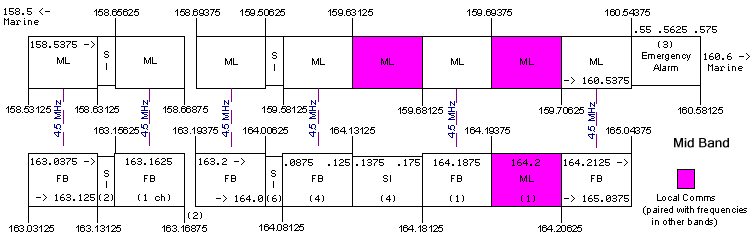 Single OR Base Mobile (or Single)
---------------------------------------
163.0375---158.5375 M2003 PBR Wide Area
163.050 ---158.550 M2004 CBS
163.0625---158.5625 M2005 CBS
163.075 ---158.575 M2006 CBS
163.0875---158.5875 M2007 SJA (0295652)
163.100 ---158.600 M2008 CBS
163.1125---158.6125 M2009 CBS
163.125 ---158.625 M2010 CBS
163.1375 single
158.64375 531 SAR
163.15 single 158.65 53a SAR (25kHz til end of 2009). Ch95 pair (Scotl.) 53a---93 (152.85)
158.65625 532 SAR
163.1625 single - Tracker
(163.175 ---158.675 non PBR)
(163.1875---158.6875 non PBR)
163.200 ---158.700 M2016 CBS
163.2125---158.7125 M2017 CBS
163.225 ---158.725 M2018 CBS
163.2375---158.7375
to unallocated
163.275 ---158.775
163.2875---158.7875 M2023 STH (or either singly)
163.300 ---158.800 M2024 SJA
163.3125---158.8125 M2025
to CBS (except 163.375--158.875 BRC)
163.425 ---158.925 M2034
163.4375---158.9375 BRC (0310908)
163.45 ---158.95 M2036 Data Dominant
163.4625---158.9625 M2037 Data Dominant
163.475 ---158.975 M2038 Data Dominant
163.4875---158.9875 M2039 BRC
163.5 ---159.0 M2040 Data Dominant
163.5125---159.0125 M2041 SJA
163.525 ---159.025 M2042 Data Dominant
163.5375---159.0375
to appears to be spare, possibly H.O.
163.5875---159.0875
163.6 ---159.1 RNLI (0138319)
163.6125---159.1125
to British Red Cross (Licence 0780200)
163.675 ---159.175
163.6875---159.1875 M2055 STH Construction only (or either singly)
163.7 ---159.2 M2056
to Data Dominant
167.7375---159.2375 M2059
163.750 ---159.250 M2060 STH Construction only (or either singly)
163.7625---159.2625
to Vodafone (Data) Ltd (was Paknet, then Data Services Ltd)
163.8375---159.3375
163.850 ---159.350 M2068 STH Construction only (or either singly)
163.875 ---159.375 M2070 Data only (IR2008)
163.8875---159.3875 M2071 Data only (IR2008)
163.900 ---159.400 M2072 STH (or 163.9 singly) (ex RQAS only)
163.9125---159.4125 M2073 Data Dominant
163.925 ---159.425 M2074 STH (or either singly)
163.9375---159.4375 M2075 Data Dominant
163.950 ---159.450 M2076 demo/parking
163.9625---159.4624 M2077 CBS
163.975 ---159.475 M2078 CBS
163.9875 STH 159.4875 STH (ex RQAS)
164.000 STH (ex RQAS) 159.500 STH (ex RQAS)
164.0125 on site 159.5125 on site
164.025 on site (*?) 159.525 on site
164.0375 on site (*?) 159.5375 on site
164.050 Simple UK (was UKG) 159.55
164.0625 Simple UK (was UKG) to spare, possibly H.O.
164.075 on site 159.575
164.0875 STH 159.5875 STH (ex RQAS)
164.1 ---159.6 M2088 Data only (IR2008)
164.1125---159.6125
164.125 STH (ex RQAS) 159.625 STH (ex RQAS)
164.1375 on site 159.6375 Local Comms returns (to 459MHz)
164.150 (*?) 159.65 Local comms ret.
164.1625 on site 159.6625 Local comms ret.
164.175 data (tracking) 159.675 Local comms ret.
164.1875 STH (ex RQAS) 159.6875 STH
164.200 page ret. (as 161) 159.700 Local comms ret.
164.2125---159.7125 18 channels :
to Vodafone (Data) Ltd (was Paknet, then Data Services Ltd)
164.425 ---159.925 base continuous (25 channels, 7 more at 163.7675) [Hear it here!]
164.4375 - 165.0375
this top section used to be mainly Private Message Handling - operators speaking
to mobile doctors etc. (AirCall/MediCall), and is now CBS "predominantly" with
some wide area or on-site technical assignments e.g. 164.475--159.975 BRC (0793939)
164.4375---159.9375 M2115
to
165.0375---160.5375 M2163 (Last "mid band" ch.)
---------------------------- --------
160.550 - 160.575 Alarms (3x 12.5kHz)
** the end of this 2nd column now joins the start of the 1st. now we've covered 4.6MHz **
160.3 to 160.55 was once used for 11 private marine channels (1970s)
(and at the time Private Message Handling thus only went to 164.775/160.275)
-165.04375=-------------------
High Band
12.5kHz channels. Some "TalkThrough". DCS.
Security firms (Datatrack mobile digital - on 5 national Securicor channels)
Ambulance service (many at 166.1-166.85), Taxis, etc.
Single OR Base Mobile (or Single)
---------------------------------------
163.0375---158.5375 M2003 PBR Wide Area
163.050 ---158.550 M2004 CBS
163.0625---158.5625 M2005 CBS
163.075 ---158.575 M2006 CBS
163.0875---158.5875 M2007 SJA (0295652)
163.100 ---158.600 M2008 CBS
163.1125---158.6125 M2009 CBS
163.125 ---158.625 M2010 CBS
163.1375 single
158.64375 531 SAR
163.15 single 158.65 53a SAR (25kHz til end of 2009). Ch95 pair (Scotl.) 53a---93 (152.85)
158.65625 532 SAR
163.1625 single - Tracker
(163.175 ---158.675 non PBR)
(163.1875---158.6875 non PBR)
163.200 ---158.700 M2016 CBS
163.2125---158.7125 M2017 CBS
163.225 ---158.725 M2018 CBS
163.2375---158.7375
to unallocated
163.275 ---158.775
163.2875---158.7875 M2023 STH (or either singly)
163.300 ---158.800 M2024 SJA
163.3125---158.8125 M2025
to CBS (except 163.375--158.875 BRC)
163.425 ---158.925 M2034
163.4375---158.9375 BRC (0310908)
163.45 ---158.95 M2036 Data Dominant
163.4625---158.9625 M2037 Data Dominant
163.475 ---158.975 M2038 Data Dominant
163.4875---158.9875 M2039 BRC
163.5 ---159.0 M2040 Data Dominant
163.5125---159.0125 M2041 SJA
163.525 ---159.025 M2042 Data Dominant
163.5375---159.0375
to appears to be spare, possibly H.O.
163.5875---159.0875
163.6 ---159.1 RNLI (0138319)
163.6125---159.1125
to British Red Cross (Licence 0780200)
163.675 ---159.175
163.6875---159.1875 M2055 STH Construction only (or either singly)
163.7 ---159.2 M2056
to Data Dominant
167.7375---159.2375 M2059
163.750 ---159.250 M2060 STH Construction only (or either singly)
163.7625---159.2625
to Vodafone (Data) Ltd (was Paknet, then Data Services Ltd)
163.8375---159.3375
163.850 ---159.350 M2068 STH Construction only (or either singly)
163.875 ---159.375 M2070 Data only (IR2008)
163.8875---159.3875 M2071 Data only (IR2008)
163.900 ---159.400 M2072 STH (or 163.9 singly) (ex RQAS only)
163.9125---159.4125 M2073 Data Dominant
163.925 ---159.425 M2074 STH (or either singly)
163.9375---159.4375 M2075 Data Dominant
163.950 ---159.450 M2076 demo/parking
163.9625---159.4624 M2077 CBS
163.975 ---159.475 M2078 CBS
163.9875 STH 159.4875 STH (ex RQAS)
164.000 STH (ex RQAS) 159.500 STH (ex RQAS)
164.0125 on site 159.5125 on site
164.025 on site (*?) 159.525 on site
164.0375 on site (*?) 159.5375 on site
164.050 Simple UK (was UKG) 159.55
164.0625 Simple UK (was UKG) to spare, possibly H.O.
164.075 on site 159.575
164.0875 STH 159.5875 STH (ex RQAS)
164.1 ---159.6 M2088 Data only (IR2008)
164.1125---159.6125
164.125 STH (ex RQAS) 159.625 STH (ex RQAS)
164.1375 on site 159.6375 Local Comms returns (to 459MHz)
164.150 (*?) 159.65 Local comms ret.
164.1625 on site 159.6625 Local comms ret.
164.175 data (tracking) 159.675 Local comms ret.
164.1875 STH (ex RQAS) 159.6875 STH
164.200 page ret. (as 161) 159.700 Local comms ret.
164.2125---159.7125 18 channels :
to Vodafone (Data) Ltd (was Paknet, then Data Services Ltd)
164.425 ---159.925 base continuous (25 channels, 7 more at 163.7675) [Hear it here!]
164.4375 - 165.0375
this top section used to be mainly Private Message Handling - operators speaking
to mobile doctors etc. (AirCall/MediCall), and is now CBS "predominantly" with
some wide area or on-site technical assignments e.g. 164.475--159.975 BRC (0793939)
164.4375---159.9375 M2115
to
165.0375---160.5375 M2163 (Last "mid band" ch.)
---------------------------- --------
160.550 - 160.575 Alarms (3x 12.5kHz)
** the end of this 2nd column now joins the start of the 1st. now we've covered 4.6MHz **
160.3 to 160.55 was once used for 11 private marine channels (1970s)
(and at the time Private Message Handling thus only went to 164.775/160.275)
-165.04375=-------------------
High Band
12.5kHz channels. Some "TalkThrough". DCS.
Security firms (Datatrack mobile digital - on 5 national Securicor channels)
Ambulance service (many at 166.1-166.85), Taxis, etc.
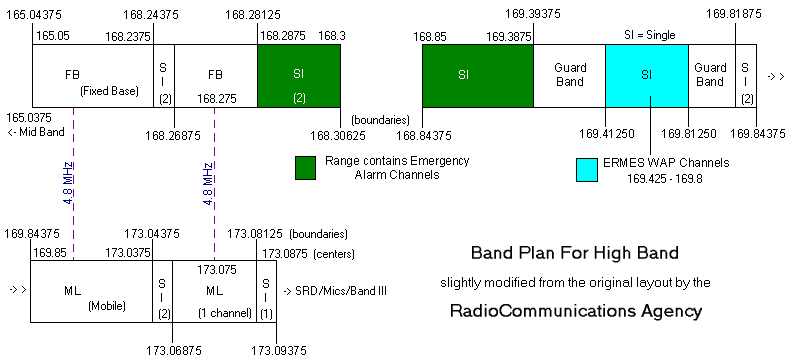 National exclusive: 45 dual, 11 single
CBS: 20 dual
On-site shared: 5 dual, 31 single
Wide Area Shared: 185 dual
Simple UK Light (was UK General): 5 single
Summary
165.05...PBR, to 168.2375 256ch (split +4.8: 169.850 -173.0375) (French splits -4.6) (ISM 168 +/- 8kHz)
168.25...PBR, to 168.3 4ch single, 1 pairing
168.3125=... H.O.
168.85...PBR, to 169.8375 46ch single (with 169.4 to 169.8125 removed)
169.85...PBR, to 173.0375 256ch single OR dual: see 165.05
173.05...PBR, to 173.0875 4ch single
Trying to subtract 4.8 in your head? Why not subtract 5 (easy) then add 0.2 (easy too)!
Subtracting 5 too hard?!! Add 5 if it's easier, then take 10!
Chart
** a 4.8 MHz difference UPWARDS
Base Mobile 256 channels, not all shown:
---------------------------------------
165.0500---169.8500 ch H001 Hxxx = (freq - 165.0375) / 0.0125
165.075 ---169.875 Road Construction (not London)
165.1625---169.9625 ON SITE 32 DUAL
165.1875---169.9875 ON SITE 33 DUAL
165.2125---170.0125 ON SITE 34 DUAL
165.6375---170.4375 btp (+165.65)
166.4375---171.2375 NHS Ambulance emerg. reserve ch.
Amb. used 166.1, 166.2, 166.275-166.4125,166.4625-166.6125, 166.75, 166.8
166.7625---171.5625 ON SITE 35 DUAL
167.0375---171.8375 ON SITE 36 DUAL
167.2000---172.000 demo/"parking"/Test&Dev
172.65 Czech licence-free two-way & 172.725, 172.95, 172.975
168.2375---173.0375 ch H256
** single freq.s (5)
---------------------------- --------
168.250 PBR H257 173.050 Simple UK Light (was UK General)
168.2625 PBR H258 173.0625 Simple UK Light (was UK General)
168.2750---173.075 PBR H259
168.2875 PBR H260 (& Alarms) 173.0875 Simple UK Light (was UK General) --173.09375= end of high band PBR--
168.300 PBR H261 173.100... H.O. + LPD/SRD
-168.3125=-boundary----------
168.325 H.O. 168.325-168.8 split +5.7: 174.025-174.5 used for ROC/UKWMO in 1970s/80s (source)
to
168.825
-168.8375=------------------- boundary used to be listed as 168.95 ----
44 channels, not all shown:
168.850 PBR H305
168.9375 PBR H312 (& Alarms)
169.0125 STH
169.050 JRC H321
169.0625 PBR ex UK General?
169.0875 Simple UK Light (was UK General)
169.1375 STH
169.1625 STH
169.1875 STH
169.3125 Simple UK Light (was UK General)
169.3375 PBR motor sports (National-RAC)
169.3875 PBR H348
-169.39375=------------------
168.9625-169.8375 used to be all PBR single, then Europe took away 169.4-169.8125 for ERMES
leaving 2 PBR channels at the top. The PBR Single band was then extended down to 168.8375=
(ex STH channels: 169.4375 169.475 169.4875 169.5375? 169.575 169.6375 169.7625)
Council Directive 90/544/EEC of 9.Oct.1990 required Member States to designate the 169.4-169.8MHz
frequency band for the pan-European land-based public radio paging service (known as ERMES).
However, it wasn't a success as other technologies (SMS) replaced the need and made ERMES redundant.
169.425 ERMES-01
ERMES Paging (25kHz, continuous, 6.25kbps, 4level FSK) [Hear it here!]
16 channels, with each country having 4 "preferred" channels more more
Austria 2,6,8,12
Czech R. 1,2,9,10,12,13
Finland - 11
France 10,14
.li 1,4,12,15
Italy & Denmark 8,10,12,14
Portugal 1,3,10,14
Slovakia 2,3,5,5,16
Sweden 10
Swiss - 1,4,12,15
to
169.800 ERMES-16
Following CEPT assessment in 2004, exclusive ERMES use was withdrawn March 2005: ECC/DEC/(05)03
New 2005 plan ECC/DEC/(05)02 to share with any remaining paging :
169.400=... Low power, <=0.5W, 12.5/25/50kHz bandwidth, hearing aids/alarms/meters/tracking
169.600=... (guard band)
169.6125=.. High power, 12.5/25kHz bandwidth, tracking, paging, PBR
169.625 .65 .7 .75 Claas Uk Limited (0785523)
to 169.8125=
-169.81875=------------------ 2 more Single channels :
169.825 PBR H383
169.8375 PBR H384
169.85... mobile (see start of second column above) or single, to 173.0375
173.05... PBR, see 2nd column opposite 168.250
173.1... SRD, to 177.2= Mics, JFMG, Theatres, Telemetry, Alarms, Telecommand, Deaf-aids
173.1875 SRD license-exempt
173.2=... licensed SRD, to 173.35= ( and 173.7= to 174= )
173.225 fixed or short range alarms only
173.35=...Aids for the deaf, to 174.415= 50kHz 2mW use the lowest freqs possible
1st set 173.35, 173.4, 173.465, 173.545, 173.64
2nd set 173.695, 173.775, 173.825, 173.95, 173.99
3rd set 174.07, 174.12, 174.185, 174.27, 174.36, 174.415
4th set 174.6, 174.675, 174.77, 174.885, 175.02
173.5125 French POCSAG paging (and 85.955)
173.5875 only telemetry, telecommand, speech, & 173.6 (1997) 10mW
173.7= medical/biological telemetry, to 174
173.7=... mics...
173.965=..Aids for handicapped, to 174.015=
173.9875=.HO, to 174.4125= (allocated, not known if used) see 168.3 for old use
There is a Euro plan (25-08) to re-organise 157.45-174: (boundaries - last pair likely: 173.9875-169.3875)
162.05 ... Base, to 165.2 (split -4.6: 157.45 -160.6) (... this one could well be the full range though)
169.825 ... Base, to 174 (split -4.6: 165.225-169.4)
and some single around 165.2125
-174=--------------------------
Band III - ex TV Broadcasting (405 lines b/w TV) (ITV) until 1984, DAB
UK: Mobile - PAMR/PBR/JFMG/PMSE (mics) + AMR + Data
Bus and coach operators, OFCOM's "B9" business class, rail.
ex French TV: 8MHz ch. F5-F10 vision at 176, 184, 192, 200, 208, 216 sound at +6.5
Euro TV (7MHz) E5 174-181, E6 181-188, ... E11 216-223, E12 223-230
ex UK TV (5MHz) B6 176-181, B7 181-186, ... B13 211-216
174.0 ... mics, to 175.1= 174.6, 174.675, 174.77, 174.885, 175.02 5mW 50kHz JFMG info
173.8 yellow 180kHz 2mW
174.1 red
174.5 blue
174.8 green
175.0 white
175.25 mics (200kHz)
175.525 mics (200kHz)
176.3=... mics, to 177.1= at 176.4 176.6 176.8 177.0
--sub band 1--
176.5=... (mics) (unused PBR channels 001-057 : 176.5 = 001)
177.2=
177.2125...PAMR/DATA, to 183.4875 (split +8: 185.2-191.5) channels 058-560 - 63 not allocated
(except 181.7-181.8 - JFMG 12.5kHz 25W simplex talkback)
Some PBR. PAMR is trunked. (control channels continuous) [Hear it here!]
Cognito data - 49 channels on 1xx.x00 / 1xx.x25 / 1xx.x50 / 1xx.x75 [Hear it here!] until Jan 31 2003
180.175 RTPI Traffic Light control, single, and 188.175
183.5=... AMR plan:
183.5125.. 25kHz channels (8), to 183.6875 - shared
183.7=... retained, to 183.9=
184.0 wideband channel - 200kHz
184.1=... retained, to 184.3=
184.3=... single user, exclusive
184.5=... JFMG, to 185.1=
184.6 news gathering mics, and 184.8 185.0
185.2=
185.2125..PBR, see -8 (189.7-189.8 JFMG 12.5kHz 25W simplex talkback)
--sub band 2--
191.5=
191.5=... JFMG
191.7 links 200kHz, news mics
191.9 links 200kHz, mics
192=...mics 200kHz max, to 193.1= 10mW 192.1 192.3 192.6 192.8 193.0
193.2=
193.2125..PBR, see +8
199.5=... JFMG links and mics, SRD
199.7 temp links - 200kHz max, stereo (1 month only, directional, 1W ERP max), mics
199.9 mics, and 200.1 200.3
200.5=... mics, to 201.1= (unused PBR channels 001-057 : 200.5 = 001)
200.6 mics, and 200.8 201.0
201.2125...PAMR/PBR, to 207.4875 (split -8: 193.2-199.5) channels 058-560 - all but 7 allocated
(95 PMR channels, 401 PAMR)
Includes Rail NRN 204.85-206.3 (to be replaced by GSM-R)
--sub band 3--
207.5=
National exclusive: 45 dual, 11 single
CBS: 20 dual
On-site shared: 5 dual, 31 single
Wide Area Shared: 185 dual
Simple UK Light (was UK General): 5 single
Summary
165.05...PBR, to 168.2375 256ch (split +4.8: 169.850 -173.0375) (French splits -4.6) (ISM 168 +/- 8kHz)
168.25...PBR, to 168.3 4ch single, 1 pairing
168.3125=... H.O.
168.85...PBR, to 169.8375 46ch single (with 169.4 to 169.8125 removed)
169.85...PBR, to 173.0375 256ch single OR dual: see 165.05
173.05...PBR, to 173.0875 4ch single
Trying to subtract 4.8 in your head? Why not subtract 5 (easy) then add 0.2 (easy too)!
Subtracting 5 too hard?!! Add 5 if it's easier, then take 10!
Chart
** a 4.8 MHz difference UPWARDS
Base Mobile 256 channels, not all shown:
---------------------------------------
165.0500---169.8500 ch H001 Hxxx = (freq - 165.0375) / 0.0125
165.075 ---169.875 Road Construction (not London)
165.1625---169.9625 ON SITE 32 DUAL
165.1875---169.9875 ON SITE 33 DUAL
165.2125---170.0125 ON SITE 34 DUAL
165.6375---170.4375 btp (+165.65)
166.4375---171.2375 NHS Ambulance emerg. reserve ch.
Amb. used 166.1, 166.2, 166.275-166.4125,166.4625-166.6125, 166.75, 166.8
166.7625---171.5625 ON SITE 35 DUAL
167.0375---171.8375 ON SITE 36 DUAL
167.2000---172.000 demo/"parking"/Test&Dev
172.65 Czech licence-free two-way & 172.725, 172.95, 172.975
168.2375---173.0375 ch H256
** single freq.s (5)
---------------------------- --------
168.250 PBR H257 173.050 Simple UK Light (was UK General)
168.2625 PBR H258 173.0625 Simple UK Light (was UK General)
168.2750---173.075 PBR H259
168.2875 PBR H260 (& Alarms) 173.0875 Simple UK Light (was UK General) --173.09375= end of high band PBR--
168.300 PBR H261 173.100... H.O. + LPD/SRD
-168.3125=-boundary----------
168.325 H.O. 168.325-168.8 split +5.7: 174.025-174.5 used for ROC/UKWMO in 1970s/80s (source)
to
168.825
-168.8375=------------------- boundary used to be listed as 168.95 ----
44 channels, not all shown:
168.850 PBR H305
168.9375 PBR H312 (& Alarms)
169.0125 STH
169.050 JRC H321
169.0625 PBR ex UK General?
169.0875 Simple UK Light (was UK General)
169.1375 STH
169.1625 STH
169.1875 STH
169.3125 Simple UK Light (was UK General)
169.3375 PBR motor sports (National-RAC)
169.3875 PBR H348
-169.39375=------------------
168.9625-169.8375 used to be all PBR single, then Europe took away 169.4-169.8125 for ERMES
leaving 2 PBR channels at the top. The PBR Single band was then extended down to 168.8375=
(ex STH channels: 169.4375 169.475 169.4875 169.5375? 169.575 169.6375 169.7625)
Council Directive 90/544/EEC of 9.Oct.1990 required Member States to designate the 169.4-169.8MHz
frequency band for the pan-European land-based public radio paging service (known as ERMES).
However, it wasn't a success as other technologies (SMS) replaced the need and made ERMES redundant.
169.425 ERMES-01
ERMES Paging (25kHz, continuous, 6.25kbps, 4level FSK) [Hear it here!]
16 channels, with each country having 4 "preferred" channels more more
Austria 2,6,8,12
Czech R. 1,2,9,10,12,13
Finland - 11
France 10,14
.li 1,4,12,15
Italy & Denmark 8,10,12,14
Portugal 1,3,10,14
Slovakia 2,3,5,5,16
Sweden 10
Swiss - 1,4,12,15
to
169.800 ERMES-16
Following CEPT assessment in 2004, exclusive ERMES use was withdrawn March 2005: ECC/DEC/(05)03
New 2005 plan ECC/DEC/(05)02 to share with any remaining paging :
169.400=... Low power, <=0.5W, 12.5/25/50kHz bandwidth, hearing aids/alarms/meters/tracking
169.600=... (guard band)
169.6125=.. High power, 12.5/25kHz bandwidth, tracking, paging, PBR
169.625 .65 .7 .75 Claas Uk Limited (0785523)
to 169.8125=
-169.81875=------------------ 2 more Single channels :
169.825 PBR H383
169.8375 PBR H384
169.85... mobile (see start of second column above) or single, to 173.0375
173.05... PBR, see 2nd column opposite 168.250
173.1... SRD, to 177.2= Mics, JFMG, Theatres, Telemetry, Alarms, Telecommand, Deaf-aids
173.1875 SRD license-exempt
173.2=... licensed SRD, to 173.35= ( and 173.7= to 174= )
173.225 fixed or short range alarms only
173.35=...Aids for the deaf, to 174.415= 50kHz 2mW use the lowest freqs possible
1st set 173.35, 173.4, 173.465, 173.545, 173.64
2nd set 173.695, 173.775, 173.825, 173.95, 173.99
3rd set 174.07, 174.12, 174.185, 174.27, 174.36, 174.415
4th set 174.6, 174.675, 174.77, 174.885, 175.02
173.5125 French POCSAG paging (and 85.955)
173.5875 only telemetry, telecommand, speech, & 173.6 (1997) 10mW
173.7= medical/biological telemetry, to 174
173.7=... mics...
173.965=..Aids for handicapped, to 174.015=
173.9875=.HO, to 174.4125= (allocated, not known if used) see 168.3 for old use
There is a Euro plan (25-08) to re-organise 157.45-174: (boundaries - last pair likely: 173.9875-169.3875)
162.05 ... Base, to 165.2 (split -4.6: 157.45 -160.6) (... this one could well be the full range though)
169.825 ... Base, to 174 (split -4.6: 165.225-169.4)
and some single around 165.2125
-174=--------------------------
Band III - ex TV Broadcasting (405 lines b/w TV) (ITV) until 1984, DAB
UK: Mobile - PAMR/PBR/JFMG/PMSE (mics) + AMR + Data
Bus and coach operators, OFCOM's "B9" business class, rail.
ex French TV: 8MHz ch. F5-F10 vision at 176, 184, 192, 200, 208, 216 sound at +6.5
Euro TV (7MHz) E5 174-181, E6 181-188, ... E11 216-223, E12 223-230
ex UK TV (5MHz) B6 176-181, B7 181-186, ... B13 211-216
174.0 ... mics, to 175.1= 174.6, 174.675, 174.77, 174.885, 175.02 5mW 50kHz JFMG info
173.8 yellow 180kHz 2mW
174.1 red
174.5 blue
174.8 green
175.0 white
175.25 mics (200kHz)
175.525 mics (200kHz)
176.3=... mics, to 177.1= at 176.4 176.6 176.8 177.0
--sub band 1--
176.5=... (mics) (unused PBR channels 001-057 : 176.5 = 001)
177.2=
177.2125...PAMR/DATA, to 183.4875 (split +8: 185.2-191.5) channels 058-560 - 63 not allocated
(except 181.7-181.8 - JFMG 12.5kHz 25W simplex talkback)
Some PBR. PAMR is trunked. (control channels continuous) [Hear it here!]
Cognito data - 49 channels on 1xx.x00 / 1xx.x25 / 1xx.x50 / 1xx.x75 [Hear it here!] until Jan 31 2003
180.175 RTPI Traffic Light control, single, and 188.175
183.5=... AMR plan:
183.5125.. 25kHz channels (8), to 183.6875 - shared
183.7=... retained, to 183.9=
184.0 wideband channel - 200kHz
184.1=... retained, to 184.3=
184.3=... single user, exclusive
184.5=... JFMG, to 185.1=
184.6 news gathering mics, and 184.8 185.0
185.2=
185.2125..PBR, see -8 (189.7-189.8 JFMG 12.5kHz 25W simplex talkback)
--sub band 2--
191.5=
191.5=... JFMG
191.7 links 200kHz, news mics
191.9 links 200kHz, mics
192=...mics 200kHz max, to 193.1= 10mW 192.1 192.3 192.6 192.8 193.0
193.2=
193.2125..PBR, see +8
199.5=... JFMG links and mics, SRD
199.7 temp links - 200kHz max, stereo (1 month only, directional, 1W ERP max), mics
199.9 mics, and 200.1 200.3
200.5=... mics, to 201.1= (unused PBR channels 001-057 : 200.5 = 001)
200.6 mics, and 200.8 201.0
201.2125...PAMR/PBR, to 207.4875 (split -8: 193.2-199.5) channels 058-560 - all but 7 allocated
(95 PMR channels, 401 PAMR)
Includes Rail NRN 204.85-206.3 (to be replaced by GSM-R)
--sub band 3--
207.5=
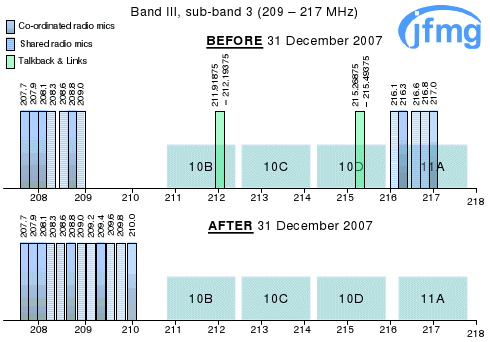 207.6=... JFMG mics, to 210.1=
207.7 coordinated
207.9 coord.
208.1 coord.
208.3 shared
208.6 shared
208.8 coord.
209.0 shared
(209.1= before end of 2007)
New from 1-1-2008 :
209.2 shared
209.4 coord.
209.6 shared
209.8 shared
210.0 coord.
210.1=... now cleared for more DAB : 10B, 10C, 10D, 11A
216... MoD for the Radiolocation Service, to 225 (OFCOM FAT 2010)
NOTES
Previous plans for use :
209.20625=.PBR (future) to 215.26875=
The initial plan had been for another block of PBR/PAMR with 8MHz split...
208.5=... PAMR/PBR, to 215.5= (split +8: 216.5-223.5)
The PBR plan changed as sub-bands 1 & 2 contained the demand, then DAB arrived and took 217.5 onwards
and so they planned -3.3MHz splits keeping space for JFMG and SRD :
209.206= - 215.26875= PAMR/PBR Frequency plan developed using 6.25 and 12.5kHz channels. No use as yet.
209.26... PBR, see +3.3
210.26... SRD
210.97... PBR, see +3.3
211.925...JFMG, to 212.1875 - mobile talkback (to 141 MHz) wide area
212.2 ... SRD
212.5625..PAMR/PBR, to 213.55 (split -3.3: 209.26-210.25)
213.56... ?SRD?
214.275...PAMR/PBR, to 215.2625 (split -3.3: 210.97-211.96) Narrowband modes
215.275...JFMG, to 215.4875 (not split -3.3: 211.97-212.18!!) temp. links
this led to a PBR plan with +3.35MHz splits :
209.2125...PAMR/PBR, to 210.2 (split +3.35: 212.5625-213.55) 12.5kHz
210.206=...reserved for PMR/PAMR, to 210.919= (split +3.35: 213.556 -214.269) bwidth not yet decided
210.919=...reserved for PMR/PAMR, to 211.919= (split +3.35: 214.269 -215.269) narrowband 5/6.25
211.925...JFMG, to 212.1875 - NOW: see 215.275 (WAS: wide area mobile talkback - to 141 MHz)
212.2 ... SRD, to 212.55
212.5625..PAMR/PBR, see -3.35: 209.2125...
213.556=..future PMR/PAMR see -3.35: 210.206=...
214.269=..future PMR/PAMR see -3.35: 210.919=...
update (July 2002) - the PBR plan now seems to be -3.35 splits with 1MHz of 6.25 narrowband :
209.2125...mobile section, to 211.91875
211.925...JFMG, to 212.1875
212.2 ...SRD, to 212.55
212.5625...PAMR/PBR, to 214.2625 (split -3.35: 209.2125-210.9125)
214.26875=.PAMR/PBR 6.25kHz spaced, to 215.26875= (split -3.35: 210.91875= - 211.91875=)
215.275... JFMG SAP base, to 215.4875 (split -3.35: 211.925-212.1875) (WAS: temp. links)
215.5=... SRD, to 217.5
216.0.. JFMG mics, to 217.1= 216.1 216.3 216.6 216.8 217.0
217.5 DAB
217.5=...DAB, to 230 (1.536 MHz bandwidth) Vertical Pol. (Wikipedia: Digital_Audio_Broadcasting)
Eureka 147 - COFDM - Umpteen hundred narrowband carriers all sharing the bits...
DAB first tested by BBC Jan 1990, demos 91-93, launched Sept 1995.
"DAB-ensemble frequencies are encoded in 19 bits and then multiplied by 16kHz" (max 8GHz)
Other possible DAB channels (4 DAB channels per 7MHz TV ch, 1.712MHz spaced)
5A 174.928 to 5D 180.064
6A 181.936 to 6D 187.072
7A 188.928 to 7D 194.064
8A 195.936 to 8D 201.072
9A 202.928 to 9D 208.064
10A 209.936 to 10D 215.072
11A 216.928
13A 230.784 to 13C 234.208
13D 235.776 to 13F 239.200
216.928 (E11-A) awarded to 4 Digital Group Limited, didn't happen, licence handed back to Ofcom on 30.Jan.2009
218.640 (E11-B) LOCAL
220.352 (E11-C) LOCAL/INR +Isle of Man +Channel Islands
222.064 (E11-D) LOCAL/INR England + Wales
223.936 (E12-A) LOCAL/INR England + Scotland
225.648 (E12-B) BBC UK + Gibraltar (224.88-226.416)
227.360 (E12-C) LOCAL England + Wales
229.072 (E12-D) LOCAL/INR +Northern Ireland
UK use, links [2012] : DAB Ensembles DAB Allocations UK Stations
DAB Sound Quality [2012]
DAB uses the MPEG-1 Audio Layer II (MP2) audio codec which has less efficient compression than newer codecs.
The typical bitrate is only 128 kbit/s so most radio stations on DAB have a lower sound quality than FM.
USA alternative : Wikipedia: FM HD Radio
"Thus HD Radio is approximately twice as data-efficient as DAB."
"codec based upon the MPEG-4 HE-AAC standard... same perceived quality as MP2 at one-quarter the bit rate"
No multiplexes either - one carrier per station as with FM - more flexible.
NOTES
224.0125.. ex JFMG PMSE, to 224.4875 portable links
There is an Amateur 1.25m allocation in the USA from 222 to 225 (ARRL Bandplans 2012)
(was 220-225 until the 1990s) which started (at 224) in 1938.
Unlikely to ever be allocated in Europe, as it's in the middle of the DAB band 217.5-230
-230---------------------------
NATO military band. (Equipment) ARFA/DRFB/FMSC/NJFA/CEAC
"military air-ground-sea tactical communications" (25kHz AM channels) some 12.5kHz spaced ch.s?
Radio Relay, PTARMIGAN multi-channel trunk links.
225-400MHz "HaveQuick" frequency hopped system (7000ch wartime mode, ~20 channels otherwise)
"In 1951 the NATO nations decided to reserve 225-400 MHz for military use, and move
air-ground-air comms to this band from the 100-150 MHz area." - DSI2
The lower end has been lost to DAB, and from 380 upwards is earmarked for Land Mobile such as TETRA.
Used by the Red Arrows, Falcons, Sharks etc for airshows
Some satellite (FM, wide bandwidth) downlinks, especially in the 240/260 MHz region. System info. More
243.0 Distress, EPIRBs 121.5 x 2 = 243 to be phased out
259.7 ex Space shuttle
282.8 Emergency / SAR & 244.6 (Scene of SAR Control), 285.85
(Thailand red CB at 245.0 - 245.9875)
The Philippines, Singapore and Brunei have a 300 mW 40 ch FRS service that operates
on the 325 MHz band (325.0 to 325.4875) - I wonder if any handies get brought over here?
Watch out for unapproved cordless phones at 375-385 (split -126: 249-259) 40 channels nbfm
326.5=... Astronomy, to 328.5= - deuterium spectral line
328.6=... Aero. Nav., to 335.4= - ILS, glideslopes
(350.1625... Indian version of FRS/PMR-446, 31 ch, to 350.5275)
380.0=...Euro emergency services band - TETRA, to 399.9= DEC(96)04 & DEC(99)04 pi/4 DQPSK
TETRA has been chosen for the UK Home Office's Airwave (PSRCP Public Safety Radio Comms Project - ex Quadrant)
for the Emergency Services (and others). Digital, networked, encrypted.
Trans-European Trunked RAdio, (TE part renamed TErrestrial). Carrier numbering (ETSI 100 392-15), more
380.0=... TETRA mobile, see +10
389.9=... TETRA single... (see TR 25-08) because 399.9-400 can't be paired
390.0=...TETRA Base, to 399.9= (split -10: 380= - 389.9=) 25kHz channels, 12.5 offset. Base continuous
390.0= Band Edge
DMO Direct Mode... (split -10) agreed at WRC 2000 ( DEC(01)19 )
(6 ch, or up to 15 x 10kHz channels, 390.005-390.145)
390.0125 ch 1 DMO
to
390.1375 ch 6 DMO
390.15= TMO Trunked Mode... (Network)
390.1625 ch 7 first TMO ch
391.5125 Test & Dev. ?
394.7875 ch 192 last TMO ch
394.8= TETRA Air-Ground-Air, to 395= DEC(01)20
394.8125 ch 193 first A-G-A
394.9875 ch 200 last A-G-A (8 ch, or up to 20 x 10kHz)
395.0=
395.0125... Not yet allocated, to 399.8875
399.9=
396.875... US ISR, to 399.975 (no fixed steps), 12.5kHz FM, 500mW, using the Icom IC-4008M
Intra-Squad Radio - may end up in use in US airbases in Europe?
Details : http://www.ld.com/cbd/archive/2000/02(February)/29-Feb-2000/58sol003.htm
http://www.idwg.cap.gov/comm-isr.htm
Common freq.s used for illegal NFM bugs 399.03 (ch C), 398.605 (A), 399.455 (B)
-399.9=---UHF------------------
Mobile (French splits +/-10)
399.9=.. Satellite, to 400.15=
399.9=... Nav, to 400.05=
Russian Tsikada "Cicada" ex Transit (NNSS) ended 31.Dec.1996 (now NIMS)
with 150MHz (f/2.66.) and near 1067MHz (f*2.66.) i.e. 1066.752, 1066.58133
400.1 Standard freq. / time
400.15=..Met. sondes (WFM), Satellite, EPIRBs, to 406.1
401.65 Argos uplinks (Satellite system collecting environmental data, wildlife tracking etc)
402... medical implants, to 405
403.55 LPD (designed for South Africa)
406.0 Emergency Locator Transmitters
406.025 EPIRBs, 406.028 5W max (COSPAS-SARSAT) IR2042
406.1=.. MoD, to 420
Especially 408-410 : replacements for old VHF local nets
- assignments in 410-420 have been moved to below 410 or higher up UHF1
Channel Tunnel and Portal area (0797899) 25 kHz
416.65 417.475 417.8 419.175 424.875
406... Syledis nav. (positioning) system, to 449 - pulses - Annoying clicks on 70cms!
409.75.Chinese version of 446/FRS (500mW, 12.5kHz spaced FM), to 409.9875 (20 channels)
410=.. mobile civil TETRA, to 415= see 420
410=... reserved for Emergency services, to 412= with 420-422 (extended TETRA?)
412=... Arqiva Ltd & Airwave Solutions Ltd, to 414 (split +10: 422-424) Auctioned march 2006 (0310692)
414=... MOD, to 415= with 424-425
418.0 UK SRDs (centre of 200kHz alloc.) to be phased out
"Only SRD equipment certified to the R&TTE Directive before 31.Dec.2002
will be accepted for use in the UK until 31.Dec.2007."
Some forums list Helicopter on-board "PolyCon" 417.5, 417.525, 417.575
and 419.1125, 419.1375 Coastguard/Police. Also 449.5375, 449.5875, 449.6875 for SAR (RAF/Navy).
UHF1: 420 to 450 - military (shares with PBR), SRD, SAB
RadioLocation is primary at 420-430 and 440-450
Mil: EPLRS/SADL (Enhanced Position Location Reporting System/Situation Awareness Data Link)
freq hopped secure data (420-450).
There is a Euro plan (25-08) to re-organise 410-430: (boundaries)
420 ... Base, to 430 (split -10: 410-420)
420-422 (split -10) Sec. of State for Health, Crown Recognised Spectrum Access (0799272) 10,000 kHz bw
420=... was used for PAMR: national civil TETRA, to 430= (split -10: 410-420)
420.0125... 400 x 25kHz channels, to 429.9875 - 12.5kHz offsets (as with TACS) Dolphin
425-430 use started January 2000, Dolphin had 100 channels within 420-425 prior to that
"further allocations may be made... in the bands 415-420 MHz paired with 425-430 MHz" - Dec.1999
425.00625=
425.0125... PBR, see 445.5125 +20.5
(425.3125=...JFMG, to 425.5626= temp links - South West large towns only - 425.3375 to 425.5375 - 5 x 50kHz)
425.5125... PBR, see 440.0125 +14.5
(427.7625=...JFMG, to 428.0125= talkback - various areas - 427.775 to 428.0)
428.025... PBR, see 442.525 +14.5
429=... MoD
70cm
-430=-... Amateur 70cm band, to 440= [checked and updated 2012] (RSGB Bandplan 2012)
Secondary. Shared with MoD, PBR...
some Govt (some odd splits to other UHF1 sections) Nuclear Electric trunked NANRCS (countries)
Common amateur splits 1.6, 7.6, 9, 9.4 MHz
There are often moves afoot (thwarted so far) to reduce the band to 432-438,
and already some non-amateur use falls within 430-432 and 438-440.
USA 70cm band is 3x the size, 420-450! (ARRL Bandplans 2012)
430=... Amateur, all modes, to 432 - away from main band 432-435 and 435-438 satellite
430.0125.. Internet Voice Gateways (12.5kHz), to 430.075
430.025.. RU1 French/Neth. repeaters, to 430.375 (RU15) (split +1.6: 431.625-431.975)
"FRU2 Sp" 430.05 +9.7 :439.75
"FRU2 H" 430.0625 +9.4 :439.4625
"FRU4 XH" 430.1125 +9.4 :439.5125
"FRU6 H" 430.15 +9.4 :439.55
"FRU8 H" 430.2 +9.4 :439.6
"FRU9 H" 430.225 +9.4 :439.625
"FRU9 XH" 430.2375 +9.4 :439.6375
"FRU13 H" 430.325 +9.4 :439.725
"FRU14 H" 430.35 +9.4 :439.75
"FRU15 H" 439.775 -9.4 :430.375
430.4... DV repeaters in (see +9 :439.4), to 430.9125
430.8 input: see +7.6 :438.4
UK Repeaters 430.825-430.975 (split +7.6 :438.425-438.575) new in 2001, first=GB3PZ
430.825 RU66 :438.425
430.8375 RU67 :438.4375
430.85 RU68 :438.45
430.8625 RU69 :438.4625
430.875 RU70 not available
430.8875 RU71 :438.4875
430.9 RU72 :438.5
430.9125 RU73 :438.5125
430.925 RU74 :438.525
430.9375 RU75 :438.5375
430.95 RU76 :438.55
430.9625 RU77 :438.5625
430.975 RU78 :438.575
430.990=.. Digital, to 431.9=
431.0...French 'transponders', to 431.15 (25kHz) (and 433.4-433.575)
431.075 Voice Gateways, to 431.175 (12.5kHz)
431.2125.. new IARU repeaters in, to 431.375 (see +1.6 :432.8125)
431-432MHz not available within 100km radius of Charing Cross, London
431=...some PBR mobile (London), to 432.0625= bases around 17MHz higher at 448 to 449.38 region
430.5 single PBR Rosewood Estates Limited (0296264) 25kHz
431.4875= to 431.5125= -unused for PBR- (from OFCOM)
431.6375= to 431.6625= -unused for PBR-
431.8375= to 431.8625= -unused for PBR-
431.8875= to 431.9125= -unused for PBR-
432= to 432.0375= -unused for PBR-
432.0375= to 432.0625= single PBR 432.04375 & 432.05625 Rosewood Estates Limited (0296264)
The public OFCOM doc also reveals the following PBR pairings:
434.025--439.775
436.025--443.650
437.025--443.775
437.0625-444.15
438.0625-444.75
439.0625-445.0625
432.0=...Narrow band
432=... EME CW/MGM... (MGM=Machine Generated Mode)
432.025.. CW/MGM... (432.05 CW centre of activity)
432.088 PSK31
432.1... SSB,CW,MGM...
432.2 SSB centre of activity
432.35 Microwave talkback
432.37 FSK441 calling
432.4=... Beacons...
432.5=... SSTV, transponders in...
432.6=... transponders out, to 432.8
432.625 Digital, & 432.65, 432.675
432.7 Fax
432.8=... Beacons (UK)... due to move to 432.4...
To be replaced by new IARU repeater channels :
432.8125 RU225 to 432.975 (RU238) (split -1.6: 431.2125-431.375)
433.0... FM channels, to 435=
433.025.. RU17 French repeater channels, to 433.2 RU24 (split -1.6: 431.425-431.6)
Shared with European 10mW LPD transceivers on 433.075 - 434.775 (69 x 25kHz channels) in ISM Band
The first 39 channels below 434.04 don't appear to be legal in the UK (OFCOM regs.)
UK repeaters 433.0-433.375 (split +1.6: 434.6-434.975) started in 1976 (UK)
433.0 RB0 :434.6
433.025 RB1 :434.625
433.05 RB2 :434.65
433.075 RB3 :434.675 LPD-1
433.1 RB4 :434.7 LPD-2
433.125 RB5 :434.725 LPD-3
433.15 RB6 :434.75 LPD-4
433.175 RB7 :434.775 LPD-5
433.2 RB8 :434.8 LPD-6
433.225 RB9 :434.825 LPD-7
433.25 RB10 :434.85 LPD-8
433.275 RB11 :434.875 LPD-9
433.3 RB12 :434.9 LPD-10
433.325 RB13 :434.925 LPD-11
433.35 RB14 :434.95 LPD-12
433.375 RB15 :434.975 LPD-13
-Amateur use-
433.4 SU16 U272 LPD-14
433.425 SU17 U274 LPD-15
433.45 SU18 U276 LPD-16 DV calling
433.475 SU19 U278 LPD-17
433.5 SU20 U280 LPD-18 Amateur FM calling
433.525 SU21 U282 LPD-19 GB2RS news
433.55 SU22 U284 LPD-20 rally talk-in
433.575 SU23 U286 LPD-21
433.6...Data/digital, "emergency priority"...
433.6 U288 LPD-22 RTTY
433.625 LPD-23 Digital
433.65 LPD-24 Digital
433.675 LPD-25 Digital
433.7 LPD-26 Emergency/Events, Fax
433.725 LPD-27 Emergency/Events
433.75 LPD-28 Emergency/Events
433.775 LPD-29 Emergency/Events
433.8 LPD-30 Digital...
to
433.95 LPD-36 Voice Gateways
433.975 LPD-37 Voice Gateways
434.0 LPD-38 Voice Gateways
434.025 LPD-39 Voice Gateways
--434.04= OFCOM rules appear to approve LPD in the UK from ch 40 onwards --
434.05 LPD-40 Voice Gateways
434.075 LPD-41
to (clear & legal LPD channels) LPD-44 calling (434.15)
434.35 LPD-52
434.375 LPD-53 Emergency Repeaters in (-1.6 :432.775 out)
434.4 LPD-54
434.425 LPD-55
434.45 LPD-56
434.475 LPD-57 Voice Gateways
434.5 LPD-58 Voice Gateways
434.525 LPD-59 Voice Gateways
434.55 LPD-60
434.575 LPD-61
434.6 LPD-62 RB0 repeater input
to
434.775 LPD-69 RB7 repeater input
434.8 RB8 in
to
434.975 RB15 in
433.92 center of problematic Euro SRD/ISM band (433.05 - 434.79) (32 x 13.56 band)
i.e. vehicles immobilised by ham transmissions *grin*
May be used for LPD and 10mW telemetry from models
SRDs must have 10% Duty Cycle or less after end of 2005
Advanced TV Research (audience figures) domestic boxes : 433.52, 434.02 or 434.52 (100kHz FSK)
434.0625 ex Experimental MPT1327 Base TX Ch 1-3, to 434.0875 removed from 2012 plan
434.6... Euro. repeaters, to 434.975 (split -1.6: reverse of UK) RU0 to RU15
435=... Satellite, to 438=
Current operational frequencies (AMSAT) [2012]
Various public sources (including PROMA's "The Art of Event..") report the following :
435.625 435.725 435.750 435.775 Cadets, RAF Reserves
438=... top 2 MHz, to 440= mainly used for FM channels and ATV
438.025 Digital, to 438.175
438.2... Euro. repeaters, to 439.475 (split -7.6 :430.6-431.875) Germany/Swiss/Austria/Spain
438.4 Emergency/Event repeater (-7.6 :430.8)
438.425..UK repeaters in, to 438.575 (see -7.6 :438.425-438.575)
438.6125 DV calling D-Star
439.4... DV repeaters (split -9 :430.4...) D-Star
439.4000 DVU32
439.4500 DVU36
439.4625 DVU37
439.4875 DVU39
439.5125 DVU41
439.5375 DVU43
439.6000 DVU48
439.6125 DVU49
439.6375 DVU51
439.6625 DVU53
439.6875 DVU55
439.7000 DVU56
439.7125 DVU57
439.7375 DVU59
439.9125 DVU73
439.6=.. Digital...
439.9875 POCSAG paging (amateur)
-440= ---
Who shares the ham band? Well, the military make good use of it (base comms etc), seeing as the hams
don't exactly use it to the full (and aren't primary users anyway)...
DERA perhaps (just speculation...) - now QinetiQ/DSTL.
In July 1999 use of the following was banned by OFCOM for a week, via letter, web-site & GB2RS:
430.650 439.450
430.700 439.575
430.750 439.625
430.825 439.825
430.875 439.875
430.975 439.925
430.400 439.350
430.525 439.400
"The civil radiolocation service operates on 432·5, 438·0, and 445·25
in accordance with the Oslo Agreement, 1983"
440
UHF1 PBR limited mainly to large cities - London, Birmingham, Manchester, Liverpool, Glasgow, Edinb., Leeds,
Aberdeen, Bradford, Derby, Halifax, Leicester, Middlesbro, NewCastle, Preston, Sheffield, Warrington,
Coventry, Bristol, Cardiff, Swansea, Newport. 12.5kHz channels.
Channel xxx = (freq - 440) / 0.0125 freq = (Ch number x 0.0125) + 440 (throughout 440-450)
except additional 0.00625 for 448:431 channels
440.0125.PBR, to 442.250 (split -14.5: 425.5125-427.750) RAM data
440.325 on-site 7 (:425.825) ch 26
440.35 on-site 8 (:425.85)
440.375 on-site 9 (:425.875)
440.4 H.O. + 440.45, 442.225
440.5375 (ex demo/parking :426.0375)
440.9 on-site 16 (:426.4)
440.925 on-site 17 (:426.425)
440.95 on-site 18 (:426.45)
441.1125 on-site 20 (:426.6125)
442.25 CBS (:427.75) ch 180
442.2625=...JFMG, to 442.5125= Temporary location TalkBack - various areas
442.275 to 442.500
442.525..PBR, to 443.4875 (split -14.5: 428.025 -428.9875) 13 JRC ch.
442.525 on-site 26 (:428.025) ch 202
442.5375 CBS (:428.0375)
442.55 on-site 27 (:428.05)
442.575 on-site 28 (:428.075)
442.6 on-site 29 (:428.1)
442.625 on-site 30 (:428.125)
442.65 on-site 31 (:428.15)
442.775 on-site 39 (:428.275)
442.875 W.A. shared 43 (:428.375)
443.45 on-site 51 (:428.95)
443.475 on-site 53 (:428.975)
443.4875 CBS (:428.9875) ch 279
443.5 ... MoD (some Eurotunnel use at 444 split +10)
444.3375 Tag Farnborough Airport Ltd (0276080) (:449.725) 12.5kHz
KDR (Swedish/Norway Kort Distanse Radio) 1W handhelds
444.6, 444.65, 444.8, 444.825, 444.85, 444.975
445.2 ... Civil TETRA DMO Direct Mode (single), to 445.3 1W ( DEC(01)21 )
(447.3-447.4 was alternative proposal)
445.5125.PBR, to 445.9875 (split -20.5: 425.0125-425.4875)
445.5125 CBS (:425.0125) ch 441
445.725 on-site 57 (:425.225)
445.800 on-site 60 (:425.3)
445.975 W.A. shared 62 (:425.475)
445.9875 CBS (:425.4875) ch 479
446.0... PBR, to 446.4 on-site single : channels 1 to 33 (12.5kHz)
PMR 446
446.006..PMR446 (Euro SRBR), to 446.093 (8x 12.5kHz - within 446-446.1, 6.25kHz offsets)
Introduced in 1999 500mW licence exempt. Status in Europe
446.00625 1 (446.005 to nearest 5kHz, 1.25kHz error)
446.01875 2 (446.020)
446.03125 3 (446.030)
446.04375 4 (446.045)
446.05625 5 (446.055)
446.06875 6 (446.070)
446.08125 7 (446.080)
446.09375 8 (446.095)
446.1=...DMR Digital PMR446, to 446.2= October 2005, ECC/DEC/(05)12, 4-level FSK, 3.6kbit/s AMBE+2 voice codec
446.103125 16 dPMR channels, 6.25kHz spaced (4800bps), to 446.196875 FDMA
OR
446.10625 8 DMR channels, 12.5kHz spaced (9600bps), to 446.19375 DMR Tier I, TDMA 2-slots
(Tier I is the licence-free (446) equivilant of the licenced VHF/UHF Tier II. Tier III = trunked)
Some PMR446 radios may be expanded to use extra channels from 445.88125 to 446.24375,
and some Binatones have a 'secret' channel 9 of 447.005
446.425=... JFMG, to 446.5125= all areas
446.45 PBR (single) Babcock Support Services Limited (0257953)
446.5125=.. JFMG, to 447.5125= various areas, links, comms, talkback simp. and duplex (base)
Links 446.5375 to 447.4875, 50kHz spaced
447.525..PBR, with gaps to 449.4875
447.525 PBR single...
447.65 on-site 34-37, to 447.6875
447.7 ? (non PBR)
447.7125 on-site 38
447.725 on-site 39
447.7375..(non PBR), to 447.7625
447.775 on-site 40
447.7875 on-site 41
447.8 PBR
447.8125 on-site 42
447.825 on-site 43
447.8375.PBR, to 447.9875
448=... PBR, to 449=
London only (split -17: shared with amateur 431-432) 6.25kHz offsets
numbering of 80 channels:
448.00625 CBS (:431.00625) ch 640
448.99375 CBS (:431.99375) ch 719
boundaries, splits, rounded carrier ranges:
448.0000= to 448.3375= -17: 431.0000= to 431.3375= (27 ch) .006 - .331
448.3375= to 448.4875= split to UHF2 (12 ch)
448.34375 CAB-S mobile channels 1-12, to 448.48125 (see +6.5: 454.84375..)
448.4875= to 448.525= -17.5: 431.3375= to 431.375= (3 ch) .493 - .518
448.525= to 448.575= single (4 ch) .531 - .568
448.575= to 448.6375= -17: 431.575= to 431.6375= (5 ch) .581 - .631
448.6375= to 448.6625= single (2 ch) .643 & .656
448.6625= to 448.8375= -17: 431.6625= to 431.8375 (14 ch) .668 - .831
448.8375= to 448.8625= single (2 ch) .843 & .856
448.8625= to 448.8875= -17: 431.8625= to 431.8875= (2 ch) .868 & .881
448.8875= to 448.9125= single (2 ch) .893 & .906
448.9125= to 448.9375= -17: 431.9125= to 431.9375= (2 ch) .918 & .931
448.9375= to 448.9625= single (2 ch) .943 & .956
448.9625= to 449.000= -17: 431.9625= to 432= (3 ch) .968 - .993
London only : some -17.5 approx splits to middle of 431-432
449.0125 from +6.5 ch13
449.025---431.38125 and from +6.6 ch19
449.0375 from +6.5 ch18
449.05----431.39375
449.0625--431.40625
449.075---431.41875
449.0875 from +6.5 ch14
449.09375= to 449.11875= Paging : 449.10625 Traffic info
449.125 single
449.1375--431.43125
449.15----431.44375
449.1625 from +6.5 ch15
449.175 from +6.5 ch16
449.1875 from +6.5 ch17
449.2-----431.45625
449.2125--431.46875
449.225---431.48125
449.2375--431.51875
449.25----431.53125
449.2625 single
449.275 single
449.2875 single
449.3 -no PBR-
449.3125 Simple UK Light (was UK General) (2002)
449.325---431.54375
449.3375--431.55625
449.35----431.56875
449.3625--431.94375
449.375---431.95625
449.3875 single
449.4 Simple UK Light (was UK General) (2002)
449.4125 single...
449.475 Simple UK Light (was UK General) (2002)
449.4875 single
449.5=... MoD
Euro Recommendation T/R 75-03 (Nice 1985) set 449.5-450 as a prefered band for UK use by
visiting foreigners for temporary PMR use, but 75-03 has not been implemented by the UK
449.75=.. Space ops/research, to 450.25= Earth-to-Space
(Czech licence-free two-way 448.490, 448.570, 448.610, 449.770, 449.810 up to 5W)
450
UHF2: 450= to 470= - emergency services, PBR, Paging, Telemetry, SRD, SAB
PBR mobile segments may contain single frequency simplex use. 12.5kHz channels. No CBS.
Data systems (RAM/Hutchinson - 14 channel pairs, 17 in UHF1) [Hear it here!] Transcomm Mobitex
UHF PMR started in the early 1960s
450-451 used to be used for Links, split +14: 464-465
other old link pairings in UHF2 used splits of 5.5, 6.5, 12.5 MHz
457-458.5, 460.5-461.5, 462.5-464, 467-470 were used.
Links have moved up the spectrum as technology has improved.
There is a Euro plan (25-08) to re-organise 450-470: (boundaries)
460 ... Base, to 470 (split -10: 450-460)
-------
OFCOM planned to find the best way to realign from 2005-2010
Keep 457/467 Marine, 466.075 paging, 458.5-459.5 SRD. All single to move to 440-450
1) 454 Paging : 440-450
2) 456 PMR : 464
3) 456/462 single PMR : 440-450
4) 457.5 Scanning Telemetry : 461.5
5) residual 999 : 466
6) 455 CAA PMR : 467
7) PMSE : 465
8) 453/460 single PMR : 440-450
9) 453 PMR : 463
10) 461 single PMR : 440-450
11) PMSE : 460
12) PMSE : 467
New Plan (approximate segments)
460.0=...PMSE
460.4=...
461.5=...Scan.Tel
462.5=...
463.32...PMR
464.84...PMSE
465.4375...
466.38...Emergency Services, to 466.92
466.937..CAA PMR
467.25=..PMSE
468.08... (468.5-469.5 in reserve due to SRD at -10)
Gaps left for future TETRA, etc.
There were so many objections, the plan was abandoned!
-------
450=... H.O. - Emergency Services and HMPs, to 453= (with 464-467.25) typical splits +13.9 or +14 (before TETRA)
(started mid 1966 as 451-452, then expanded up to 453, then down by 1MHz to include 450-451 1987-jul.1989)
25kHz channels until 1999, then used some 12.5kHz
452.0-452.275 split 14 : 466.0-466.275 used for ROC/UKWMO links in 1970s/80s (source)
Dredging International (0734629) 12.5kHz single
450.1 450.4 450.65 450.9 451.45 464.1 464.4 464.65 464.8 465.0 466.15
453.00625= boundary for start of UHF2 PBR
453.0125 PBR single, or dual with mobile at 461.275
453.025..PBR, to 453.9875 dual 12.5kHz (split +6.5: 459.525-460.4875)
..and 25kHz single:
453.025----459.525 on-site 1 dual
453.0375 single (459.5375 = H.O.)
453.050----459.55
453.0625---459.5625 on-site 2 dual
453.075 on-site 31 459.575 on-site 1
453.0875---459.5875 on-site 3 dual
453.100----459.6 on-site 4 dual
453.1125---459.6125 on-site 5 dual
453.125 on-site 32 459.625 on-site 2
453.1375---459.6375 BT Plc (0075934)
453.150----459.65
453.1625---459.6625 BT Plc (0075934)
453.175----459.675 on-site 7 dual
453.1875---459.6875 BT Plc (0075934)
453.200----459.7
453.2175---459.7175 BT Plc (0075934)
453.225 on-site 33 459.725 on-site 3
453.2375---459.7375 BT Plc (0075934)
453.250----459.75 W.A. shared 4
453.2625---459.7625 BT Plc (0075934)
453.275----459.775
453.2875---459.7875 BT Plc (0075934)
453.300 on-site 34 459.8 on-site 4
453.3175---459.8175 BT Plc (0075934)
453.325----459.825
453.3375---459.8375 BT Plc (0075934)
453.350 on-site 35 459.85 on-site 5
453.3625---459.8625 BT Plc (0075934)
453.375----459.875 on-site, many hospitals
453.3875---459.8875 BT Plc (0075934)
453.400 on-site 36 459.9 on-site 6
453.4125---459.9125
453.425 on-site 37 459.925 on-site 7
453.4375---459.9375 on-site
453.450 on-site 38 459.95 on-site 8
453.4625---459.9625
453.475----459.975 on-site
453.4875---459.9875
453.500----460.0 on-site 8 dual
453.5125---460.0125
453.525 on-site 39 460.025 on-site 9
453.5375---460.0375
453.550----460.05 National 4 dual (rail)
453.5625---460.0625
453.575 on-site 40 460.075 on-site 10
453.5875---460.0875 Tesco (0298142)
453.600----460.1 on-site 9 dual
453.6125 rail 453.6125---460.1125 rail
453.625 on-site 41 460.125 on-site 11
453.6375---460.1375 M&S (0284510)
453.650 on-site 42 460.15 on-site 12
453.6625---460.1625 BT (0297497)
453.675 on-site 43 460.175 on-site 13
453.6875 Demo ---460.1875
453.700
453.7125---460.2125
453.725 on-site 44 460.225 on-site 14
453.7375---460.7375 tech. assigned - on-site?
453.750----460.25 on-site 11 dual
453.7625---460.2625
453.775----460.275 tech. assigned - on-site?
453.7875---460.2875
453.800----460.3 wide area
453.8125---460.3125
453.825----460.325 tech. assigned - on-site?
453.8375---460.3375 tech. assigned
453.850----460.35 wide area
453.8625---460.3625
453.875 on-site 45 460.375 on-site 15
453.8875---460.3875
453.900----460.4 National 5 dual (rail)
453.9125---460.4125
453.925----460.425 on-site 14 dual
453.9375---460.4375
453.950 on-site 46 460.450 on-site 16
453.9625---460.4625 wide area
453.975----460.475 W.A. shared 7
453.9875---460.4875
London 2012 Olympic Delivery Authority, dual channels
453.4875 453.5375 453.7875 453.8625 453.8875 453.9375
456.3625 456.4375 456.5125 456.5875 456.6625 456.7125 456.7625 456.8125 456.8875 456.9375
454.025 ... Paging and some PBR, to 454.825
New (3.apr.2000) On-site Religious Observance Radio service i.e. "Call-to-prayer"
454.39375 454.40625 454.79375 454.80625 ( +/- 6.25kHz around 454.4 & 454.8 )
10 min.s max. broadcasts - follow-ons must wait four times the length of the
preceding message. 3km range, maybe more.
454.06875 Leicester City Council (0250278) 12.5kHz
454.08125 Leicester City Council (0250278) 12.5kHz
454.15 dual 25kHz (split +10: 464.15) i.e. Airradio
454.3 dual 25kHz (split +10: 464.3) i.e. Airradio
454.30625 Leicester City Council (0250278) 12.5kHz
454.375 dual 25kHz (split +10: 464.375) i.e. Airradio
454.4 On-site Religious Observance Radio service
454.425 Parking/Demo/hire/trunked (split +7: 461.425)
454.45 JRC (:460.825)
454.5 Divided into 2x 6.25 channels Business Radio (Area Defined) (split : 460.7625)
454.496875 Office of Communications (:460.759375) 6.25kHz nationwide (0797748)
454.503125 Office of Communications (:460.765625) 6.25kHz nationwide (0797748)
454.525 dual 25kHz (split +10: 464.525) i.e. Airradio
454.55 JRC (:460.85)
454.575 dual 25kHz (split +7: 461.575) i.e. Airradio
454.6 dual 25kHz (split +7: 461.6) i.e. Airradio
454.625 dual 25kHz (split +7: 461.625) i.e. Airradio
454.625 JRC (:460.875)
454.65 dual 25kHz (split +7: 461.65) i.e. Airradio
454.675 JRC (:460.975)
454.7 single 25kHz
454.7 dual 25kHz (split +7: 461.7) i.e. Airradio TETRA
454.725 dual 25kHz (split +7: 461.725) i.e. Airradio
454.75 dual 25kHz (split +7: 461.75) i.e. Airradio
454.775 dual 25kHz (split +7: 461.775) i.e. Airradio
454.8 On-site Religious Observance Radio service
454.81875 Leicester City Council (0250278) 12.5kHz
454.825 single
454.8375=
454.84375..."CAB Secure" (Rail CAB-S or CSR) ch 1-12, to 454.98125 (split -6.5: 448.34375-448.48125)
1 454.84375:448.34375 12.5kHz spaced with 6.25kHz offsets
2 454.85625:448.35625 control (data)
to
12 454.98125:448.48125
13 455.5125:449.0125 (-6.5)
14 455.5875:449.0875
15 455.6625:449.1625
16 455.675 :449.175
17 455.6875:449.1875
18 455.5375:449.0375
19 455.625 :449.025
CSR/NRN replaced by GSM-R (921-925MHz) between 2007 and 2013.
454.85...PBR, to 454.975
454.9875=...JFMG, to 455.4625= short term links and location talkback base (with 468.018-468.506) (+airborne)
455.475..PBR, to 455.85 (split +5.3/5.5/5.65: 460.775-461.225) was mostly Airports (CAA), now various on-site too
some channels were once split -6.5: 449.0375-449.1875 - as is the current CAB-S system
single or dual +5.3 +5.5 +5.65
455.475 --- 460.775
455.4875--- 460.7875
455.5 --- 460.8 461.0
(455.5125 13)
455.525 --- 461.175
455.5375--- 461.1875 (and CAB-S 18)
455.55 --- 460.85 461.2
455.5625--- 460.8625 461.2125
455.575 --- 460.875 461.075 461.225
(455.5875 14)
455.6 --- 460.9
455.6125--- 460.9125 461.1125
455.625 --- 460.925 461.125 (and CAB-S 19)
455.6375--- 460.9375
455.65 --- 460.95
(455.6625 15)
(455.675 16)
(455.6875 17) (was once paired +4.0: 459.6875)
455.7 --- 461.0
455.7125--- 461.0125
455.725 --- 461.025 461.225
455.7375--- 461.0375
455.75 --- 461.05
455.7625--- 461.0625
455.775 --- 461.075
455.7875--- 461.0875
455.8 --- 461.1
455.8125--- 461.1125
455.825 --- 461.125
455.8375--- 461.1375
455.85 --- 461.15
455.8625 ?
455.875 ?
455.8875... H.O., to 455.9875 Fire Service on-site ("fireground") etc.
455.9875 Inter Service Liason, ch 69 (as ch 70 with 462.5375)
456.0... PBR, to 456.9875 dual 12.5kHz (split +5.5: 461.500-462.4875) and single:
456.0 ---461.5 National 18 dual
456.0125---461.5125 STH/demo/parking Trunked
456.025 ---461.525 on-site 15 dual
456.050 ---461.550 W.A.Shared 8
456.0625---461.5625 JRC
to
456.3125---461.8125 (21 ch)
456.2625---461.7625 National 35 dual
456.3375---461.8375 STH/demo/parking Trunked
456.35 ---461.85 on-site 16 dual
456.375 ---461.875 National 38 dual
456.3875---461.8875 STH or either singly
456.4 ---461.9 National 39 dual
456.4125---461.9125 National 40 dual
456.425 ---461.925 National 41 dual
456.4625---461.9625 STH/demo/parking Trunked
456.475 ---461.975 W.A.Shared 9
462.050 ex UK General
456.5625---462.0625 STH/demo/parking Trunked
456.575 on-site 47 462.075 on-site 25
456.600 ---462.100 on-site 18 dual
456.625 on-site 48 462.125 on-site 26
456.650 ---462.150 on-site 19 dual
456.675 ---462.175 on-site 20 dual
456.6875---462.1875 STH/demo/parking Trunked
456.725 on-site 49 462.225 on-site 27
456.775 on-site 50 462.275 on-site 28
456.800 on-site 51 462.300 on-site 29
456.825 ---462.325 on-site 23 dual
456.875 ---462.375 on-site 24 dual
456.8625 STH (ex RQAS) 462.3625 STH
462.375
456.900 on-site 52 462.400 on-site 30
456.925 ---462.425 demo/parking or either singly
456.9625---462.4625 STH/demo/parking Trunked
456.975 PBR 462.475 STH
456.9875---462.4875 STH (or 456.9875 singly)
CIBS 456.975 was the Coach and Independent Bus Sector emergency 5W channel (til 31.12.04)
457.0= ... H.O. (some split +5.5), to 457.25=
Fire Service (source : PROMA) Incident/BA channels
457.256 ... JFMG short term location talkback base, to 457.468 (with 467.293-467.531) 6.25 kHz offsets
457.475=... H.O. (Fire)
457.4875 ch 7
457.5=.. Scanning Telemetry, to 458.5= (split +5.5: Outstations at 463-464)
457.50625-458.49375 Scanners, 12.5kHz channels 1 to 80 (i.e. 6.25kHz offsets) - with 463.00625-463.99375
457.525 ... Marine on-board comms, to 457.575 (may be split +10) International
2W max. Was 25kHz spaced, WRC-97 added 2 x 12.5kHz channels at 457.5375 and 457.5625
For USA/Can./Philippines territorial waters, 25kHz, an extra 457 channel and a different split:
457.525 to 457.6 (split +10.225: 467.75-467.825)
-Simp.-Rptr-
457.525 1 D G
457.5375 O K
457.550 2 E H
457.5625 P L
457.575 3 F J
(457.600 US: R4)
458.5
458.5=.. Telemetry, SRD, Model Control, Local Comms, to 459.5=
458.5=.. Telemetry, SRD, to 459.1=
458.5=... Telemetry, Telecommand - Industrial/Commercial - 500mW, to 458.95
458.825 Fixed Alarms 100mW
458.8375 Portable Alarms 100mW
458.9 Vehicle paging 100mW
458.9625=..Medical/Bio, to 459.1=
458.525..model control, to 459.475 - channels 1 to 39
458.85.. On-site paging / local comms, to 459.475 (25kHz)
459.0 some single use
"Simple Site Light" (2008) cheaply licensed 2W Voice/Paging like "Simple UK Light" (ex "UK General")
but allowing base stations and 25kHz b/w. Shared with r/c models, but that's low power - CTCSS deals with it.
459.05
(459.075 why the gap?)
459.1
to (25kHz steps)
459.475
Simple Site Light replaced "self-select" one-way paging and the "Local Communications" licence that paired:
459.125, .15, .25 .35 .45 : 160.0 .025 .05 .075 .1 or 164.2 (any pairings)
459.175 to 459.3 (except 459.25) : 159.6375-159.7 (not .6875) or 164.2 (any pairings)
459.325 : 161.0125
459.375 : 161.0375
459.400 : 161.0625
459.425 : 161.0875
459.475 : 161.1125
Simple Site Light users may use 459 Single, or make their own pairings from :
26.2375 26.410 26.4375 26.4625 26.545 26.588 26.6155 26.6695 26.7255 26.8155 26.8655 26.865
and the above 459 channels (459.05 - 459.475)
Paging and Data:
49.0 - 49.4125, 49.4875,
159.6375 - 159.675, 159.7, 161.0 - 161.11250, 164.2
459.4875=
459.4875=.. H.O. (.5 .5125 .5375) ex Air ambulances
459.525 ... PBR, see 453.025
460.500=... H.O., to 460.75= Some prisons. Was used for air traffic control links, to +6.5: 467...
460.7625 PBR, see 454.5
460.775 ... PBR, see 455.475 (and some 454)
461.2375... JFMG, & 461.25 (split +7.2875: 468.525 & 468.5375)
461.2625.PBR and SRBR, to 461.4875 (SRBR until 31.Dec.2003)
461.2625 PBR: Call-Systems Technology Ltd (0302545) - was SRBR
461.275 mobile - base=453.0125
461.2875 UK General 1
461.3 Alarmnet Limited (0789582) - was SRBR paging (and demo/parking for that) until end of 2006
461.3125 on-site 17
461.325 on-site 18
461.3375 on-site 19
461.35 on-site 20
461.3625 on-site 21
461.375 UK General 2
461.3875 on-site 22
461.4 on-site 23
461.4125 special events
461.425 mobile side :454.425 (was special events)
461.4375 special events
461.450 UK General 3
461.4625 on-site 24
461.475 PBR: Call-Systems Technology Ltd (0302545) - was SRBR
461.4875 PBR: Call-Systems Technology Ltd (0302545) - was SRBR
461.500 ... PBR, see 456
462.49375= boundary for end of UHF2 PBR
462.500=... H.O., to 462.75=
mobile for Fire channels 2,5,70 (from 455/457)
(US GMRS/FRS handies - and white/black/orange "dot" handhelds)
GMRS ch 1 to 8 at 462.55 to 462.725 (25kHz steps) with mobile at +5MHz
FRS ch 1 to 7 at 462.5625 to 462.7125 (25kHz steps) also used for GMRS single
& ch 8 to 14 at 467.5625 to 467.7125 (5MHz above ch 1 to 7)
462.550 G1
462.5625 F1
462.575 G2
462.5875 F2
462.600 G3
462.6125 F3
462.625 G4
462.6375 F4
462.650 G5
462.6625 F5
462.675 G6
462.6875 F6
462.700 G7
462.7125 F7
462.725 G8
F8-F14: see 467.5625...
462.756 ... JFMG fixed sites talkback (split +6.7375/+6.875: 469.493-469.868) 6.25kHz offsets
463.000=... ST, see 457.5=
464.000=... H.O., to 467.25= see 450.025=
(464.5 & 464.55 USA brown and yellow "dot" unlicensed handhelds)
466.05 Paging
466.075 Paging
467.25=..(managed by OFCOM), to 469.875= (mostly JFMG)
467.2625=...JFMG... links and talkback (+airborne)
467.275 ... see 457.25
467.525 .. Marine on-board, to 467.575 single, or dual: see -10 NOT USA/Can./Philippines
467.75... USA/Can./Philippines Marine on-board, to 467.825 (split -10.225: 457.525-457.6)
-Simp.-Rptr-
467.525 4 A G
467.5375 M K
467.550 5 B H
467.5625 N L (is also FRS-8)
467.575 6 C J
(467.750 US: M1)
(467.775 US: M2)
(467.800 US: M3)
(467.825 US: M4)
467.55... USA FRS (and GMRS repeaters in), to 467.725 - see 462.55
467.5625 F8 & Marine
467.5875 F9
467.6125 F10
467.6375 F11
467.6625 F12
467.6875 F13
467.7125 F14
(467.7625 USA J-dot unlicensed handhelds)
(467.8125 USA K-dot)
(467.85... USA silver,gold,red,blue "star" radios, to 467.925
467.6... Euro railways T/R 22-01 (Malaga-Torremolinos 1975), to 468.1 (split -10) 25kHz ch
468.0125 single.
468.018 ... JFMG, to 468.5375, see 455 and 461.237 (includes Special Event PMR)
469.493 ... fixed sites, to 469.868 - see 462.756
469.875=..H.O. England & Wales
-470=--------------------------
BROADCASTING Primary, Land Mobile as secondary (PMSE managed by JFMG).
TV in Bands IV and V, arranged in the UK as 8MHz channels from 21 to 69 ending at 862 MHz.
Exact definitions vary for Bands 4 and 5, with the gap in the middle at ch 36.
Ch 69 was never used for TV, just PMSE, which also makes use of spare channels around the band per location.
One extra 8MHz UK channel 862-870 is known as channel 70, used for SRD, especially 863-865 mics.
UK DSO (Digital Switch Over from analogue) from Nov 2008 (Selkirk, Border region) to Oct 2012 (N Ireland).
Freeview HD launched in April 2010.
Present (2012) situation :
DTTV - Digital Terrestial TV, COFDM - 2k (1705 carriers, 7.61MHz bw) or 8k (6817)
Launched (UK) as ONdigital 15 Nov 1998, changed to ITV Digital 11 July 2001, then Freeview 30 Oct 2002.
Radar has been removed (July 2009) from around channel 36, and Radio Astronomy protection (ch 38), so
the entire ch 21-69 was free for Broadcasting and PMSE until the "800 MHz band" was given to IMT.
Mobile Broadband intrusion :
Switchover planned to release channels 31-40 (600MHz Band) and 63-68 (800MHz Band) for Ofcom to re-license,
as WRC 2000 had decided to re-allocate from 806 to 960 MHz to UMTS. But seven years later, WRC-07 then
allocated 790-862MHz (ch 61-69) to mobile services throughout Region 1 (primary) as from 17.jun.2015
(in some CEPT countries it is possible to utilise this band for mobile services before 2015).
An "800 MHz Clearance" followed (2012 onwards, during DSO), to clear ch 61 & 62, and move PMSE from 69 to 38,
as a European standard 800MHz FDD channel plan was drawn up for 4G mobile broadband at 790-862.
Offsets - may be used to alleviate co-channel interference.
DTV may have negative or positive offsets of 1/6th MHz (166.666kHz) on any individual multiplex.
With Analogue TV, this involved 'offset units' of 1/12 of the Line Frequency (15.625kHz UK).
UK TV sound often appeared to be on xxx.225 or xxx.275 instead of the nominal xxx.250
due to the use of 20/12 offsets (26.041666 kHz).
With US NTSC it was approximately 10kHz, in France somewhere around 37.5kHz (29ou 37.760416? 30ou 39.0625?).
(no offsets used on analogue radio, but DAB ensembles may be shifted by some steps on the 16kHz raster)
In France the same DVB-T standard is used, so you may TV DX with a UK TV. Their "TNT" started 31.mar.2005,
and HD launched 30.oct.2008. French ASO (Analogue Switch Off) ran from November 2009 to November 2011.
bound.s--ch
470-478 21 476.425.. Australian/NZ UHF CB (if any used in the UK), 80 x 12.5kHz, to 477.4125
478-486 22
486-494 23
494-502 24
502-510 25
510-518 26
518-526 27
526-534 28
534-542 29
542-550 30
550-558 31 *7* "600 MHz Band" start (550-606)
558-566 32 *7* 'Digital dividend' from DSO, likely to be awarded to 3 more TV 'layers' (7 to 9)
566-574 33 *7*
574-582 34 *8*
582-590 35 *8*
590-598 36 *8*
598-606 37 *9* "600 MHz Band" end
606-614 38 UK PMSE (replaced ch69, confirmed 30.Jun.09) available 1-1-2012 when R. Astronomy (610) protection ended
614-622 39
622-630 40
630-638 41
638-646 42
646-654 43
654-662 44
662-670 45
670-678 46
678-686 47
686-694 48
694-702 49
702-710 50
710-718 51
718-726 52
726-734 53
734-742 54
742-750 55
750-758 56
758-766 57
766-774 58
774-782 59
782-790 60
------------ End of TV Band after DSO and 'DTT clearance' ---------
790-798 61 * "800 MHz Band" start (790-862)
798-806 62 *
806-814 63 *
814-822 64 *
822-830 65 * (824-849 & 869-894 are blocked on RX equipment sold in USA)
830-838 66 *
838-846 67 *
846-854 68 *
854-862 69 * "800 MHz Band" end - UK PMSE til end 2012. Access til at least 1.jul.2012, 1-Oct-12 Lond, NI, Tyne Tees
(862-870 70 remains SRD)
207.6=... JFMG mics, to 210.1=
207.7 coordinated
207.9 coord.
208.1 coord.
208.3 shared
208.6 shared
208.8 coord.
209.0 shared
(209.1= before end of 2007)
New from 1-1-2008 :
209.2 shared
209.4 coord.
209.6 shared
209.8 shared
210.0 coord.
210.1=... now cleared for more DAB : 10B, 10C, 10D, 11A
216... MoD for the Radiolocation Service, to 225 (OFCOM FAT 2010)
NOTES
Previous plans for use :
209.20625=.PBR (future) to 215.26875=
The initial plan had been for another block of PBR/PAMR with 8MHz split...
208.5=... PAMR/PBR, to 215.5= (split +8: 216.5-223.5)
The PBR plan changed as sub-bands 1 & 2 contained the demand, then DAB arrived and took 217.5 onwards
and so they planned -3.3MHz splits keeping space for JFMG and SRD :
209.206= - 215.26875= PAMR/PBR Frequency plan developed using 6.25 and 12.5kHz channels. No use as yet.
209.26... PBR, see +3.3
210.26... SRD
210.97... PBR, see +3.3
211.925...JFMG, to 212.1875 - mobile talkback (to 141 MHz) wide area
212.2 ... SRD
212.5625..PAMR/PBR, to 213.55 (split -3.3: 209.26-210.25)
213.56... ?SRD?
214.275...PAMR/PBR, to 215.2625 (split -3.3: 210.97-211.96) Narrowband modes
215.275...JFMG, to 215.4875 (not split -3.3: 211.97-212.18!!) temp. links
this led to a PBR plan with +3.35MHz splits :
209.2125...PAMR/PBR, to 210.2 (split +3.35: 212.5625-213.55) 12.5kHz
210.206=...reserved for PMR/PAMR, to 210.919= (split +3.35: 213.556 -214.269) bwidth not yet decided
210.919=...reserved for PMR/PAMR, to 211.919= (split +3.35: 214.269 -215.269) narrowband 5/6.25
211.925...JFMG, to 212.1875 - NOW: see 215.275 (WAS: wide area mobile talkback - to 141 MHz)
212.2 ... SRD, to 212.55
212.5625..PAMR/PBR, see -3.35: 209.2125...
213.556=..future PMR/PAMR see -3.35: 210.206=...
214.269=..future PMR/PAMR see -3.35: 210.919=...
update (July 2002) - the PBR plan now seems to be -3.35 splits with 1MHz of 6.25 narrowband :
209.2125...mobile section, to 211.91875
211.925...JFMG, to 212.1875
212.2 ...SRD, to 212.55
212.5625...PAMR/PBR, to 214.2625 (split -3.35: 209.2125-210.9125)
214.26875=.PAMR/PBR 6.25kHz spaced, to 215.26875= (split -3.35: 210.91875= - 211.91875=)
215.275... JFMG SAP base, to 215.4875 (split -3.35: 211.925-212.1875) (WAS: temp. links)
215.5=... SRD, to 217.5
216.0.. JFMG mics, to 217.1= 216.1 216.3 216.6 216.8 217.0
217.5 DAB
217.5=...DAB, to 230 (1.536 MHz bandwidth) Vertical Pol. (Wikipedia: Digital_Audio_Broadcasting)
Eureka 147 - COFDM - Umpteen hundred narrowband carriers all sharing the bits...
DAB first tested by BBC Jan 1990, demos 91-93, launched Sept 1995.
"DAB-ensemble frequencies are encoded in 19 bits and then multiplied by 16kHz" (max 8GHz)
Other possible DAB channels (4 DAB channels per 7MHz TV ch, 1.712MHz spaced)
5A 174.928 to 5D 180.064
6A 181.936 to 6D 187.072
7A 188.928 to 7D 194.064
8A 195.936 to 8D 201.072
9A 202.928 to 9D 208.064
10A 209.936 to 10D 215.072
11A 216.928
13A 230.784 to 13C 234.208
13D 235.776 to 13F 239.200
216.928 (E11-A) awarded to 4 Digital Group Limited, didn't happen, licence handed back to Ofcom on 30.Jan.2009
218.640 (E11-B) LOCAL
220.352 (E11-C) LOCAL/INR +Isle of Man +Channel Islands
222.064 (E11-D) LOCAL/INR England + Wales
223.936 (E12-A) LOCAL/INR England + Scotland
225.648 (E12-B) BBC UK + Gibraltar (224.88-226.416)
227.360 (E12-C) LOCAL England + Wales
229.072 (E12-D) LOCAL/INR +Northern Ireland
UK use, links [2012] : DAB Ensembles DAB Allocations UK Stations
DAB Sound Quality [2012]
DAB uses the MPEG-1 Audio Layer II (MP2) audio codec which has less efficient compression than newer codecs.
The typical bitrate is only 128 kbit/s so most radio stations on DAB have a lower sound quality than FM.
USA alternative : Wikipedia: FM HD Radio
"Thus HD Radio is approximately twice as data-efficient as DAB."
"codec based upon the MPEG-4 HE-AAC standard... same perceived quality as MP2 at one-quarter the bit rate"
No multiplexes either - one carrier per station as with FM - more flexible.
NOTES
224.0125.. ex JFMG PMSE, to 224.4875 portable links
There is an Amateur 1.25m allocation in the USA from 222 to 225 (ARRL Bandplans 2012)
(was 220-225 until the 1990s) which started (at 224) in 1938.
Unlikely to ever be allocated in Europe, as it's in the middle of the DAB band 217.5-230
-230---------------------------
NATO military band. (Equipment) ARFA/DRFB/FMSC/NJFA/CEAC
"military air-ground-sea tactical communications" (25kHz AM channels) some 12.5kHz spaced ch.s?
Radio Relay, PTARMIGAN multi-channel trunk links.
225-400MHz "HaveQuick" frequency hopped system (7000ch wartime mode, ~20 channels otherwise)
"In 1951 the NATO nations decided to reserve 225-400 MHz for military use, and move
air-ground-air comms to this band from the 100-150 MHz area." - DSI2
The lower end has been lost to DAB, and from 380 upwards is earmarked for Land Mobile such as TETRA.
Used by the Red Arrows, Falcons, Sharks etc for airshows
Some satellite (FM, wide bandwidth) downlinks, especially in the 240/260 MHz region. System info. More
243.0 Distress, EPIRBs 121.5 x 2 = 243 to be phased out
259.7 ex Space shuttle
282.8 Emergency / SAR & 244.6 (Scene of SAR Control), 285.85
(Thailand red CB at 245.0 - 245.9875)
The Philippines, Singapore and Brunei have a 300 mW 40 ch FRS service that operates
on the 325 MHz band (325.0 to 325.4875) - I wonder if any handies get brought over here?
Watch out for unapproved cordless phones at 375-385 (split -126: 249-259) 40 channels nbfm
326.5=... Astronomy, to 328.5= - deuterium spectral line
328.6=... Aero. Nav., to 335.4= - ILS, glideslopes
(350.1625... Indian version of FRS/PMR-446, 31 ch, to 350.5275)
380.0=...Euro emergency services band - TETRA, to 399.9= DEC(96)04 & DEC(99)04 pi/4 DQPSK
TETRA has been chosen for the UK Home Office's Airwave (PSRCP Public Safety Radio Comms Project - ex Quadrant)
for the Emergency Services (and others). Digital, networked, encrypted.
Trans-European Trunked RAdio, (TE part renamed TErrestrial). Carrier numbering (ETSI 100 392-15), more
380.0=... TETRA mobile, see +10
389.9=... TETRA single... (see TR 25-08) because 399.9-400 can't be paired
390.0=...TETRA Base, to 399.9= (split -10: 380= - 389.9=) 25kHz channels, 12.5 offset. Base continuous
390.0= Band Edge
DMO Direct Mode... (split -10) agreed at WRC 2000 ( DEC(01)19 )
(6 ch, or up to 15 x 10kHz channels, 390.005-390.145)
390.0125 ch 1 DMO
to
390.1375 ch 6 DMO
390.15= TMO Trunked Mode... (Network)
390.1625 ch 7 first TMO ch
391.5125 Test & Dev. ?
394.7875 ch 192 last TMO ch
394.8= TETRA Air-Ground-Air, to 395= DEC(01)20
394.8125 ch 193 first A-G-A
394.9875 ch 200 last A-G-A (8 ch, or up to 20 x 10kHz)
395.0=
395.0125... Not yet allocated, to 399.8875
399.9=
396.875... US ISR, to 399.975 (no fixed steps), 12.5kHz FM, 500mW, using the Icom IC-4008M
Intra-Squad Radio - may end up in use in US airbases in Europe?
Details : http://www.ld.com/cbd/archive/2000/02(February)/29-Feb-2000/58sol003.htm
http://www.idwg.cap.gov/comm-isr.htm
Common freq.s used for illegal NFM bugs 399.03 (ch C), 398.605 (A), 399.455 (B)
-399.9=---UHF------------------
Mobile (French splits +/-10)
399.9=.. Satellite, to 400.15=
399.9=... Nav, to 400.05=
Russian Tsikada "Cicada" ex Transit (NNSS) ended 31.Dec.1996 (now NIMS)
with 150MHz (f/2.66.) and near 1067MHz (f*2.66.) i.e. 1066.752, 1066.58133
400.1 Standard freq. / time
400.15=..Met. sondes (WFM), Satellite, EPIRBs, to 406.1
401.65 Argos uplinks (Satellite system collecting environmental data, wildlife tracking etc)
402... medical implants, to 405
403.55 LPD (designed for South Africa)
406.0 Emergency Locator Transmitters
406.025 EPIRBs, 406.028 5W max (COSPAS-SARSAT) IR2042
406.1=.. MoD, to 420
Especially 408-410 : replacements for old VHF local nets
- assignments in 410-420 have been moved to below 410 or higher up UHF1
Channel Tunnel and Portal area (0797899) 25 kHz
416.65 417.475 417.8 419.175 424.875
406... Syledis nav. (positioning) system, to 449 - pulses - Annoying clicks on 70cms!
409.75.Chinese version of 446/FRS (500mW, 12.5kHz spaced FM), to 409.9875 (20 channels)
410=.. mobile civil TETRA, to 415= see 420
410=... reserved for Emergency services, to 412= with 420-422 (extended TETRA?)
412=... Arqiva Ltd & Airwave Solutions Ltd, to 414 (split +10: 422-424) Auctioned march 2006 (0310692)
414=... MOD, to 415= with 424-425
418.0 UK SRDs (centre of 200kHz alloc.) to be phased out
"Only SRD equipment certified to the R&TTE Directive before 31.Dec.2002
will be accepted for use in the UK until 31.Dec.2007."
Some forums list Helicopter on-board "PolyCon" 417.5, 417.525, 417.575
and 419.1125, 419.1375 Coastguard/Police. Also 449.5375, 449.5875, 449.6875 for SAR (RAF/Navy).
UHF1: 420 to 450 - military (shares with PBR), SRD, SAB
RadioLocation is primary at 420-430 and 440-450
Mil: EPLRS/SADL (Enhanced Position Location Reporting System/Situation Awareness Data Link)
freq hopped secure data (420-450).
There is a Euro plan (25-08) to re-organise 410-430: (boundaries)
420 ... Base, to 430 (split -10: 410-420)
420-422 (split -10) Sec. of State for Health, Crown Recognised Spectrum Access (0799272) 10,000 kHz bw
420=... was used for PAMR: national civil TETRA, to 430= (split -10: 410-420)
420.0125... 400 x 25kHz channels, to 429.9875 - 12.5kHz offsets (as with TACS) Dolphin
425-430 use started January 2000, Dolphin had 100 channels within 420-425 prior to that
"further allocations may be made... in the bands 415-420 MHz paired with 425-430 MHz" - Dec.1999
425.00625=
425.0125... PBR, see 445.5125 +20.5
(425.3125=...JFMG, to 425.5626= temp links - South West large towns only - 425.3375 to 425.5375 - 5 x 50kHz)
425.5125... PBR, see 440.0125 +14.5
(427.7625=...JFMG, to 428.0125= talkback - various areas - 427.775 to 428.0)
428.025... PBR, see 442.525 +14.5
429=... MoD
70cm
-430=-... Amateur 70cm band, to 440= [checked and updated 2012] (RSGB Bandplan 2012)
Secondary. Shared with MoD, PBR...
some Govt (some odd splits to other UHF1 sections) Nuclear Electric trunked NANRCS (countries)
Common amateur splits 1.6, 7.6, 9, 9.4 MHz
There are often moves afoot (thwarted so far) to reduce the band to 432-438,
and already some non-amateur use falls within 430-432 and 438-440.
USA 70cm band is 3x the size, 420-450! (ARRL Bandplans 2012)
430=... Amateur, all modes, to 432 - away from main band 432-435 and 435-438 satellite
430.0125.. Internet Voice Gateways (12.5kHz), to 430.075
430.025.. RU1 French/Neth. repeaters, to 430.375 (RU15) (split +1.6: 431.625-431.975)
"FRU2 Sp" 430.05 +9.7 :439.75
"FRU2 H" 430.0625 +9.4 :439.4625
"FRU4 XH" 430.1125 +9.4 :439.5125
"FRU6 H" 430.15 +9.4 :439.55
"FRU8 H" 430.2 +9.4 :439.6
"FRU9 H" 430.225 +9.4 :439.625
"FRU9 XH" 430.2375 +9.4 :439.6375
"FRU13 H" 430.325 +9.4 :439.725
"FRU14 H" 430.35 +9.4 :439.75
"FRU15 H" 439.775 -9.4 :430.375
430.4... DV repeaters in (see +9 :439.4), to 430.9125
430.8 input: see +7.6 :438.4
UK Repeaters 430.825-430.975 (split +7.6 :438.425-438.575) new in 2001, first=GB3PZ
430.825 RU66 :438.425
430.8375 RU67 :438.4375
430.85 RU68 :438.45
430.8625 RU69 :438.4625
430.875 RU70 not available
430.8875 RU71 :438.4875
430.9 RU72 :438.5
430.9125 RU73 :438.5125
430.925 RU74 :438.525
430.9375 RU75 :438.5375
430.95 RU76 :438.55
430.9625 RU77 :438.5625
430.975 RU78 :438.575
430.990=.. Digital, to 431.9=
431.0...French 'transponders', to 431.15 (25kHz) (and 433.4-433.575)
431.075 Voice Gateways, to 431.175 (12.5kHz)
431.2125.. new IARU repeaters in, to 431.375 (see +1.6 :432.8125)
431-432MHz not available within 100km radius of Charing Cross, London
431=...some PBR mobile (London), to 432.0625= bases around 17MHz higher at 448 to 449.38 region
430.5 single PBR Rosewood Estates Limited (0296264) 25kHz
431.4875= to 431.5125= -unused for PBR- (from OFCOM)
431.6375= to 431.6625= -unused for PBR-
431.8375= to 431.8625= -unused for PBR-
431.8875= to 431.9125= -unused for PBR-
432= to 432.0375= -unused for PBR-
432.0375= to 432.0625= single PBR 432.04375 & 432.05625 Rosewood Estates Limited (0296264)
The public OFCOM doc also reveals the following PBR pairings:
434.025--439.775
436.025--443.650
437.025--443.775
437.0625-444.15
438.0625-444.75
439.0625-445.0625
432.0=...Narrow band
432=... EME CW/MGM... (MGM=Machine Generated Mode)
432.025.. CW/MGM... (432.05 CW centre of activity)
432.088 PSK31
432.1... SSB,CW,MGM...
432.2 SSB centre of activity
432.35 Microwave talkback
432.37 FSK441 calling
432.4=... Beacons...
432.5=... SSTV, transponders in...
432.6=... transponders out, to 432.8
432.625 Digital, & 432.65, 432.675
432.7 Fax
432.8=... Beacons (UK)... due to move to 432.4...
To be replaced by new IARU repeater channels :
432.8125 RU225 to 432.975 (RU238) (split -1.6: 431.2125-431.375)
433.0... FM channels, to 435=
433.025.. RU17 French repeater channels, to 433.2 RU24 (split -1.6: 431.425-431.6)
Shared with European 10mW LPD transceivers on 433.075 - 434.775 (69 x 25kHz channels) in ISM Band
The first 39 channels below 434.04 don't appear to be legal in the UK (OFCOM regs.)
UK repeaters 433.0-433.375 (split +1.6: 434.6-434.975) started in 1976 (UK)
433.0 RB0 :434.6
433.025 RB1 :434.625
433.05 RB2 :434.65
433.075 RB3 :434.675 LPD-1
433.1 RB4 :434.7 LPD-2
433.125 RB5 :434.725 LPD-3
433.15 RB6 :434.75 LPD-4
433.175 RB7 :434.775 LPD-5
433.2 RB8 :434.8 LPD-6
433.225 RB9 :434.825 LPD-7
433.25 RB10 :434.85 LPD-8
433.275 RB11 :434.875 LPD-9
433.3 RB12 :434.9 LPD-10
433.325 RB13 :434.925 LPD-11
433.35 RB14 :434.95 LPD-12
433.375 RB15 :434.975 LPD-13
-Amateur use-
433.4 SU16 U272 LPD-14
433.425 SU17 U274 LPD-15
433.45 SU18 U276 LPD-16 DV calling
433.475 SU19 U278 LPD-17
433.5 SU20 U280 LPD-18 Amateur FM calling
433.525 SU21 U282 LPD-19 GB2RS news
433.55 SU22 U284 LPD-20 rally talk-in
433.575 SU23 U286 LPD-21
433.6...Data/digital, "emergency priority"...
433.6 U288 LPD-22 RTTY
433.625 LPD-23 Digital
433.65 LPD-24 Digital
433.675 LPD-25 Digital
433.7 LPD-26 Emergency/Events, Fax
433.725 LPD-27 Emergency/Events
433.75 LPD-28 Emergency/Events
433.775 LPD-29 Emergency/Events
433.8 LPD-30 Digital...
to
433.95 LPD-36 Voice Gateways
433.975 LPD-37 Voice Gateways
434.0 LPD-38 Voice Gateways
434.025 LPD-39 Voice Gateways
--434.04= OFCOM rules appear to approve LPD in the UK from ch 40 onwards --
434.05 LPD-40 Voice Gateways
434.075 LPD-41
to (clear & legal LPD channels) LPD-44 calling (434.15)
434.35 LPD-52
434.375 LPD-53 Emergency Repeaters in (-1.6 :432.775 out)
434.4 LPD-54
434.425 LPD-55
434.45 LPD-56
434.475 LPD-57 Voice Gateways
434.5 LPD-58 Voice Gateways
434.525 LPD-59 Voice Gateways
434.55 LPD-60
434.575 LPD-61
434.6 LPD-62 RB0 repeater input
to
434.775 LPD-69 RB7 repeater input
434.8 RB8 in
to
434.975 RB15 in
433.92 center of problematic Euro SRD/ISM band (433.05 - 434.79) (32 x 13.56 band)
i.e. vehicles immobilised by ham transmissions *grin*
May be used for LPD and 10mW telemetry from models
SRDs must have 10% Duty Cycle or less after end of 2005
Advanced TV Research (audience figures) domestic boxes : 433.52, 434.02 or 434.52 (100kHz FSK)
434.0625 ex Experimental MPT1327 Base TX Ch 1-3, to 434.0875 removed from 2012 plan
434.6... Euro. repeaters, to 434.975 (split -1.6: reverse of UK) RU0 to RU15
435=... Satellite, to 438=
Current operational frequencies (AMSAT) [2012]
Various public sources (including PROMA's "The Art of Event..") report the following :
435.625 435.725 435.750 435.775 Cadets, RAF Reserves
438=... top 2 MHz, to 440= mainly used for FM channels and ATV
438.025 Digital, to 438.175
438.2... Euro. repeaters, to 439.475 (split -7.6 :430.6-431.875) Germany/Swiss/Austria/Spain
438.4 Emergency/Event repeater (-7.6 :430.8)
438.425..UK repeaters in, to 438.575 (see -7.6 :438.425-438.575)
438.6125 DV calling D-Star
439.4... DV repeaters (split -9 :430.4...) D-Star
439.4000 DVU32
439.4500 DVU36
439.4625 DVU37
439.4875 DVU39
439.5125 DVU41
439.5375 DVU43
439.6000 DVU48
439.6125 DVU49
439.6375 DVU51
439.6625 DVU53
439.6875 DVU55
439.7000 DVU56
439.7125 DVU57
439.7375 DVU59
439.9125 DVU73
439.6=.. Digital...
439.9875 POCSAG paging (amateur)
-440= ---
Who shares the ham band? Well, the military make good use of it (base comms etc), seeing as the hams
don't exactly use it to the full (and aren't primary users anyway)...
DERA perhaps (just speculation...) - now QinetiQ/DSTL.
In July 1999 use of the following was banned by OFCOM for a week, via letter, web-site & GB2RS:
430.650 439.450
430.700 439.575
430.750 439.625
430.825 439.825
430.875 439.875
430.975 439.925
430.400 439.350
430.525 439.400
"The civil radiolocation service operates on 432·5, 438·0, and 445·25
in accordance with the Oslo Agreement, 1983"
440
UHF1 PBR limited mainly to large cities - London, Birmingham, Manchester, Liverpool, Glasgow, Edinb., Leeds,
Aberdeen, Bradford, Derby, Halifax, Leicester, Middlesbro, NewCastle, Preston, Sheffield, Warrington,
Coventry, Bristol, Cardiff, Swansea, Newport. 12.5kHz channels.
Channel xxx = (freq - 440) / 0.0125 freq = (Ch number x 0.0125) + 440 (throughout 440-450)
except additional 0.00625 for 448:431 channels
440.0125.PBR, to 442.250 (split -14.5: 425.5125-427.750) RAM data
440.325 on-site 7 (:425.825) ch 26
440.35 on-site 8 (:425.85)
440.375 on-site 9 (:425.875)
440.4 H.O. + 440.45, 442.225
440.5375 (ex demo/parking :426.0375)
440.9 on-site 16 (:426.4)
440.925 on-site 17 (:426.425)
440.95 on-site 18 (:426.45)
441.1125 on-site 20 (:426.6125)
442.25 CBS (:427.75) ch 180
442.2625=...JFMG, to 442.5125= Temporary location TalkBack - various areas
442.275 to 442.500
442.525..PBR, to 443.4875 (split -14.5: 428.025 -428.9875) 13 JRC ch.
442.525 on-site 26 (:428.025) ch 202
442.5375 CBS (:428.0375)
442.55 on-site 27 (:428.05)
442.575 on-site 28 (:428.075)
442.6 on-site 29 (:428.1)
442.625 on-site 30 (:428.125)
442.65 on-site 31 (:428.15)
442.775 on-site 39 (:428.275)
442.875 W.A. shared 43 (:428.375)
443.45 on-site 51 (:428.95)
443.475 on-site 53 (:428.975)
443.4875 CBS (:428.9875) ch 279
443.5 ... MoD (some Eurotunnel use at 444 split +10)
444.3375 Tag Farnborough Airport Ltd (0276080) (:449.725) 12.5kHz
KDR (Swedish/Norway Kort Distanse Radio) 1W handhelds
444.6, 444.65, 444.8, 444.825, 444.85, 444.975
445.2 ... Civil TETRA DMO Direct Mode (single), to 445.3 1W ( DEC(01)21 )
(447.3-447.4 was alternative proposal)
445.5125.PBR, to 445.9875 (split -20.5: 425.0125-425.4875)
445.5125 CBS (:425.0125) ch 441
445.725 on-site 57 (:425.225)
445.800 on-site 60 (:425.3)
445.975 W.A. shared 62 (:425.475)
445.9875 CBS (:425.4875) ch 479
446.0... PBR, to 446.4 on-site single : channels 1 to 33 (12.5kHz)
PMR 446
446.006..PMR446 (Euro SRBR), to 446.093 (8x 12.5kHz - within 446-446.1, 6.25kHz offsets)
Introduced in 1999 500mW licence exempt. Status in Europe
446.00625 1 (446.005 to nearest 5kHz, 1.25kHz error)
446.01875 2 (446.020)
446.03125 3 (446.030)
446.04375 4 (446.045)
446.05625 5 (446.055)
446.06875 6 (446.070)
446.08125 7 (446.080)
446.09375 8 (446.095)
446.1=...DMR Digital PMR446, to 446.2= October 2005, ECC/DEC/(05)12, 4-level FSK, 3.6kbit/s AMBE+2 voice codec
446.103125 16 dPMR channels, 6.25kHz spaced (4800bps), to 446.196875 FDMA
OR
446.10625 8 DMR channels, 12.5kHz spaced (9600bps), to 446.19375 DMR Tier I, TDMA 2-slots
(Tier I is the licence-free (446) equivilant of the licenced VHF/UHF Tier II. Tier III = trunked)
Some PMR446 radios may be expanded to use extra channels from 445.88125 to 446.24375,
and some Binatones have a 'secret' channel 9 of 447.005
446.425=... JFMG, to 446.5125= all areas
446.45 PBR (single) Babcock Support Services Limited (0257953)
446.5125=.. JFMG, to 447.5125= various areas, links, comms, talkback simp. and duplex (base)
Links 446.5375 to 447.4875, 50kHz spaced
447.525..PBR, with gaps to 449.4875
447.525 PBR single...
447.65 on-site 34-37, to 447.6875
447.7 ? (non PBR)
447.7125 on-site 38
447.725 on-site 39
447.7375..(non PBR), to 447.7625
447.775 on-site 40
447.7875 on-site 41
447.8 PBR
447.8125 on-site 42
447.825 on-site 43
447.8375.PBR, to 447.9875
448=... PBR, to 449=
London only (split -17: shared with amateur 431-432) 6.25kHz offsets
numbering of 80 channels:
448.00625 CBS (:431.00625) ch 640
448.99375 CBS (:431.99375) ch 719
boundaries, splits, rounded carrier ranges:
448.0000= to 448.3375= -17: 431.0000= to 431.3375= (27 ch) .006 - .331
448.3375= to 448.4875= split to UHF2 (12 ch)
448.34375 CAB-S mobile channels 1-12, to 448.48125 (see +6.5: 454.84375..)
448.4875= to 448.525= -17.5: 431.3375= to 431.375= (3 ch) .493 - .518
448.525= to 448.575= single (4 ch) .531 - .568
448.575= to 448.6375= -17: 431.575= to 431.6375= (5 ch) .581 - .631
448.6375= to 448.6625= single (2 ch) .643 & .656
448.6625= to 448.8375= -17: 431.6625= to 431.8375 (14 ch) .668 - .831
448.8375= to 448.8625= single (2 ch) .843 & .856
448.8625= to 448.8875= -17: 431.8625= to 431.8875= (2 ch) .868 & .881
448.8875= to 448.9125= single (2 ch) .893 & .906
448.9125= to 448.9375= -17: 431.9125= to 431.9375= (2 ch) .918 & .931
448.9375= to 448.9625= single (2 ch) .943 & .956
448.9625= to 449.000= -17: 431.9625= to 432= (3 ch) .968 - .993
London only : some -17.5 approx splits to middle of 431-432
449.0125 from +6.5 ch13
449.025---431.38125 and from +6.6 ch19
449.0375 from +6.5 ch18
449.05----431.39375
449.0625--431.40625
449.075---431.41875
449.0875 from +6.5 ch14
449.09375= to 449.11875= Paging : 449.10625 Traffic info
449.125 single
449.1375--431.43125
449.15----431.44375
449.1625 from +6.5 ch15
449.175 from +6.5 ch16
449.1875 from +6.5 ch17
449.2-----431.45625
449.2125--431.46875
449.225---431.48125
449.2375--431.51875
449.25----431.53125
449.2625 single
449.275 single
449.2875 single
449.3 -no PBR-
449.3125 Simple UK Light (was UK General) (2002)
449.325---431.54375
449.3375--431.55625
449.35----431.56875
449.3625--431.94375
449.375---431.95625
449.3875 single
449.4 Simple UK Light (was UK General) (2002)
449.4125 single...
449.475 Simple UK Light (was UK General) (2002)
449.4875 single
449.5=... MoD
Euro Recommendation T/R 75-03 (Nice 1985) set 449.5-450 as a prefered band for UK use by
visiting foreigners for temporary PMR use, but 75-03 has not been implemented by the UK
449.75=.. Space ops/research, to 450.25= Earth-to-Space
(Czech licence-free two-way 448.490, 448.570, 448.610, 449.770, 449.810 up to 5W)
450
UHF2: 450= to 470= - emergency services, PBR, Paging, Telemetry, SRD, SAB
PBR mobile segments may contain single frequency simplex use. 12.5kHz channels. No CBS.
Data systems (RAM/Hutchinson - 14 channel pairs, 17 in UHF1) [Hear it here!] Transcomm Mobitex
UHF PMR started in the early 1960s
450-451 used to be used for Links, split +14: 464-465
other old link pairings in UHF2 used splits of 5.5, 6.5, 12.5 MHz
457-458.5, 460.5-461.5, 462.5-464, 467-470 were used.
Links have moved up the spectrum as technology has improved.
There is a Euro plan (25-08) to re-organise 450-470: (boundaries)
460 ... Base, to 470 (split -10: 450-460)
-------
OFCOM planned to find the best way to realign from 2005-2010
Keep 457/467 Marine, 466.075 paging, 458.5-459.5 SRD. All single to move to 440-450
1) 454 Paging : 440-450
2) 456 PMR : 464
3) 456/462 single PMR : 440-450
4) 457.5 Scanning Telemetry : 461.5
5) residual 999 : 466
6) 455 CAA PMR : 467
7) PMSE : 465
8) 453/460 single PMR : 440-450
9) 453 PMR : 463
10) 461 single PMR : 440-450
11) PMSE : 460
12) PMSE : 467
New Plan (approximate segments)
460.0=...PMSE
460.4=...
461.5=...Scan.Tel
462.5=...
463.32...PMR
464.84...PMSE
465.4375...
466.38...Emergency Services, to 466.92
466.937..CAA PMR
467.25=..PMSE
468.08... (468.5-469.5 in reserve due to SRD at -10)
Gaps left for future TETRA, etc.
There were so many objections, the plan was abandoned!
-------
450=... H.O. - Emergency Services and HMPs, to 453= (with 464-467.25) typical splits +13.9 or +14 (before TETRA)
(started mid 1966 as 451-452, then expanded up to 453, then down by 1MHz to include 450-451 1987-jul.1989)
25kHz channels until 1999, then used some 12.5kHz
452.0-452.275 split 14 : 466.0-466.275 used for ROC/UKWMO links in 1970s/80s (source)
Dredging International (0734629) 12.5kHz single
450.1 450.4 450.65 450.9 451.45 464.1 464.4 464.65 464.8 465.0 466.15
453.00625= boundary for start of UHF2 PBR
453.0125 PBR single, or dual with mobile at 461.275
453.025..PBR, to 453.9875 dual 12.5kHz (split +6.5: 459.525-460.4875)
..and 25kHz single:
453.025----459.525 on-site 1 dual
453.0375 single (459.5375 = H.O.)
453.050----459.55
453.0625---459.5625 on-site 2 dual
453.075 on-site 31 459.575 on-site 1
453.0875---459.5875 on-site 3 dual
453.100----459.6 on-site 4 dual
453.1125---459.6125 on-site 5 dual
453.125 on-site 32 459.625 on-site 2
453.1375---459.6375 BT Plc (0075934)
453.150----459.65
453.1625---459.6625 BT Plc (0075934)
453.175----459.675 on-site 7 dual
453.1875---459.6875 BT Plc (0075934)
453.200----459.7
453.2175---459.7175 BT Plc (0075934)
453.225 on-site 33 459.725 on-site 3
453.2375---459.7375 BT Plc (0075934)
453.250----459.75 W.A. shared 4
453.2625---459.7625 BT Plc (0075934)
453.275----459.775
453.2875---459.7875 BT Plc (0075934)
453.300 on-site 34 459.8 on-site 4
453.3175---459.8175 BT Plc (0075934)
453.325----459.825
453.3375---459.8375 BT Plc (0075934)
453.350 on-site 35 459.85 on-site 5
453.3625---459.8625 BT Plc (0075934)
453.375----459.875 on-site, many hospitals
453.3875---459.8875 BT Plc (0075934)
453.400 on-site 36 459.9 on-site 6
453.4125---459.9125
453.425 on-site 37 459.925 on-site 7
453.4375---459.9375 on-site
453.450 on-site 38 459.95 on-site 8
453.4625---459.9625
453.475----459.975 on-site
453.4875---459.9875
453.500----460.0 on-site 8 dual
453.5125---460.0125
453.525 on-site 39 460.025 on-site 9
453.5375---460.0375
453.550----460.05 National 4 dual (rail)
453.5625---460.0625
453.575 on-site 40 460.075 on-site 10
453.5875---460.0875 Tesco (0298142)
453.600----460.1 on-site 9 dual
453.6125 rail 453.6125---460.1125 rail
453.625 on-site 41 460.125 on-site 11
453.6375---460.1375 M&S (0284510)
453.650 on-site 42 460.15 on-site 12
453.6625---460.1625 BT (0297497)
453.675 on-site 43 460.175 on-site 13
453.6875 Demo ---460.1875
453.700
453.7125---460.2125
453.725 on-site 44 460.225 on-site 14
453.7375---460.7375 tech. assigned - on-site?
453.750----460.25 on-site 11 dual
453.7625---460.2625
453.775----460.275 tech. assigned - on-site?
453.7875---460.2875
453.800----460.3 wide area
453.8125---460.3125
453.825----460.325 tech. assigned - on-site?
453.8375---460.3375 tech. assigned
453.850----460.35 wide area
453.8625---460.3625
453.875 on-site 45 460.375 on-site 15
453.8875---460.3875
453.900----460.4 National 5 dual (rail)
453.9125---460.4125
453.925----460.425 on-site 14 dual
453.9375---460.4375
453.950 on-site 46 460.450 on-site 16
453.9625---460.4625 wide area
453.975----460.475 W.A. shared 7
453.9875---460.4875
London 2012 Olympic Delivery Authority, dual channels
453.4875 453.5375 453.7875 453.8625 453.8875 453.9375
456.3625 456.4375 456.5125 456.5875 456.6625 456.7125 456.7625 456.8125 456.8875 456.9375
454.025 ... Paging and some PBR, to 454.825
New (3.apr.2000) On-site Religious Observance Radio service i.e. "Call-to-prayer"
454.39375 454.40625 454.79375 454.80625 ( +/- 6.25kHz around 454.4 & 454.8 )
10 min.s max. broadcasts - follow-ons must wait four times the length of the
preceding message. 3km range, maybe more.
454.06875 Leicester City Council (0250278) 12.5kHz
454.08125 Leicester City Council (0250278) 12.5kHz
454.15 dual 25kHz (split +10: 464.15) i.e. Airradio
454.3 dual 25kHz (split +10: 464.3) i.e. Airradio
454.30625 Leicester City Council (0250278) 12.5kHz
454.375 dual 25kHz (split +10: 464.375) i.e. Airradio
454.4 On-site Religious Observance Radio service
454.425 Parking/Demo/hire/trunked (split +7: 461.425)
454.45 JRC (:460.825)
454.5 Divided into 2x 6.25 channels Business Radio (Area Defined) (split : 460.7625)
454.496875 Office of Communications (:460.759375) 6.25kHz nationwide (0797748)
454.503125 Office of Communications (:460.765625) 6.25kHz nationwide (0797748)
454.525 dual 25kHz (split +10: 464.525) i.e. Airradio
454.55 JRC (:460.85)
454.575 dual 25kHz (split +7: 461.575) i.e. Airradio
454.6 dual 25kHz (split +7: 461.6) i.e. Airradio
454.625 dual 25kHz (split +7: 461.625) i.e. Airradio
454.625 JRC (:460.875)
454.65 dual 25kHz (split +7: 461.65) i.e. Airradio
454.675 JRC (:460.975)
454.7 single 25kHz
454.7 dual 25kHz (split +7: 461.7) i.e. Airradio TETRA
454.725 dual 25kHz (split +7: 461.725) i.e. Airradio
454.75 dual 25kHz (split +7: 461.75) i.e. Airradio
454.775 dual 25kHz (split +7: 461.775) i.e. Airradio
454.8 On-site Religious Observance Radio service
454.81875 Leicester City Council (0250278) 12.5kHz
454.825 single
454.8375=
454.84375..."CAB Secure" (Rail CAB-S or CSR) ch 1-12, to 454.98125 (split -6.5: 448.34375-448.48125)
1 454.84375:448.34375 12.5kHz spaced with 6.25kHz offsets
2 454.85625:448.35625 control (data)
to
12 454.98125:448.48125
13 455.5125:449.0125 (-6.5)
14 455.5875:449.0875
15 455.6625:449.1625
16 455.675 :449.175
17 455.6875:449.1875
18 455.5375:449.0375
19 455.625 :449.025
CSR/NRN replaced by GSM-R (921-925MHz) between 2007 and 2013.
454.85...PBR, to 454.975
454.9875=...JFMG, to 455.4625= short term links and location talkback base (with 468.018-468.506) (+airborne)
455.475..PBR, to 455.85 (split +5.3/5.5/5.65: 460.775-461.225) was mostly Airports (CAA), now various on-site too
some channels were once split -6.5: 449.0375-449.1875 - as is the current CAB-S system
single or dual +5.3 +5.5 +5.65
455.475 --- 460.775
455.4875--- 460.7875
455.5 --- 460.8 461.0
(455.5125 13)
455.525 --- 461.175
455.5375--- 461.1875 (and CAB-S 18)
455.55 --- 460.85 461.2
455.5625--- 460.8625 461.2125
455.575 --- 460.875 461.075 461.225
(455.5875 14)
455.6 --- 460.9
455.6125--- 460.9125 461.1125
455.625 --- 460.925 461.125 (and CAB-S 19)
455.6375--- 460.9375
455.65 --- 460.95
(455.6625 15)
(455.675 16)
(455.6875 17) (was once paired +4.0: 459.6875)
455.7 --- 461.0
455.7125--- 461.0125
455.725 --- 461.025 461.225
455.7375--- 461.0375
455.75 --- 461.05
455.7625--- 461.0625
455.775 --- 461.075
455.7875--- 461.0875
455.8 --- 461.1
455.8125--- 461.1125
455.825 --- 461.125
455.8375--- 461.1375
455.85 --- 461.15
455.8625 ?
455.875 ?
455.8875... H.O., to 455.9875 Fire Service on-site ("fireground") etc.
455.9875 Inter Service Liason, ch 69 (as ch 70 with 462.5375)
456.0... PBR, to 456.9875 dual 12.5kHz (split +5.5: 461.500-462.4875) and single:
456.0 ---461.5 National 18 dual
456.0125---461.5125 STH/demo/parking Trunked
456.025 ---461.525 on-site 15 dual
456.050 ---461.550 W.A.Shared 8
456.0625---461.5625 JRC
to
456.3125---461.8125 (21 ch)
456.2625---461.7625 National 35 dual
456.3375---461.8375 STH/demo/parking Trunked
456.35 ---461.85 on-site 16 dual
456.375 ---461.875 National 38 dual
456.3875---461.8875 STH or either singly
456.4 ---461.9 National 39 dual
456.4125---461.9125 National 40 dual
456.425 ---461.925 National 41 dual
456.4625---461.9625 STH/demo/parking Trunked
456.475 ---461.975 W.A.Shared 9
462.050 ex UK General
456.5625---462.0625 STH/demo/parking Trunked
456.575 on-site 47 462.075 on-site 25
456.600 ---462.100 on-site 18 dual
456.625 on-site 48 462.125 on-site 26
456.650 ---462.150 on-site 19 dual
456.675 ---462.175 on-site 20 dual
456.6875---462.1875 STH/demo/parking Trunked
456.725 on-site 49 462.225 on-site 27
456.775 on-site 50 462.275 on-site 28
456.800 on-site 51 462.300 on-site 29
456.825 ---462.325 on-site 23 dual
456.875 ---462.375 on-site 24 dual
456.8625 STH (ex RQAS) 462.3625 STH
462.375
456.900 on-site 52 462.400 on-site 30
456.925 ---462.425 demo/parking or either singly
456.9625---462.4625 STH/demo/parking Trunked
456.975 PBR 462.475 STH
456.9875---462.4875 STH (or 456.9875 singly)
CIBS 456.975 was the Coach and Independent Bus Sector emergency 5W channel (til 31.12.04)
457.0= ... H.O. (some split +5.5), to 457.25=
Fire Service (source : PROMA) Incident/BA channels
457.256 ... JFMG short term location talkback base, to 457.468 (with 467.293-467.531) 6.25 kHz offsets
457.475=... H.O. (Fire)
457.4875 ch 7
457.5=.. Scanning Telemetry, to 458.5= (split +5.5: Outstations at 463-464)
457.50625-458.49375 Scanners, 12.5kHz channels 1 to 80 (i.e. 6.25kHz offsets) - with 463.00625-463.99375
457.525 ... Marine on-board comms, to 457.575 (may be split +10) International
2W max. Was 25kHz spaced, WRC-97 added 2 x 12.5kHz channels at 457.5375 and 457.5625
For USA/Can./Philippines territorial waters, 25kHz, an extra 457 channel and a different split:
457.525 to 457.6 (split +10.225: 467.75-467.825)
-Simp.-Rptr-
457.525 1 D G
457.5375 O K
457.550 2 E H
457.5625 P L
457.575 3 F J
(457.600 US: R4)
458.5
458.5=.. Telemetry, SRD, Model Control, Local Comms, to 459.5=
458.5=.. Telemetry, SRD, to 459.1=
458.5=... Telemetry, Telecommand - Industrial/Commercial - 500mW, to 458.95
458.825 Fixed Alarms 100mW
458.8375 Portable Alarms 100mW
458.9 Vehicle paging 100mW
458.9625=..Medical/Bio, to 459.1=
458.525..model control, to 459.475 - channels 1 to 39
458.85.. On-site paging / local comms, to 459.475 (25kHz)
459.0 some single use
"Simple Site Light" (2008) cheaply licensed 2W Voice/Paging like "Simple UK Light" (ex "UK General")
but allowing base stations and 25kHz b/w. Shared with r/c models, but that's low power - CTCSS deals with it.
459.05
(459.075 why the gap?)
459.1
to (25kHz steps)
459.475
Simple Site Light replaced "self-select" one-way paging and the "Local Communications" licence that paired:
459.125, .15, .25 .35 .45 : 160.0 .025 .05 .075 .1 or 164.2 (any pairings)
459.175 to 459.3 (except 459.25) : 159.6375-159.7 (not .6875) or 164.2 (any pairings)
459.325 : 161.0125
459.375 : 161.0375
459.400 : 161.0625
459.425 : 161.0875
459.475 : 161.1125
Simple Site Light users may use 459 Single, or make their own pairings from :
26.2375 26.410 26.4375 26.4625 26.545 26.588 26.6155 26.6695 26.7255 26.8155 26.8655 26.865
and the above 459 channels (459.05 - 459.475)
Paging and Data:
49.0 - 49.4125, 49.4875,
159.6375 - 159.675, 159.7, 161.0 - 161.11250, 164.2
459.4875=
459.4875=.. H.O. (.5 .5125 .5375) ex Air ambulances
459.525 ... PBR, see 453.025
460.500=... H.O., to 460.75= Some prisons. Was used for air traffic control links, to +6.5: 467...
460.7625 PBR, see 454.5
460.775 ... PBR, see 455.475 (and some 454)
461.2375... JFMG, & 461.25 (split +7.2875: 468.525 & 468.5375)
461.2625.PBR and SRBR, to 461.4875 (SRBR until 31.Dec.2003)
461.2625 PBR: Call-Systems Technology Ltd (0302545) - was SRBR
461.275 mobile - base=453.0125
461.2875 UK General 1
461.3 Alarmnet Limited (0789582) - was SRBR paging (and demo/parking for that) until end of 2006
461.3125 on-site 17
461.325 on-site 18
461.3375 on-site 19
461.35 on-site 20
461.3625 on-site 21
461.375 UK General 2
461.3875 on-site 22
461.4 on-site 23
461.4125 special events
461.425 mobile side :454.425 (was special events)
461.4375 special events
461.450 UK General 3
461.4625 on-site 24
461.475 PBR: Call-Systems Technology Ltd (0302545) - was SRBR
461.4875 PBR: Call-Systems Technology Ltd (0302545) - was SRBR
461.500 ... PBR, see 456
462.49375= boundary for end of UHF2 PBR
462.500=... H.O., to 462.75=
mobile for Fire channels 2,5,70 (from 455/457)
(US GMRS/FRS handies - and white/black/orange "dot" handhelds)
GMRS ch 1 to 8 at 462.55 to 462.725 (25kHz steps) with mobile at +5MHz
FRS ch 1 to 7 at 462.5625 to 462.7125 (25kHz steps) also used for GMRS single
& ch 8 to 14 at 467.5625 to 467.7125 (5MHz above ch 1 to 7)
462.550 G1
462.5625 F1
462.575 G2
462.5875 F2
462.600 G3
462.6125 F3
462.625 G4
462.6375 F4
462.650 G5
462.6625 F5
462.675 G6
462.6875 F6
462.700 G7
462.7125 F7
462.725 G8
F8-F14: see 467.5625...
462.756 ... JFMG fixed sites talkback (split +6.7375/+6.875: 469.493-469.868) 6.25kHz offsets
463.000=... ST, see 457.5=
464.000=... H.O., to 467.25= see 450.025=
(464.5 & 464.55 USA brown and yellow "dot" unlicensed handhelds)
466.05 Paging
466.075 Paging
467.25=..(managed by OFCOM), to 469.875= (mostly JFMG)
467.2625=...JFMG... links and talkback (+airborne)
467.275 ... see 457.25
467.525 .. Marine on-board, to 467.575 single, or dual: see -10 NOT USA/Can./Philippines
467.75... USA/Can./Philippines Marine on-board, to 467.825 (split -10.225: 457.525-457.6)
-Simp.-Rptr-
467.525 4 A G
467.5375 M K
467.550 5 B H
467.5625 N L (is also FRS-8)
467.575 6 C J
(467.750 US: M1)
(467.775 US: M2)
(467.800 US: M3)
(467.825 US: M4)
467.55... USA FRS (and GMRS repeaters in), to 467.725 - see 462.55
467.5625 F8 & Marine
467.5875 F9
467.6125 F10
467.6375 F11
467.6625 F12
467.6875 F13
467.7125 F14
(467.7625 USA J-dot unlicensed handhelds)
(467.8125 USA K-dot)
(467.85... USA silver,gold,red,blue "star" radios, to 467.925
467.6... Euro railways T/R 22-01 (Malaga-Torremolinos 1975), to 468.1 (split -10) 25kHz ch
468.0125 single.
468.018 ... JFMG, to 468.5375, see 455 and 461.237 (includes Special Event PMR)
469.493 ... fixed sites, to 469.868 - see 462.756
469.875=..H.O. England & Wales
-470=--------------------------
BROADCASTING Primary, Land Mobile as secondary (PMSE managed by JFMG).
TV in Bands IV and V, arranged in the UK as 8MHz channels from 21 to 69 ending at 862 MHz.
Exact definitions vary for Bands 4 and 5, with the gap in the middle at ch 36.
Ch 69 was never used for TV, just PMSE, which also makes use of spare channels around the band per location.
One extra 8MHz UK channel 862-870 is known as channel 70, used for SRD, especially 863-865 mics.
UK DSO (Digital Switch Over from analogue) from Nov 2008 (Selkirk, Border region) to Oct 2012 (N Ireland).
Freeview HD launched in April 2010.
Present (2012) situation :
DTTV - Digital Terrestial TV, COFDM - 2k (1705 carriers, 7.61MHz bw) or 8k (6817)
Launched (UK) as ONdigital 15 Nov 1998, changed to ITV Digital 11 July 2001, then Freeview 30 Oct 2002.
Radar has been removed (July 2009) from around channel 36, and Radio Astronomy protection (ch 38), so
the entire ch 21-69 was free for Broadcasting and PMSE until the "800 MHz band" was given to IMT.
Mobile Broadband intrusion :
Switchover planned to release channels 31-40 (600MHz Band) and 63-68 (800MHz Band) for Ofcom to re-license,
as WRC 2000 had decided to re-allocate from 806 to 960 MHz to UMTS. But seven years later, WRC-07 then
allocated 790-862MHz (ch 61-69) to mobile services throughout Region 1 (primary) as from 17.jun.2015
(in some CEPT countries it is possible to utilise this band for mobile services before 2015).
An "800 MHz Clearance" followed (2012 onwards, during DSO), to clear ch 61 & 62, and move PMSE from 69 to 38,
as a European standard 800MHz FDD channel plan was drawn up for 4G mobile broadband at 790-862.
Offsets - may be used to alleviate co-channel interference.
DTV may have negative or positive offsets of 1/6th MHz (166.666kHz) on any individual multiplex.
With Analogue TV, this involved 'offset units' of 1/12 of the Line Frequency (15.625kHz UK).
UK TV sound often appeared to be on xxx.225 or xxx.275 instead of the nominal xxx.250
due to the use of 20/12 offsets (26.041666 kHz).
With US NTSC it was approximately 10kHz, in France somewhere around 37.5kHz (29ou 37.760416? 30ou 39.0625?).
(no offsets used on analogue radio, but DAB ensembles may be shifted by some steps on the 16kHz raster)
In France the same DVB-T standard is used, so you may TV DX with a UK TV. Their "TNT" started 31.mar.2005,
and HD launched 30.oct.2008. French ASO (Analogue Switch Off) ran from November 2009 to November 2011.
bound.s--ch
470-478 21 476.425.. Australian/NZ UHF CB (if any used in the UK), 80 x 12.5kHz, to 477.4125
478-486 22
486-494 23
494-502 24
502-510 25
510-518 26
518-526 27
526-534 28
534-542 29
542-550 30
550-558 31 *7* "600 MHz Band" start (550-606)
558-566 32 *7* 'Digital dividend' from DSO, likely to be awarded to 3 more TV 'layers' (7 to 9)
566-574 33 *7*
574-582 34 *8*
582-590 35 *8*
590-598 36 *8*
598-606 37 *9* "600 MHz Band" end
606-614 38 UK PMSE (replaced ch69, confirmed 30.Jun.09) available 1-1-2012 when R. Astronomy (610) protection ended
614-622 39
622-630 40
630-638 41
638-646 42
646-654 43
654-662 44
662-670 45
670-678 46
678-686 47
686-694 48
694-702 49
702-710 50
710-718 51
718-726 52
726-734 53
734-742 54
742-750 55
750-758 56
758-766 57
766-774 58
774-782 59
782-790 60
------------ End of TV Band after DSO and 'DTT clearance' ---------
790-798 61 * "800 MHz Band" start (790-862)
798-806 62 *
806-814 63 *
814-822 64 *
822-830 65 * (824-849 & 869-894 are blocked on RX equipment sold in USA)
830-838 66 *
838-846 67 *
846-854 68 *
854-862 69 * "800 MHz Band" end - UK PMSE til end 2012. Access til at least 1.jul.2012, 1-Oct-12 Lond, NI, Tyne Tees
(862-870 70 remains SRD)
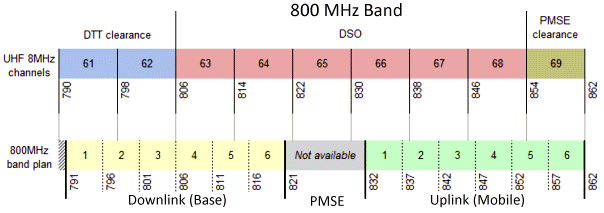 800 MHz band plan for 4G LTE Mobile
FDD (Freq. Division) of 2 x 30MHz (each 30 divided into 6 x 5MHz), 41MHz split
790-791 (1MHz guardband at ch61)
791-821 Base - Downlinks DL1 to DL6
821-832 11MHz "Duplex Gap" to be used (from 1-1-2013) for PMSE, 1mW ERP without licence, or:
823-826 licenced, 20mW EIRP (RIR1009-18)
826-832 licenced, 100mW EIRP (RIR1009-13)
832-862 Mobile - Uplinks UL1 to UL6
NOTES
Analogue TV of the past :
UK System I (1969-2012) - PAL : Offsets of +/- 26.0416 kHz may be used to alleviate co-channel interference
AM Vision carrier at +1.25 (Lower Sideband vestigial)
FMW Sound carrier at +7.25 (sound 6 higher than video - 5.996 actually. 5.9996?) (50kHz deviation FM)
Nicam digital sound at +7.802 (QPSK) first test 1984, introduced summer 1991 on BBC2
(Colour at +5.683)
French System L - Secam : Offsets of +/- 37.5 (?) kHz may be used.
AM Vision carrier at +1.25 (inverted video)
AM Sound carrier at +7.75 (sound 6.5 higher than video)
Nicam digital sound at +7.55
JFMG - ch 21 to 34 - mics and talkback (split +80MHz)
Central London ONLY :
473.275 Camera Data etc. + 473.300, 473.350 1W max
473.400=... Short Term audio links, to 474= 5W max, up to 200kHz
474.0=... Indoor Talkback, to 475= (split -4 : 470= to 471=) 1W max
475.0=... ST links, to 475.25= (as 473.4)
bound.s--ch--sound-
470-478 21 477.25 can be used, remember, for special event PMR - split 4.1 for example
478-486 22 485.25
486-494 23 493.25
494-502 24 501.25 some lists show 500.0 MHz as a mil distress channel. Hmmmm ??!!!
502-510 25 509.25
510-518 26 517.25
518-526 27 525.25
526-534 28 533.25
534-542 29 541.25
542-550 30 549.25
550-558 31 557.25
558-566 32 565.25
566-574 33 573.25
574-582 34 581.25
582-590 35 589.25 + JFMG links and mics (radar on 586 until 1995)
590-598 (36) 597.25 VCRs / Computers etc
594 Aeronautical Radar 50cm - cleared by OFCOM, June 2009
598-606 37 605.25 + JFMG links (was once used for radar on 602, until 1995)
606-614 38 613.25 + JFMG mics
610 Radio Astronomy
614-622 39 621.25 + JFMG talkback (split -80MHz), to 662 NZ 50cm band
622-630 40 629.25
630-638 41 637.25
638-646 42 645.25
646-654 43 653.25
654-662 44 661.25
662-670 45 669.25
670-678 46 677.25
678-686 47 685.25
686-694 48 693.25
694-702 49 701.25 (695-720 talkback)
702-710 50 709.25
710-718 51 717.25
718-726 52 725.25
726-734 53 733.25
734-742 54 741.25
742-750 55 749.25
750-758 56 757.25
758-766 57 765.25
766-774 58 773.25
774-782 59 781.25
782-790 60 789.25
790-798 61 797.25 Military Radio Relay from 790
798-806 62 805.25
806-814 63 813.25
814-822 64 821.25
822-830 65 829.25
830-838 66 837.25
838-846 67 845.25
846-854 68 853.25
854-862 (69) JFMG SAB
862-870 (70) SRD
-854=--------------------------
Channel 69, now part of '800 MHz Band'. Previous life as PMSE :
854=... JFMG ch69 - PMSE, mics, to 862
854.0=... "allocated to a government department", to 854.25=
854.25=.. JFMG up to 1W - mics / talkback / links, to 862
higher powered links at 856.8 and 860.6 - 200kHz b.width, or subdivided to 50kHz channels
mics only at 854.9 855.275 855.9 856.175 856.575 857.625 857.95
858.2 858.65 860.4 860.9 861.2 861.55 861.75 (all 200kHz b.width)
mic channels may be used for talkback subject to appropriate power restictions
858.750 - 859.750 only available to radiomics, indoors - because:
856=... MoD, to 859.75 "500 kHz tactical training radio relay channels"
860.1=... Shared mic channels, available accross UK, to 862=
-862=--------------------------
Channel 70, Euro-harmonised Short Range Devices band, 863 to 870
"mobile except aeronautical mobile service", to 960 (T/R 75-02)
862=... HO, to 863= "Fire Service band" "currently reserved for Fire Service Telemetry"
862.9625 BA telemetry (869.5 for other industry)
863=... Low Band - Audio
Wireless speakers, Cordless headphones, consumer mics, etc ('ch 70' mics), assisted listening
10mW max (300kHz bw) Euro-harmonised 1998
864.8= 50kHz bw, to 865=
ETSI EN 300 220 "This appears to be a sub-band
for 'Narrow band analogue voice' permitted 100% duty cycle at 10mW e.r.p"
http://www.atcb.com/publicdocs/New-CEPT-70-03-Document.pdf
864.8125 1
864.8375 2
864.8625 3
864.8875 4 Calling
864.9125 5
864.9375 6
864.9625 7
864.9875 8
865=... Mid Band - RFID
866... proposed for Asset Tracking, to 868 (to 177-191 MHz CDMA)
867.6.. proposed ETSI paging narrow band returns, to 868.0
868=... High Band - Misc SRD, to 870 - Alarms, telemetry, control and other data
European licence-free LPD Short Range Device (SRD860) two-way radio, max legal power 5mW
on 126 channels in 5 bands
868=... 25mW ...
Band A SRD-860 868.00625-868.59375 48 ch (12.5kHz)
868.6 .. Alarms - 10mW ...
868.7 .. 25mW ...
Band B SRD-860 868.70625-869.19375 40 ch (12.5kHz)
869.2 .. Euro Social Alarms ...
869.25.. Alarms - 10mW ...
869.3... (SRD) ...
Band C2 SRD-860 869.31250-869.38750 4 ch (25kHz)
869.4... 500mW ...
Band C SRD-860 869.41250-869.63750 10 ch (25kHz)
869.65.. Alarms - 25mW ...
869.7... 5mW Cybiko
Band D SRD-860 869.70625-869.99375 24 ch (12.5kHz)
NOTES
869-894 & 824-849 are blocked on RX equipment sold in USA
864.1= .. CT2, to 868.1= phased out. No new equipment after April 2005
864.15 ch 1, to 868.05 ch 40 (100kHz steps) - 10mW 2 level FSK
-870=--------------------------
Mobile
870=... Mobile, usually Dual (870-915 mobile) with 45MHz split to 915-960 (base) ...
870 - 871 Euro-band for ERMES returns
870.0 - 870.6 announced 13.jul.2000
870 - 876 reserved for future TETRA
872 (917)
876 (921) 876.0125... proposed Euro-UIC direct-mode single freq duplex, to 876.0625 (5 x 12.5kHz) 1W
880 (925) 888... SRD, to 889 to be phased out by 2004
890 (935) 898.. ISM +/- 8 MHz
915 (960)
902... unapproved USA cordless phones, to 908 (handsets -90, +19.9 or +24)
Base
915=... Base section, to 960= (split -45: 870-915) Cellphones - GSM Global System for Mobility
915-933 "Army communications training with wide-band Triffid radio relay sets"
915=... reserved for future TETRA, Europe, to 921 (-45: 870-876) (esp 916-917, UK)
919.5=.. future Amateur, to 920= recommended by DSI2 for 2008
921=... UIC, to 925= (by 2005) Euro. Railways GSM-R system
"roll out should start in 2002 and be completed by 2006 ... following a European initiative called EIRENE"
Channel numbers GSM-R 921.2 (ch955).. E-GSM 925.2 (975).. 934.8 (1023).. 935.0 (ch 0).. GSM 935.2 (1)..
921.0.. unused guard band, to 921.1 (see 876 for direct mode)
921.2 first
924.8 last (19th)
925.0 this channel is a wasted 'guard band'
925=... E-GSM - Extended GSM, 925.2 to 935 925-960(:880-915) is UMTS Band VIII
935=... GSM, to 960= (-45: 890-915) (tech, more, more, more, MikeP) [Hear it here!]
935.2 - 959.8 (ch 1-124) TDMA 200kHz channels. Digital duplex. Scrambled. Base continuous, 1.5kW max!
935.2 - 939.6 Vodafone
939.8 - 947 O2 (Cellnet)
947.4 - 954.8 Vodafone
955.2 - 960= O2 (Cellnet)
A cellsite broadcasting on 951.2 may also be using another channel such as 954.8 for traffic
which is why it may not show up on a freq. counter.
Maximum mast-to-phone distance (due to timing limitations) is 35km (8km for 3G).
Find your local antennas with NetMonitor (Nokia)! (Motorola) (*4329 with Trium) (Siemens)
- shows channel number, signal strength in -dBm, distance to mast in 500m steps (during calls), and more!
Latest smart phones (Android) have some free apps that can show you Cell ID numbers and signal strength.
NOTES
917=... ex ETACS/TACS, to 950= 1985 - (phased out by 2005) Cellnet until 1.Oct.2000 Vodafone end of May 2001
917.0125 to 949.9875 (25 kHz duplex channels, 12.5kHz offsets)
917.0125 to 934.9625 ch 1329 to 2047
934.9875 to 949.9875 ch 0 to 600
(Control channels at 935.56-936.06 & 943.06-943.56) [Hear it here!]
917 - 924 Vodafone
925 - 933.1 Cellnet
933.9- 935.1 Vodafone
In 1987 the GSM Directive reserved the use of part of the 900MHz spectrum band for GSM
.. updated in September 2009 by Directive 2009/114/EC to allow more advanced, next generation wireless technologies
to also use this band of the radio spectrum, starting with 3G (UMTS) mobile broadband technology.
930=... CT1+ euro cordless phones, to 932= (split -45) from 1980s to 2002 ( phased out: DEC(01)01 )
930.0125.. 80 x 25kHz channels, to 931.9875 unapproved cordless phones
933=... DSRR, to 935= (Digital Short Range Radio), never happened (Euro plans withdrawn)
Draft idea announced by DTI march 1986, became Euro decision ERC/DEC/(93)01e 12th March 1993
and ETSI standard spec I-ETS 300 168 - max 4W
Base 933-935, -45 split to mobile 888-890
Control channels 933.6625 & 934.3125 : 888.6625 & 889.3125
T/R 20-10 E 1990-93 withdrawn 01 November 1996
934.0125.ex UK CB, to 934.9625 (934/81) (20 channels, 50kHz spacing) 8W 2.Nov.1981 to 31.12.1998 history
Phased out from end of 1988 due to impending DSRR which never came to be,
the 934/81 band became part of ETACS, later Extended GSM.
959=... CT1 euro cordless phones, to 960= (split -45) from 1980s to 2002 ( phased out: DEC(01)01 )
959.0125.. 40 x 25kHz channels, to 959.9875
There is an Amateur 33cm allocation in the USA from 902 to 928 MHz, and 922-927 in NZ (ARRL Bandplans 2012)
-960=--------------------------
Aero. Navigation (DME/IFF),
Military Link16/JTIDS (969-1206) Tactical Data Link / Secure Voice (timeslot divided)
on 969 (single channel) or hopped over 51ch (3MHz spaced), avoiding +/-20MHz around IFF channels.
DME dates back to the 1950s.
966 Astronomy +/-4 MHz
978.... DME Ground reply X channels, to 1087 (paired with 1xx.x0 MHz) (to +63)
978 ADS-B Universal Access Transceivers (air+ground) FAA/US for Euro use by 2012 (1MHz bandwidth)
1025... DME Air mobile channels, to 1150 (1-126 x 1 MHz channels; 1-16 and 60-69 not used)
Selected in aircraft by tuning to a paired channel between 108 and 118 MHz
Pulses transmitted by the aircraft, returned by the ground station & time difference measured.
1104... DME Ground reply Y channels, to 1213 (paired with 1xx.x5 MHz) (to -63)
TACAN is like DME for slant distance measurement
but the return pulses give bearing info instead of using any VHF signal
1030 SSR/IFF (Squalk) Ground (secondary radar - rotating), air reply on 1090 (4MHz bandwidth)
use AM to detect (pulses stand out more over silence than over noise) [Hear it here!]
1164 - 1215 future GPS L5 and Galileo downlinks (WRC 2000)
with 1260-1300 and 5010-5030 - uplinks at 1300-1350 and 5000-5010
-1,215=---microwaves---(1.215 GHz)--------
Mobile, military, radar, navigation, fixed etc...
Rather specialist, wavelengths of less than 30cm really do allow
for high gain antennas, with very narrow beamwidths. Cable losses
become very noticeable and/or untenable. Mobile "flutter" quite
severe, mobile systems need many more base stations to cover a given
area. Most useful uses are direct fixed links, point to point, satellite
(line of sight), low range etc.
So - mostly un-interceptable and/or digital.
1215... Civil airport radar, to 1350 & radiolocation, satellite
1246... Russian GLONASS GPS L2, 0-12: 1246+n(0.4375) see 1602
23cm [checked and updated 2012] (RSGB Bandplan 2012)
1240=... Amateur 23cm band, to 1325= CW,SSB/FM/TV secondary
1240=... Alternative Narrowband/Beacon...
1240.75 FM/DV repeaters in (see 1249)
1241=... Data...
1242=... ATV repeaters in (see 1300)...
1249=... FM/DV repeaters (spit -8.25 :1240.775...) future use
1249.025 to 1249.225
1249.25=...
1250=... CAUTION to avoid interefence to Primary User...
1260-1270 Amateur Satellite uplinks
1290=...
1290.994= repeaters in (see 1297)...
1291.494=... All modes
1296=... Preferred Narrowband Segment, to 1297 (MGM=Machine Generated Mode)
1296... CW,MGM...
1296.0...EME, to 1296.025
1296.138 PSK31
1296.15.. SSB,CW,MGM...
1296.2 Centre of Activity
1296.4.. Linear transponder input, to 1296.6
1296.5 Image Mode Centre of Activity (SSTV, Fax etc)
1296.6 Narrowband Data Centre of Activity (MGM, RTTY etc)
1296.6.. Linear transponder output, to 1296.7
1296.75.. Beacons...
1297... FM/DV repeaters RM0 to RM19 (split -6 :1291..)
1297.0 RM0 GB3NO Norwich
1297.025 RM1 (not in use)
1297.05 RM2 GB3FM Farnham
1297.075 RM3 GB3PS Royston, GB3SE Stoke-on-Trent
1297.1 RM4 (not in use)
1297.125 RM5 (not in use)
1297.15 RM6 GB3MM Wolverhampton
1297.35 RM14A :1277.35 (-20) GB3AK Alveston
1297.375 RM15 GB3WC Flockton
(1297.475 RM19 not in UK yet, like others not listed)
1297.5.. FM/DV simplex, to 1298=
1297.50 SM20 FM calling
to
1297.725 SM29 DV calling
1297.75 SM30
1297.9 Voice Gateways, to 1297.975
1298=... All Modes, to 1299= General mixed analogue/digital in 25kHz ch:
1298.025 RS1
to 1298.275..German repeaters, to 1298.65 (split -28 :1270..)
1298.975 RS39 1298.025..French repeaters, to 1298.70 (split -28 :1270..)
1299=... Data...
1299.75= FM/DV 25kHz ch:
1299.775
to 1299.85 RM0A :1293.85 (-6) GB3BK Romley
1299.975
1300=... ATV
TV repeater outputs from 1985 (UK)
-1325= ---
-1,350=------------------
1,350=...Civil fixed links (split +142: 1492-1517) new. JRC links
1370..Radioastronomy, to 1400
1,375=...Govt / MoD links (split +52: 1427-1452)
"radio relay training... wide-band surveillance, video, data links, aeronautical telemetry"
1394 Civil video links - MPT 1349 standard (band 1389-1399)
1,400=...Transmission Prohibited
Astronomy, Space Research, SETI, Hydrogen Line. Certain frequencies around here
propagate very well through the universe, so the boffins listen here for extra-
terrestial transmissions. But surely the little grey men are doing the same thing?
1420 SETI@Home (+/-1.25MHz)
1,427=...Govt links (split -52: 1375-1400)
1450... Civil links, to 1467.5 (split +62.5: 1512.5-1530.0) x
1,452=...L-Band DAB & links
DAB "23 blocks of spectrum available... 9 of these blocks have been made available for terrestrial use
using the Eureka 147 technology... availability of the band is not assured until 2007...
The remaining 14 blocks are currently earmarked in CEPT for satellite digital radio."
LA 1452.192-1453.728
LB 1453.904-1455.440
LC 1455.616-1457.152
LD 1457.328-1458.864
LE 1459.040-1460.576
LF 1460.752-1462.288
LG 1462.464-1464.000
LH 1464.176-1465.712
LI 1465.888-1467.424
& Worldspace digital satellite broadcasting 1467-1492 (7025-7075 MHz uplinks) more
3 sat.s, each with 3 beams of 2 TDM carriers (one left, one right circular pol.)
TDMs are QPSK modulated, overall rate of 3.68 Mbit/s - 96 so called Prime Rate Channels
(PRCs) having 16 kbit/s each. MP3 audio coding. 2.3MHz TDM sep. detail
Receivers cover 1453.384 to 1490.644 MHz (52 centers currently: 1467.184-1490.644, 0.460 MHz steps)
Orbital positions :
AfriStar 21 East - 1469R 1471L 1478R 1481L (MHz & Pol) details
AsiaStar 105 East - 1473R 1475L 1478L 1480R 1488R 1490L details
AmeriStar 95 West - (2002) (details)
1467.5..Civil links, to 1472.5 (split +40.0: 1507.5-1512.5) x
1488.25..JFMG links, to 1490.75
1,492=...Civil fixed links (split -142: 1350-1375)
1507.5..Civil links, to 1512.5 (split -40.0: 1467.5-1472.5) x
1512.5..Civil links, to 1530 (split -62.5: 1450.0-1467.5) x
1,517=...Civil links, JFMG, one-way, possible future MSS expansion
1517... JFMG, ant. restrictions : 1517.25 Horizontal 1517.75 Vertical
1518... JFMG, to 1525 available until further notice from OFCOM
1,525=...Satellite comms downlinks - Inmarsat GMDSS etc (uplinks 1626.5-1660.5) (+101.5) more SpaceChecker
Thuraya (digital) - (Feeder Links E-S 6425-6725MHz, S-E 3400-3625MHz)
1535-1544 30kHz FM comms, 25kHz steps : 1535.025... ch 001, to 1543.475 ch 339
1,559=...Radionavigation, to 1626.5=
1,575.42 Navstar GPS Nav L1 C/A (military accuracy with 1227.6 L2 +/-14MHz) spread (20,231km orbit)
The L1 carrier is modulated by all three GPS data streams, C/A, P and Nav/System Data.
The L2 carrier is modulated by two GPS data streams, P-code and Nav/System Data.
The L3 carrier 1381.05 MHz is a non-navigation signal associated with nuclear burst detection.
L4 is 1379.913 MHz (1841.4 MHz had been considered)
L5 1176.45 MHz (third 'civil' signal) band 1166-1186
1,602... Russian GLONASS L1, 0-12: 1602+n(0.5625) spread spectrum
1,610=...Mobile-satellite systems, uplinks (down at -101.5)
1,610=...LEO MSS, to 1626.5= (up&down) CDMA i.e. Globalstar, Iridium (TDMA, 780km up)
1,645.5..Distress EPIRBs, to 1646.5 (Inmarsat E) 1645.6-1645.8?
1,660.5=.Radioastronomy, to 1668
1,668=...H.O. links (with 1698-1700)
1,670=...TFTS ground stations (see 1800), possible future MSS (TFTS "1670.5 and 1671.5")
Sondes (met & mil), to 1690
1,675=...Meteo satellite, to 1710
1,677=...H.O. mobile applications, to 1685
1,683=...possible future MSS, to 1690
1,690=...Weather Satellite HRPT (Hi-res pics), to 1710= NOAA, GOES, MeteoSat. EUMETSAT:
1675.181 DCP, to 1675.381 - 3kHz b/w
1675.929 PCM telemetry - 30kHz b/w
1686.833 DATTS format - 660kHz bandwidth / Burst PCM 5.4MHz b/w
1691 A1 20.5dBW
1694.5 A2 19dBW
HRI 660kHz b/w, WEEFAX 26kHz b/w
MDD ch1 1695.6438, ch2 1695.7250, ch 3 1695.7562, ch4 1695.7874 +/- 15.6kHz (360kHz b/w)
1,698=...H.O. links, to 1700 (with 1668-1670)
1,710=...links, radioastronomy, Skynet uplinks, PCN mobile phones, to 1880= :
1,785=...JFMG 50mW, to 1800=
1785.7...radio mics, to 1799.3
1790=... secondary to H.O. links, to 1798
1,800.30.TFTS in-flight digital phones (air-ground), to 1804.969 (164 x 30.303 kHz channels : ground at -130)
To be withdrawn (2002 decision) and kept for harmonised use, probably MSS
1,805=...PCN mobile phone system GSM 1800, to 1880= (split -95: 1710-1785) UMTS Band III
Standard : 1805.2 to 1879.8 (374x TDMA 200kHz channels) Digital duplex. Scrambled. Base continuous. info.
Channels numbered 512-885 Foreign GSM 1900 (split -80) : 1930.2 (512) - 1989.8 (810)
1805.2 - 1810.8 O2 (Cellnet) (ex 1805-1807.5 TFTS guard)
(1807.5-1815.5 H.O. Fixed links split: +494.5)
1811 - 1816.6 Vodafone
1816.8 - 1846.6 T Mobile (One 2 One) (ex 1820-1860 links, split: -110)
1846.8 - 1876.6 Orange
1876.7=- 1880= guard-band to protect DECT
(1873.5-1897.5) offshore Fixed Links (split: -108)
1,880=...DECT Digital Euro. Cordless Telephones, to 1900=
1881.792..ch1, to 1897.344 ch10 (steps of 1.728 MHz) encrypted, base continuous (pulses), less than 250mW
Single Freq. Duplex (Digital TDMA) - supporting 12 conversations at once per channel
1,900=...future UMTS, to 1980= (with 2110-2170) IMT-2000, FPLMTS 3G 3rd generation mobile issues
"licences will comprise three of (2x10)+5MHz (C,D,E), one of 2x15MHz (B) and one of (2x15)+5 MHz (A)."
WRC 2000 added 806-960, 1710-1885, 2500-2690 (Satellite 2500-2520 & 2670-2690),
and for satellite: 1525-1544 & 1545-1559, 1610-1626.5 & 1626.5-1645.5 & 1646.5-1660.5, 2483.5-2500
1900=.. single, to 1920=
1902.4 D
1907.4 E
1912.4 C
1917.4 A
1919.9= guardband, to 1920=
1920=.. paired, to 1980= mobile/uplink see +190 (2110-2170)
1,980=...MSS, to 2010
2,010=...3G licence-exempt band, to 2025 (first carrier 2013 or higher, last 2022.2)
2,025=...FWA, to 2110 (with 2200-2290) "2 x 45 MHz identified by CEPT as harmonised bands for tactical radio relay."
JFMG 20-100W Not within 5km of Bude or Menwith Hill
2,110=...3G Base/Downlink, to 2170= (split -190: 1920-1980) 12 x 5MHz channels on a 0.2MHz raster (some overlap)
2110.0= guardband, to 2110.3= freq. = 2075.2 + (ch * 0.2) Dec(99)25 UMTS Band I
2112.8 A (A has 14.6MHz) 2112.8 is lowest allowed carrier (ch 188), 2167.2 highest (ch 460)
2117.6 A
2122.4 A
2124.9=
2127.4 C (C has 10MHz)
2132.4 C
2134.9=
2137.4 B
2142.? B (B has 14.8MHz) must be 5MHz between operators, less is OK for one operator
2147.2 B
2149.7=
2152.2 D (D&E have 10MHz each)
2157.2 D
2162.2 E
2167.2 E
2169.7= guardband, to 2170.0=
2,170=...MSS, to 2200 (and 1980-2010)
2,200=...SKYNET satellites telemetry downlinks, to 2290
"Sat. Telecommand, Telemetry and Control (TT&C) ... at 1760 - 1840 MHz for the command uplinks"
2,300... Airborne Telemetry, to 2330 (extension to 2400)
2,310=...Ham 13cm band, to 2,450= (2360 UK Police A-G Video?)
"military fixed, telemetry and mobile.. long-range airborne telemetry links are particularly protected."
2,400=...deregulated band, to 2483.5 (WiFi 802.11b 11Mbps, 802.11g 54Mbps)
Some FWA in Scotland
JFMG video links & cameras, to 2.68 (20MHz channels?) (+ some video senders)
2402.. Bluetooth digital SRD ch0, to 2480 ch78 (79 x 1MHz channels) within 2401.5= to 2480.5=
1600 hops per sec over 32 channels
2402.. FHSS ch2, to 2480 ch80
2403.. HomeRF, to 2477 (75 x 1MHz OR 5 x 15MHz channels)
2446.. Auto.Vehic.Ident. (500mW) and RFID (up to 4W), to 2454
2450 ISM, your microwave oven (2455). Really.
PRR Personal Role Radio (mil) more (435MHz remote PTT)
"2,400 - 2483 MHz, 256 Channels available, 100 mW, QPSK (Direct Sequence Spread Spectrum)"
2,483.5=.MSS, to 2500=
2,500=...see 2,620
2,570=...UMTS TDD, to 2,620
2,620=...UMTS Band VIII, FDD IMT-E, to 2,690= (split -120: 2500-2570) 4G LTE 14 x 5MHz ch?
2,700=...Radar, to 3100 - 10cm band
2700-2900 "airfield surveillance and traffic control radars for civil aviation, and military airfields."
2900-3100 "Civil maritime, air traffic control and range safety radars, together with naval radars."
3.100=...Mil radio location, to 3400
"heavily used for high-powered land, airborne and naval radars with a considerable geographical spread"
3400-3600 "MoD assigns some frequencies for airborne and naval radars and for radar development."
"also agreed to civil use of this band for mobile TV Outside Broadcasts and for civil FWA."
3,400=...Ham 9cm band, to 3,475=
3,442=...Police helicopter video downlinks, to 3475
3,475.6=.FWA/RFA/RLL, to 3,492.688 (split -50: 3425-3442) used by Ionica 1993-??(97?)
2001 report : 3425-3442 paired with 3476-3493, 2x17MHz (51MHz duplex)
3,500=...PMSE, to 3600 - 5 video channels
3,605=...FWA, to 3689 (3925-4009) 2x36MHz "currently used by Tele-2"
3,675=...C-Band satellite TV, to 4,200=
4,200=...Mil/Civil aircraft precision radar altimeters and ground proximity warning systems, to 4400=
4,400=...NATO harmonised military fixed and mobile services, to 5000= "fixed links between military establishments"
"wide-band channels for 'down-the-hill' high capacity links for tactical area communications systems."
Future tropospheric scatter systems, wideband, "ranges in excess of 300 kilometres"
5,000=...Microwave Landing System, to 5,150=
5,150=...RLAN Short Range High Data Rate Nomadic Equipment, to 5,875=
(802.11a), to 5350
5,250=...EESS, to 5460
5,350=...radar... "Military tactical radars use 5250-5850 for short to medium range functions"
5,650=...Ham 6cm band, to 5,850=
5,795=...RTTT (Road to vehicle systems), to 5.805 (possibly to 5.815) tolls etc. DEC(02)01
with 63-64 GHz (vehicle-to-vehicle or road-to-vehicle) and 76-77 GHz (radar)
7,125=...Fixed to 8500 - ERO prefered channels
7,250=...UK SKYNET fixed satellite down-links (MSS down at 7250-7300), to 7750
"The up-link is engineered at 7900-8400 with 7900-7950 MHz for MSS up-links"
"the primary military link to UK forces overseas. The satellite allocation is a harmonised NATO band"
Mil. downlink band 7300-7750 MHz is shared with civil fixed links
8500-10125 "allocated to the radiolocation service although the band 9300-9500 is primarily
for radio navigation. The band is widely used for military radars including battlefield radar,
surveillance radars at ranges and MoD DPA sites, precision approach radars at many airfields and
on naval vessels for missile control and tracking. Assignments exist also for wide band data links"
9,000 Radar, to 9500 - 3cm band
10,000=...Ham 3cm band, to 10,150= - and 10,300= to 10,500=
10,065 TV repeater o/p
FWA service at 10.125-10.225 paired with 10.475-10.575
"MoD manages the band 10.125-10.5 GHz for high discrimination radars, some of which are in development
or on trial, and airborne data links"
10,500 SRD - movement detectors
10,680=...Space research, to 10.7=
-10,700=--(10.7 GHz)-----------
Satellite TV, Ku band - Astra,Eutelsat,Intelsat etc. (35,876km up)
"FREE TO AIR Mpeg2 SATELLITE RADIO" (with bit rates)
10,700=..FSS (fixed sat. service)
11,700=..BSS (DBS - Band VI)
12,500=..Telecom
-12,750=-----------------------
These are really small radio wavelengths...
Fixed links - 23/25/38GHz bands, 32, 51.4-52.6, 55.78-59
13,250=.."aeronautical radio navigation and radiolocation. The band is widely used for
airborne doppler radars and naval radars", to 14=
14,620=..harmonised NATO band, to 15.23 - "fixed and mobile communications and airborne data links.
The band is also used for short-range radio relay and fixed links"
15,700=..MoD, to 17.3 - "wideband data, command links, trial radars, survey, distance measuring and
civil airfield movement control radar devices" 15.7-17.1 NATO harmonised
20,200=..harmonised NATO band, to 21.2 "planned for down-link military mobile satellite systems,
paired with the up-links at 43.5-45.5 GHz ... some USAF systems use this band in the UK."
"There is great pressure for this band to be used for civil satellite systems of non-NATO countries"
24,000=..Ham 12mm band, to 24.25= and SRD movement detectors
26,500=..NATO harmonised, to 27.5= fixed and mobile "planned for wide band systems"
27,500=..Fixed/Fixed Satellite '28GHz Band', to 29.5=
28-28.5 BFWA Broadband Fixed Wireless Access, with 29-29.5 'forward and return channels of 112 MHz'
(28.0525-28.4445 with 29.0605-29.4525)
29,500=..Satellite Interactive Terminals, to 30=
30,000=..NATO harmonised, to 31= no MoD use but paired with 20.2-21.2
31,300=..EESS, Space Research, Radioastronomy, to 31.8
31,800=..Fixed Links, to 33.4 "All SRDs are to be withdrawn from this band by 31st December 2003"
33,400=..NATO harmonised radiolocationn, to 36= "Naval, land and airborne tracking radars"
36,000=..NATO harmonised, to 37= "military fixed and mobile services: there is no current use"
39,500=..NATO harmonised, to 40.5= "planned for satellite systems.. paired with 50.4-51.4 .. no current use"
40,500=..future ITC 7mm MVDS Multipoint Video Distribution, to 42.5=
47,000=..Ham 6mm band, to 47,200=
59,000=..UK : fixed, mobile and radiolocation services, to 64= "MoD manages the mobile and radiolocation usage"
59 - 61 NATO harmonised
63,000 2nd Phase Road Traffic and Transport Telematics
71,000=..Fixed, Fixed satellite, Mobile, and Mobile satellite services, to 74
75,500=..Ham 4mm band, to 76,000= until 31.dec.2006
76,000 Vehicle Radar Systems
77,000=..MoD Radiolocation. to 81= "Trials are current"
77,500=..Ham 4mm band, to 78,000= from 1.jan.2003 (and 78-81 secondary)
81,000=..Fixed, Fixed satellite, Mobile, and Mobile satellite services, to 84
86,000=..EESS, Space Research, to 92=
92,000=..Fixed, Fixed satellite, Mobile and Radiolocation services, to 95= Mod "Trials are current"
95,000=..Mobile, Mobile satellite, Radio navigation satellite, short range radiolocation devices, to 100=
134,000=..Ham 2mm band, to 136,000= from 1.jan.2003 (and 122.25-123 + 136-141 secondary)
142,000=..Ham 2mm band, to 144,000= until 31.dec.2006
248,000=..Ham 1.2mm band, to 250,000= (and from 2003, 241-248 GHz secondary)
Radio or Far Infra-Red? There's a bit of overlap near 1mm wavelengths...
-275,000=-----(275 GHz)--------
Far Infra-Red, to 25,000 GHz (over 1mm to 12µm)
-25,000,000=--(25 THz)---------
Infra-red
-441 THz=----------------------
Visible wavelengths. Otherwise known as "Light". Red to Violet (680-420nm)
Some of my favourite frequencies. Green is rather nice.
-714 THz=----------------------
Near Ultraviolet. 300nm-180nm
http://ledmuseum.home.att.net/ledleft.htm
370-390nm Ultraviolet
400-418nm Violet
430-485nm Blue
495-505nm Turquoise
525nm Green
555-575mn Yellow/Green
585-595nm Yellow
595-605nm Amber
605-620nm Orange
620-635nm Orange/Red
640-700nm Red
700-1300nm Infra-red
-1,666 THz=--------------------
Far Ultraviolet 180nm-91nm
-3,289 THz=--------------------
Extreme Ultraviolet 91nm-10nm
912-100 Angstroms
(or UV A 380-320nm, UV B 320-290nm (middle), UV C 290-10nm)
-30,000,000,000=--(30 PHz)-----
X-rays 10nm-10pm
100-0.1 Angstroms
-30,000,000,000,000=-(30 EHz)--
Gamma rays 10pm-100fm and beyond
That's enough. Obsessive? Me? Hehe.. wonder what a "profiler" would say about all this!
800 MHz band plan for 4G LTE Mobile
FDD (Freq. Division) of 2 x 30MHz (each 30 divided into 6 x 5MHz), 41MHz split
790-791 (1MHz guardband at ch61)
791-821 Base - Downlinks DL1 to DL6
821-832 11MHz "Duplex Gap" to be used (from 1-1-2013) for PMSE, 1mW ERP without licence, or:
823-826 licenced, 20mW EIRP (RIR1009-18)
826-832 licenced, 100mW EIRP (RIR1009-13)
832-862 Mobile - Uplinks UL1 to UL6
NOTES
Analogue TV of the past :
UK System I (1969-2012) - PAL : Offsets of +/- 26.0416 kHz may be used to alleviate co-channel interference
AM Vision carrier at +1.25 (Lower Sideband vestigial)
FMW Sound carrier at +7.25 (sound 6 higher than video - 5.996 actually. 5.9996?) (50kHz deviation FM)
Nicam digital sound at +7.802 (QPSK) first test 1984, introduced summer 1991 on BBC2
(Colour at +5.683)
French System L - Secam : Offsets of +/- 37.5 (?) kHz may be used.
AM Vision carrier at +1.25 (inverted video)
AM Sound carrier at +7.75 (sound 6.5 higher than video)
Nicam digital sound at +7.55
JFMG - ch 21 to 34 - mics and talkback (split +80MHz)
Central London ONLY :
473.275 Camera Data etc. + 473.300, 473.350 1W max
473.400=... Short Term audio links, to 474= 5W max, up to 200kHz
474.0=... Indoor Talkback, to 475= (split -4 : 470= to 471=) 1W max
475.0=... ST links, to 475.25= (as 473.4)
bound.s--ch--sound-
470-478 21 477.25 can be used, remember, for special event PMR - split 4.1 for example
478-486 22 485.25
486-494 23 493.25
494-502 24 501.25 some lists show 500.0 MHz as a mil distress channel. Hmmmm ??!!!
502-510 25 509.25
510-518 26 517.25
518-526 27 525.25
526-534 28 533.25
534-542 29 541.25
542-550 30 549.25
550-558 31 557.25
558-566 32 565.25
566-574 33 573.25
574-582 34 581.25
582-590 35 589.25 + JFMG links and mics (radar on 586 until 1995)
590-598 (36) 597.25 VCRs / Computers etc
594 Aeronautical Radar 50cm - cleared by OFCOM, June 2009
598-606 37 605.25 + JFMG links (was once used for radar on 602, until 1995)
606-614 38 613.25 + JFMG mics
610 Radio Astronomy
614-622 39 621.25 + JFMG talkback (split -80MHz), to 662 NZ 50cm band
622-630 40 629.25
630-638 41 637.25
638-646 42 645.25
646-654 43 653.25
654-662 44 661.25
662-670 45 669.25
670-678 46 677.25
678-686 47 685.25
686-694 48 693.25
694-702 49 701.25 (695-720 talkback)
702-710 50 709.25
710-718 51 717.25
718-726 52 725.25
726-734 53 733.25
734-742 54 741.25
742-750 55 749.25
750-758 56 757.25
758-766 57 765.25
766-774 58 773.25
774-782 59 781.25
782-790 60 789.25
790-798 61 797.25 Military Radio Relay from 790
798-806 62 805.25
806-814 63 813.25
814-822 64 821.25
822-830 65 829.25
830-838 66 837.25
838-846 67 845.25
846-854 68 853.25
854-862 (69) JFMG SAB
862-870 (70) SRD
-854=--------------------------
Channel 69, now part of '800 MHz Band'. Previous life as PMSE :
854=... JFMG ch69 - PMSE, mics, to 862
854.0=... "allocated to a government department", to 854.25=
854.25=.. JFMG up to 1W - mics / talkback / links, to 862
higher powered links at 856.8 and 860.6 - 200kHz b.width, or subdivided to 50kHz channels
mics only at 854.9 855.275 855.9 856.175 856.575 857.625 857.95
858.2 858.65 860.4 860.9 861.2 861.55 861.75 (all 200kHz b.width)
mic channels may be used for talkback subject to appropriate power restictions
858.750 - 859.750 only available to radiomics, indoors - because:
856=... MoD, to 859.75 "500 kHz tactical training radio relay channels"
860.1=... Shared mic channels, available accross UK, to 862=
-862=--------------------------
Channel 70, Euro-harmonised Short Range Devices band, 863 to 870
"mobile except aeronautical mobile service", to 960 (T/R 75-02)
862=... HO, to 863= "Fire Service band" "currently reserved for Fire Service Telemetry"
862.9625 BA telemetry (869.5 for other industry)
863=... Low Band - Audio
Wireless speakers, Cordless headphones, consumer mics, etc ('ch 70' mics), assisted listening
10mW max (300kHz bw) Euro-harmonised 1998
864.8= 50kHz bw, to 865=
ETSI EN 300 220 "This appears to be a sub-band
for 'Narrow band analogue voice' permitted 100% duty cycle at 10mW e.r.p"
http://www.atcb.com/publicdocs/New-CEPT-70-03-Document.pdf
864.8125 1
864.8375 2
864.8625 3
864.8875 4 Calling
864.9125 5
864.9375 6
864.9625 7
864.9875 8
865=... Mid Band - RFID
866... proposed for Asset Tracking, to 868 (to 177-191 MHz CDMA)
867.6.. proposed ETSI paging narrow band returns, to 868.0
868=... High Band - Misc SRD, to 870 - Alarms, telemetry, control and other data
European licence-free LPD Short Range Device (SRD860) two-way radio, max legal power 5mW
on 126 channels in 5 bands
868=... 25mW ...
Band A SRD-860 868.00625-868.59375 48 ch (12.5kHz)
868.6 .. Alarms - 10mW ...
868.7 .. 25mW ...
Band B SRD-860 868.70625-869.19375 40 ch (12.5kHz)
869.2 .. Euro Social Alarms ...
869.25.. Alarms - 10mW ...
869.3... (SRD) ...
Band C2 SRD-860 869.31250-869.38750 4 ch (25kHz)
869.4... 500mW ...
Band C SRD-860 869.41250-869.63750 10 ch (25kHz)
869.65.. Alarms - 25mW ...
869.7... 5mW Cybiko
Band D SRD-860 869.70625-869.99375 24 ch (12.5kHz)
NOTES
869-894 & 824-849 are blocked on RX equipment sold in USA
864.1= .. CT2, to 868.1= phased out. No new equipment after April 2005
864.15 ch 1, to 868.05 ch 40 (100kHz steps) - 10mW 2 level FSK
-870=--------------------------
Mobile
870=... Mobile, usually Dual (870-915 mobile) with 45MHz split to 915-960 (base) ...
870 - 871 Euro-band for ERMES returns
870.0 - 870.6 announced 13.jul.2000
870 - 876 reserved for future TETRA
872 (917)
876 (921) 876.0125... proposed Euro-UIC direct-mode single freq duplex, to 876.0625 (5 x 12.5kHz) 1W
880 (925) 888... SRD, to 889 to be phased out by 2004
890 (935) 898.. ISM +/- 8 MHz
915 (960)
902... unapproved USA cordless phones, to 908 (handsets -90, +19.9 or +24)
Base
915=... Base section, to 960= (split -45: 870-915) Cellphones - GSM Global System for Mobility
915-933 "Army communications training with wide-band Triffid radio relay sets"
915=... reserved for future TETRA, Europe, to 921 (-45: 870-876) (esp 916-917, UK)
919.5=.. future Amateur, to 920= recommended by DSI2 for 2008
921=... UIC, to 925= (by 2005) Euro. Railways GSM-R system
"roll out should start in 2002 and be completed by 2006 ... following a European initiative called EIRENE"
Channel numbers GSM-R 921.2 (ch955).. E-GSM 925.2 (975).. 934.8 (1023).. 935.0 (ch 0).. GSM 935.2 (1)..
921.0.. unused guard band, to 921.1 (see 876 for direct mode)
921.2 first
924.8 last (19th)
925.0 this channel is a wasted 'guard band'
925=... E-GSM - Extended GSM, 925.2 to 935 925-960(:880-915) is UMTS Band VIII
935=... GSM, to 960= (-45: 890-915) (tech, more, more, more, MikeP) [Hear it here!]
935.2 - 959.8 (ch 1-124) TDMA 200kHz channels. Digital duplex. Scrambled. Base continuous, 1.5kW max!
935.2 - 939.6 Vodafone
939.8 - 947 O2 (Cellnet)
947.4 - 954.8 Vodafone
955.2 - 960= O2 (Cellnet)
A cellsite broadcasting on 951.2 may also be using another channel such as 954.8 for traffic
which is why it may not show up on a freq. counter.
Maximum mast-to-phone distance (due to timing limitations) is 35km (8km for 3G).
Find your local antennas with NetMonitor (Nokia)! (Motorola) (*4329 with Trium) (Siemens)
- shows channel number, signal strength in -dBm, distance to mast in 500m steps (during calls), and more!
Latest smart phones (Android) have some free apps that can show you Cell ID numbers and signal strength.
NOTES
917=... ex ETACS/TACS, to 950= 1985 - (phased out by 2005) Cellnet until 1.Oct.2000 Vodafone end of May 2001
917.0125 to 949.9875 (25 kHz duplex channels, 12.5kHz offsets)
917.0125 to 934.9625 ch 1329 to 2047
934.9875 to 949.9875 ch 0 to 600
(Control channels at 935.56-936.06 & 943.06-943.56) [Hear it here!]
917 - 924 Vodafone
925 - 933.1 Cellnet
933.9- 935.1 Vodafone
In 1987 the GSM Directive reserved the use of part of the 900MHz spectrum band for GSM
.. updated in September 2009 by Directive 2009/114/EC to allow more advanced, next generation wireless technologies
to also use this band of the radio spectrum, starting with 3G (UMTS) mobile broadband technology.
930=... CT1+ euro cordless phones, to 932= (split -45) from 1980s to 2002 ( phased out: DEC(01)01 )
930.0125.. 80 x 25kHz channels, to 931.9875 unapproved cordless phones
933=... DSRR, to 935= (Digital Short Range Radio), never happened (Euro plans withdrawn)
Draft idea announced by DTI march 1986, became Euro decision ERC/DEC/(93)01e 12th March 1993
and ETSI standard spec I-ETS 300 168 - max 4W
Base 933-935, -45 split to mobile 888-890
Control channels 933.6625 & 934.3125 : 888.6625 & 889.3125
T/R 20-10 E 1990-93 withdrawn 01 November 1996
934.0125.ex UK CB, to 934.9625 (934/81) (20 channels, 50kHz spacing) 8W 2.Nov.1981 to 31.12.1998 history
Phased out from end of 1988 due to impending DSRR which never came to be,
the 934/81 band became part of ETACS, later Extended GSM.
959=... CT1 euro cordless phones, to 960= (split -45) from 1980s to 2002 ( phased out: DEC(01)01 )
959.0125.. 40 x 25kHz channels, to 959.9875
There is an Amateur 33cm allocation in the USA from 902 to 928 MHz, and 922-927 in NZ (ARRL Bandplans 2012)
-960=--------------------------
Aero. Navigation (DME/IFF),
Military Link16/JTIDS (969-1206) Tactical Data Link / Secure Voice (timeslot divided)
on 969 (single channel) or hopped over 51ch (3MHz spaced), avoiding +/-20MHz around IFF channels.
DME dates back to the 1950s.
966 Astronomy +/-4 MHz
978.... DME Ground reply X channels, to 1087 (paired with 1xx.x0 MHz) (to +63)
978 ADS-B Universal Access Transceivers (air+ground) FAA/US for Euro use by 2012 (1MHz bandwidth)
1025... DME Air mobile channels, to 1150 (1-126 x 1 MHz channels; 1-16 and 60-69 not used)
Selected in aircraft by tuning to a paired channel between 108 and 118 MHz
Pulses transmitted by the aircraft, returned by the ground station & time difference measured.
1104... DME Ground reply Y channels, to 1213 (paired with 1xx.x5 MHz) (to -63)
TACAN is like DME for slant distance measurement
but the return pulses give bearing info instead of using any VHF signal
1030 SSR/IFF (Squalk) Ground (secondary radar - rotating), air reply on 1090 (4MHz bandwidth)
use AM to detect (pulses stand out more over silence than over noise) [Hear it here!]
1164 - 1215 future GPS L5 and Galileo downlinks (WRC 2000)
with 1260-1300 and 5010-5030 - uplinks at 1300-1350 and 5000-5010
-1,215=---microwaves---(1.215 GHz)--------
Mobile, military, radar, navigation, fixed etc...
Rather specialist, wavelengths of less than 30cm really do allow
for high gain antennas, with very narrow beamwidths. Cable losses
become very noticeable and/or untenable. Mobile "flutter" quite
severe, mobile systems need many more base stations to cover a given
area. Most useful uses are direct fixed links, point to point, satellite
(line of sight), low range etc.
So - mostly un-interceptable and/or digital.
1215... Civil airport radar, to 1350 & radiolocation, satellite
1246... Russian GLONASS GPS L2, 0-12: 1246+n(0.4375) see 1602
23cm [checked and updated 2012] (RSGB Bandplan 2012)
1240=... Amateur 23cm band, to 1325= CW,SSB/FM/TV secondary
1240=... Alternative Narrowband/Beacon...
1240.75 FM/DV repeaters in (see 1249)
1241=... Data...
1242=... ATV repeaters in (see 1300)...
1249=... FM/DV repeaters (spit -8.25 :1240.775...) future use
1249.025 to 1249.225
1249.25=...
1250=... CAUTION to avoid interefence to Primary User...
1260-1270 Amateur Satellite uplinks
1290=...
1290.994= repeaters in (see 1297)...
1291.494=... All modes
1296=... Preferred Narrowband Segment, to 1297 (MGM=Machine Generated Mode)
1296... CW,MGM...
1296.0...EME, to 1296.025
1296.138 PSK31
1296.15.. SSB,CW,MGM...
1296.2 Centre of Activity
1296.4.. Linear transponder input, to 1296.6
1296.5 Image Mode Centre of Activity (SSTV, Fax etc)
1296.6 Narrowband Data Centre of Activity (MGM, RTTY etc)
1296.6.. Linear transponder output, to 1296.7
1296.75.. Beacons...
1297... FM/DV repeaters RM0 to RM19 (split -6 :1291..)
1297.0 RM0 GB3NO Norwich
1297.025 RM1 (not in use)
1297.05 RM2 GB3FM Farnham
1297.075 RM3 GB3PS Royston, GB3SE Stoke-on-Trent
1297.1 RM4 (not in use)
1297.125 RM5 (not in use)
1297.15 RM6 GB3MM Wolverhampton
1297.35 RM14A :1277.35 (-20) GB3AK Alveston
1297.375 RM15 GB3WC Flockton
(1297.475 RM19 not in UK yet, like others not listed)
1297.5.. FM/DV simplex, to 1298=
1297.50 SM20 FM calling
to
1297.725 SM29 DV calling
1297.75 SM30
1297.9 Voice Gateways, to 1297.975
1298=... All Modes, to 1299= General mixed analogue/digital in 25kHz ch:
1298.025 RS1
to 1298.275..German repeaters, to 1298.65 (split -28 :1270..)
1298.975 RS39 1298.025..French repeaters, to 1298.70 (split -28 :1270..)
1299=... Data...
1299.75= FM/DV 25kHz ch:
1299.775
to 1299.85 RM0A :1293.85 (-6) GB3BK Romley
1299.975
1300=... ATV
TV repeater outputs from 1985 (UK)
-1325= ---
-1,350=------------------
1,350=...Civil fixed links (split +142: 1492-1517) new. JRC links
1370..Radioastronomy, to 1400
1,375=...Govt / MoD links (split +52: 1427-1452)
"radio relay training... wide-band surveillance, video, data links, aeronautical telemetry"
1394 Civil video links - MPT 1349 standard (band 1389-1399)
1,400=...Transmission Prohibited
Astronomy, Space Research, SETI, Hydrogen Line. Certain frequencies around here
propagate very well through the universe, so the boffins listen here for extra-
terrestial transmissions. But surely the little grey men are doing the same thing?
1420 SETI@Home (+/-1.25MHz)
1,427=...Govt links (split -52: 1375-1400)
1450... Civil links, to 1467.5 (split +62.5: 1512.5-1530.0) x
1,452=...L-Band DAB & links
DAB "23 blocks of spectrum available... 9 of these blocks have been made available for terrestrial use
using the Eureka 147 technology... availability of the band is not assured until 2007...
The remaining 14 blocks are currently earmarked in CEPT for satellite digital radio."
LA 1452.192-1453.728
LB 1453.904-1455.440
LC 1455.616-1457.152
LD 1457.328-1458.864
LE 1459.040-1460.576
LF 1460.752-1462.288
LG 1462.464-1464.000
LH 1464.176-1465.712
LI 1465.888-1467.424
& Worldspace digital satellite broadcasting 1467-1492 (7025-7075 MHz uplinks) more
3 sat.s, each with 3 beams of 2 TDM carriers (one left, one right circular pol.)
TDMs are QPSK modulated, overall rate of 3.68 Mbit/s - 96 so called Prime Rate Channels
(PRCs) having 16 kbit/s each. MP3 audio coding. 2.3MHz TDM sep. detail
Receivers cover 1453.384 to 1490.644 MHz (52 centers currently: 1467.184-1490.644, 0.460 MHz steps)
Orbital positions :
AfriStar 21 East - 1469R 1471L 1478R 1481L (MHz & Pol) details
AsiaStar 105 East - 1473R 1475L 1478L 1480R 1488R 1490L details
AmeriStar 95 West - (2002) (details)
1467.5..Civil links, to 1472.5 (split +40.0: 1507.5-1512.5) x
1488.25..JFMG links, to 1490.75
1,492=...Civil fixed links (split -142: 1350-1375)
1507.5..Civil links, to 1512.5 (split -40.0: 1467.5-1472.5) x
1512.5..Civil links, to 1530 (split -62.5: 1450.0-1467.5) x
1,517=...Civil links, JFMG, one-way, possible future MSS expansion
1517... JFMG, ant. restrictions : 1517.25 Horizontal 1517.75 Vertical
1518... JFMG, to 1525 available until further notice from OFCOM
1,525=...Satellite comms downlinks - Inmarsat GMDSS etc (uplinks 1626.5-1660.5) (+101.5) more SpaceChecker
Thuraya (digital) - (Feeder Links E-S 6425-6725MHz, S-E 3400-3625MHz)
1535-1544 30kHz FM comms, 25kHz steps : 1535.025... ch 001, to 1543.475 ch 339
1,559=...Radionavigation, to 1626.5=
1,575.42 Navstar GPS Nav L1 C/A (military accuracy with 1227.6 L2 +/-14MHz) spread (20,231km orbit)
The L1 carrier is modulated by all three GPS data streams, C/A, P and Nav/System Data.
The L2 carrier is modulated by two GPS data streams, P-code and Nav/System Data.
The L3 carrier 1381.05 MHz is a non-navigation signal associated with nuclear burst detection.
L4 is 1379.913 MHz (1841.4 MHz had been considered)
L5 1176.45 MHz (third 'civil' signal) band 1166-1186
1,602... Russian GLONASS L1, 0-12: 1602+n(0.5625) spread spectrum
1,610=...Mobile-satellite systems, uplinks (down at -101.5)
1,610=...LEO MSS, to 1626.5= (up&down) CDMA i.e. Globalstar, Iridium (TDMA, 780km up)
1,645.5..Distress EPIRBs, to 1646.5 (Inmarsat E) 1645.6-1645.8?
1,660.5=.Radioastronomy, to 1668
1,668=...H.O. links (with 1698-1700)
1,670=...TFTS ground stations (see 1800), possible future MSS (TFTS "1670.5 and 1671.5")
Sondes (met & mil), to 1690
1,675=...Meteo satellite, to 1710
1,677=...H.O. mobile applications, to 1685
1,683=...possible future MSS, to 1690
1,690=...Weather Satellite HRPT (Hi-res pics), to 1710= NOAA, GOES, MeteoSat. EUMETSAT:
1675.181 DCP, to 1675.381 - 3kHz b/w
1675.929 PCM telemetry - 30kHz b/w
1686.833 DATTS format - 660kHz bandwidth / Burst PCM 5.4MHz b/w
1691 A1 20.5dBW
1694.5 A2 19dBW
HRI 660kHz b/w, WEEFAX 26kHz b/w
MDD ch1 1695.6438, ch2 1695.7250, ch 3 1695.7562, ch4 1695.7874 +/- 15.6kHz (360kHz b/w)
1,698=...H.O. links, to 1700 (with 1668-1670)
1,710=...links, radioastronomy, Skynet uplinks, PCN mobile phones, to 1880= :
1,785=...JFMG 50mW, to 1800=
1785.7...radio mics, to 1799.3
1790=... secondary to H.O. links, to 1798
1,800.30.TFTS in-flight digital phones (air-ground), to 1804.969 (164 x 30.303 kHz channels : ground at -130)
To be withdrawn (2002 decision) and kept for harmonised use, probably MSS
1,805=...PCN mobile phone system GSM 1800, to 1880= (split -95: 1710-1785) UMTS Band III
Standard : 1805.2 to 1879.8 (374x TDMA 200kHz channels) Digital duplex. Scrambled. Base continuous. info.
Channels numbered 512-885 Foreign GSM 1900 (split -80) : 1930.2 (512) - 1989.8 (810)
1805.2 - 1810.8 O2 (Cellnet) (ex 1805-1807.5 TFTS guard)
(1807.5-1815.5 H.O. Fixed links split: +494.5)
1811 - 1816.6 Vodafone
1816.8 - 1846.6 T Mobile (One 2 One) (ex 1820-1860 links, split: -110)
1846.8 - 1876.6 Orange
1876.7=- 1880= guard-band to protect DECT
(1873.5-1897.5) offshore Fixed Links (split: -108)
1,880=...DECT Digital Euro. Cordless Telephones, to 1900=
1881.792..ch1, to 1897.344 ch10 (steps of 1.728 MHz) encrypted, base continuous (pulses), less than 250mW
Single Freq. Duplex (Digital TDMA) - supporting 12 conversations at once per channel
1,900=...future UMTS, to 1980= (with 2110-2170) IMT-2000, FPLMTS 3G 3rd generation mobile issues
"licences will comprise three of (2x10)+5MHz (C,D,E), one of 2x15MHz (B) and one of (2x15)+5 MHz (A)."
WRC 2000 added 806-960, 1710-1885, 2500-2690 (Satellite 2500-2520 & 2670-2690),
and for satellite: 1525-1544 & 1545-1559, 1610-1626.5 & 1626.5-1645.5 & 1646.5-1660.5, 2483.5-2500
1900=.. single, to 1920=
1902.4 D
1907.4 E
1912.4 C
1917.4 A
1919.9= guardband, to 1920=
1920=.. paired, to 1980= mobile/uplink see +190 (2110-2170)
1,980=...MSS, to 2010
2,010=...3G licence-exempt band, to 2025 (first carrier 2013 or higher, last 2022.2)
2,025=...FWA, to 2110 (with 2200-2290) "2 x 45 MHz identified by CEPT as harmonised bands for tactical radio relay."
JFMG 20-100W Not within 5km of Bude or Menwith Hill
2,110=...3G Base/Downlink, to 2170= (split -190: 1920-1980) 12 x 5MHz channels on a 0.2MHz raster (some overlap)
2110.0= guardband, to 2110.3= freq. = 2075.2 + (ch * 0.2) Dec(99)25 UMTS Band I
2112.8 A (A has 14.6MHz) 2112.8 is lowest allowed carrier (ch 188), 2167.2 highest (ch 460)
2117.6 A
2122.4 A
2124.9=
2127.4 C (C has 10MHz)
2132.4 C
2134.9=
2137.4 B
2142.? B (B has 14.8MHz) must be 5MHz between operators, less is OK for one operator
2147.2 B
2149.7=
2152.2 D (D&E have 10MHz each)
2157.2 D
2162.2 E
2167.2 E
2169.7= guardband, to 2170.0=
2,170=...MSS, to 2200 (and 1980-2010)
2,200=...SKYNET satellites telemetry downlinks, to 2290
"Sat. Telecommand, Telemetry and Control (TT&C) ... at 1760 - 1840 MHz for the command uplinks"
2,300... Airborne Telemetry, to 2330 (extension to 2400)
2,310=...Ham 13cm band, to 2,450= (2360 UK Police A-G Video?)
"military fixed, telemetry and mobile.. long-range airborne telemetry links are particularly protected."
2,400=...deregulated band, to 2483.5 (WiFi 802.11b 11Mbps, 802.11g 54Mbps)
Some FWA in Scotland
JFMG video links & cameras, to 2.68 (20MHz channels?) (+ some video senders)
2402.. Bluetooth digital SRD ch0, to 2480 ch78 (79 x 1MHz channels) within 2401.5= to 2480.5=
1600 hops per sec over 32 channels
2402.. FHSS ch2, to 2480 ch80
2403.. HomeRF, to 2477 (75 x 1MHz OR 5 x 15MHz channels)
2446.. Auto.Vehic.Ident. (500mW) and RFID (up to 4W), to 2454
2450 ISM, your microwave oven (2455). Really.
PRR Personal Role Radio (mil) more (435MHz remote PTT)
"2,400 - 2483 MHz, 256 Channels available, 100 mW, QPSK (Direct Sequence Spread Spectrum)"
2,483.5=.MSS, to 2500=
2,500=...see 2,620
2,570=...UMTS TDD, to 2,620
2,620=...UMTS Band VIII, FDD IMT-E, to 2,690= (split -120: 2500-2570) 4G LTE 14 x 5MHz ch?
2,700=...Radar, to 3100 - 10cm band
2700-2900 "airfield surveillance and traffic control radars for civil aviation, and military airfields."
2900-3100 "Civil maritime, air traffic control and range safety radars, together with naval radars."
3.100=...Mil radio location, to 3400
"heavily used for high-powered land, airborne and naval radars with a considerable geographical spread"
3400-3600 "MoD assigns some frequencies for airborne and naval radars and for radar development."
"also agreed to civil use of this band for mobile TV Outside Broadcasts and for civil FWA."
3,400=...Ham 9cm band, to 3,475=
3,442=...Police helicopter video downlinks, to 3475
3,475.6=.FWA/RFA/RLL, to 3,492.688 (split -50: 3425-3442) used by Ionica 1993-??(97?)
2001 report : 3425-3442 paired with 3476-3493, 2x17MHz (51MHz duplex)
3,500=...PMSE, to 3600 - 5 video channels
3,605=...FWA, to 3689 (3925-4009) 2x36MHz "currently used by Tele-2"
3,675=...C-Band satellite TV, to 4,200=
4,200=...Mil/Civil aircraft precision radar altimeters and ground proximity warning systems, to 4400=
4,400=...NATO harmonised military fixed and mobile services, to 5000= "fixed links between military establishments"
"wide-band channels for 'down-the-hill' high capacity links for tactical area communications systems."
Future tropospheric scatter systems, wideband, "ranges in excess of 300 kilometres"
5,000=...Microwave Landing System, to 5,150=
5,150=...RLAN Short Range High Data Rate Nomadic Equipment, to 5,875=
(802.11a), to 5350
5,250=...EESS, to 5460
5,350=...radar... "Military tactical radars use 5250-5850 for short to medium range functions"
5,650=...Ham 6cm band, to 5,850=
5,795=...RTTT (Road to vehicle systems), to 5.805 (possibly to 5.815) tolls etc. DEC(02)01
with 63-64 GHz (vehicle-to-vehicle or road-to-vehicle) and 76-77 GHz (radar)
7,125=...Fixed to 8500 - ERO prefered channels
7,250=...UK SKYNET fixed satellite down-links (MSS down at 7250-7300), to 7750
"The up-link is engineered at 7900-8400 with 7900-7950 MHz for MSS up-links"
"the primary military link to UK forces overseas. The satellite allocation is a harmonised NATO band"
Mil. downlink band 7300-7750 MHz is shared with civil fixed links
8500-10125 "allocated to the radiolocation service although the band 9300-9500 is primarily
for radio navigation. The band is widely used for military radars including battlefield radar,
surveillance radars at ranges and MoD DPA sites, precision approach radars at many airfields and
on naval vessels for missile control and tracking. Assignments exist also for wide band data links"
9,000 Radar, to 9500 - 3cm band
10,000=...Ham 3cm band, to 10,150= - and 10,300= to 10,500=
10,065 TV repeater o/p
FWA service at 10.125-10.225 paired with 10.475-10.575
"MoD manages the band 10.125-10.5 GHz for high discrimination radars, some of which are in development
or on trial, and airborne data links"
10,500 SRD - movement detectors
10,680=...Space research, to 10.7=
-10,700=--(10.7 GHz)-----------
Satellite TV, Ku band - Astra,Eutelsat,Intelsat etc. (35,876km up)
"FREE TO AIR Mpeg2 SATELLITE RADIO" (with bit rates)
10,700=..FSS (fixed sat. service)
11,700=..BSS (DBS - Band VI)
12,500=..Telecom
-12,750=-----------------------
These are really small radio wavelengths...
Fixed links - 23/25/38GHz bands, 32, 51.4-52.6, 55.78-59
13,250=.."aeronautical radio navigation and radiolocation. The band is widely used for
airborne doppler radars and naval radars", to 14=
14,620=..harmonised NATO band, to 15.23 - "fixed and mobile communications and airborne data links.
The band is also used for short-range radio relay and fixed links"
15,700=..MoD, to 17.3 - "wideband data, command links, trial radars, survey, distance measuring and
civil airfield movement control radar devices" 15.7-17.1 NATO harmonised
20,200=..harmonised NATO band, to 21.2 "planned for down-link military mobile satellite systems,
paired with the up-links at 43.5-45.5 GHz ... some USAF systems use this band in the UK."
"There is great pressure for this band to be used for civil satellite systems of non-NATO countries"
24,000=..Ham 12mm band, to 24.25= and SRD movement detectors
26,500=..NATO harmonised, to 27.5= fixed and mobile "planned for wide band systems"
27,500=..Fixed/Fixed Satellite '28GHz Band', to 29.5=
28-28.5 BFWA Broadband Fixed Wireless Access, with 29-29.5 'forward and return channels of 112 MHz'
(28.0525-28.4445 with 29.0605-29.4525)
29,500=..Satellite Interactive Terminals, to 30=
30,000=..NATO harmonised, to 31= no MoD use but paired with 20.2-21.2
31,300=..EESS, Space Research, Radioastronomy, to 31.8
31,800=..Fixed Links, to 33.4 "All SRDs are to be withdrawn from this band by 31st December 2003"
33,400=..NATO harmonised radiolocationn, to 36= "Naval, land and airborne tracking radars"
36,000=..NATO harmonised, to 37= "military fixed and mobile services: there is no current use"
39,500=..NATO harmonised, to 40.5= "planned for satellite systems.. paired with 50.4-51.4 .. no current use"
40,500=..future ITC 7mm MVDS Multipoint Video Distribution, to 42.5=
47,000=..Ham 6mm band, to 47,200=
59,000=..UK : fixed, mobile and radiolocation services, to 64= "MoD manages the mobile and radiolocation usage"
59 - 61 NATO harmonised
63,000 2nd Phase Road Traffic and Transport Telematics
71,000=..Fixed, Fixed satellite, Mobile, and Mobile satellite services, to 74
75,500=..Ham 4mm band, to 76,000= until 31.dec.2006
76,000 Vehicle Radar Systems
77,000=..MoD Radiolocation. to 81= "Trials are current"
77,500=..Ham 4mm band, to 78,000= from 1.jan.2003 (and 78-81 secondary)
81,000=..Fixed, Fixed satellite, Mobile, and Mobile satellite services, to 84
86,000=..EESS, Space Research, to 92=
92,000=..Fixed, Fixed satellite, Mobile and Radiolocation services, to 95= Mod "Trials are current"
95,000=..Mobile, Mobile satellite, Radio navigation satellite, short range radiolocation devices, to 100=
134,000=..Ham 2mm band, to 136,000= from 1.jan.2003 (and 122.25-123 + 136-141 secondary)
142,000=..Ham 2mm band, to 144,000= until 31.dec.2006
248,000=..Ham 1.2mm band, to 250,000= (and from 2003, 241-248 GHz secondary)
Radio or Far Infra-Red? There's a bit of overlap near 1mm wavelengths...
-275,000=-----(275 GHz)--------
Far Infra-Red, to 25,000 GHz (over 1mm to 12µm)
-25,000,000=--(25 THz)---------
Infra-red
-441 THz=----------------------
Visible wavelengths. Otherwise known as "Light". Red to Violet (680-420nm)
Some of my favourite frequencies. Green is rather nice.
-714 THz=----------------------
Near Ultraviolet. 300nm-180nm
http://ledmuseum.home.att.net/ledleft.htm
370-390nm Ultraviolet
400-418nm Violet
430-485nm Blue
495-505nm Turquoise
525nm Green
555-575mn Yellow/Green
585-595nm Yellow
595-605nm Amber
605-620nm Orange
620-635nm Orange/Red
640-700nm Red
700-1300nm Infra-red
-1,666 THz=--------------------
Far Ultraviolet 180nm-91nm
-3,289 THz=--------------------
Extreme Ultraviolet 91nm-10nm
912-100 Angstroms
(or UV A 380-320nm, UV B 320-290nm (middle), UV C 290-10nm)
-30,000,000,000=--(30 PHz)-----
X-rays 10nm-10pm
100-0.1 Angstroms
-30,000,000,000,000=-(30 EHz)--
Gamma rays 10pm-100fm and beyond
That's enough. Obsessive? Me? Hehe.. wonder what a "profiler" would say about all this!
Frequency multiplied by wavelength gives 300,000,000 m/s - the speed of light...
or 299,792,458 to be more exact.
300 mHz > 3000 mHz 1Gm > 100Mm easier to count s/cycle than c/s !
3 Hz > 30 Hz 100Mm > 10Mm VERY long waves! Natural 'Earth' waves
30 Hz > 300 Hz ELF 10Mm > 1Mm Bass!
300 Hz > 3000 Hz ILF 1000km > 100km Voice frequencies (sound)
3 kHz > 30 kHz VLF 100km > 10km
30 kHz > 300 kHz LF 10km > 1km
300 kHz > 3000 kHz MF 1km > 100m
3 MHz > 30 MHz HF 100m > 10m
30 MHz > 300 MHz VHF 10m > 1m
300 MHz > 3000 MHz UHF 1m > 10cm
3 GHz > 30 GHz SHF 10cm > 1cm
30 GHz > 300 GHz EHF 1cm > 1mm mainly experimental
300 GHz > 30 THz THF 1mm > 10um limits of radio / far infra-red
30 THz > 300 THz 10um > 1um infra-red light
300 THz > 3000 THz 1um > 100nm infra red > visible > ultra violet (near & far)
3 PHz > 30 PHz 100nm > 10nm extreme ultra violet
30 PHz > 30 EHz 10nm > 10pm x-rays
30 EHz > 10pm > Gamma rays
1 micron = 1 micrometre = 1um = 1000nm = one thousandth of a mm
10 Angstrom = 1 nanometre i.e. 5000A=500nm 1A=0.1nm=100pm
X unit (Xu) = approx. 0.001002 angstrom, or 100.2 femtometres, defined by
M. Siegbahn in 1925. Formerly used for measuring the wavelength of X rays
and gamma rays now measured in picometres (pm) or femtometres (fm).
1 Fermi = 1fm = about the size of an atom's nucleus
Metric prefixes
Ten to the power of
-33 vunkto v
-30 wekto w
-27 xonto x
-24 yocto y
-21 zepto z
-18 atto a Greek: atten = eighteen
-15 femto f Greek: fempten = fifteen
-12 (trillionth) pico p 'little bit'
-9 (billionth) nano n nanos = dwarf
-6 (millionth) micro u mikros = small
-3 (thousandth) milli m mille = thousand
-2 (hundredth) centi c centum = hundred
-1 (tenth) deci d decimus = tenth
1 (ten) deca da deka = ten
2 (hundred) hecto h hekaton = hundred
3 (thousand) kilo k Greek: Khilioi = 1000
( 4 (ten thous.) myria my myriad = 10000 ) an old one! (info)
6 (million) mega M megas = great
9 (billion) giga G gigas = giant
12 (trillion) tera T teras = monster
15 (quadrillion) peta P pente = five (General Conference of Weights and Measures 1975)
18 (quintillion) exa E hex = six
21 (sextillion) zetta Z z in latin (General Conference of Weights and Measures 1990)
24 (septillion) yotta Y y in latin
27 (octillion) xona X x in latin
30 (nonillion) weka W w in latin (bronto b/B is a myth)
33 (decillion vunda V v in latin
36 (undecillion)
39 (dodecillion) These American terms obviously increment by one per
42 (tredecillion) thousand. In Europe however, we prefer to do it by
45 (quattuordecillion) millions. Thus a Euro billion is a million millions
48 (quindecillion) and not a thousand millions.
51 (sexdecillion)
99 (dotrigintillion)
100 (googol)
120 (novemtrigintillion)
303 (centillion)
googol (googolplex)
Gloss.
ACARS Air Comms Addressing/Reporting System
AM Amplitude Modulation (power output varies with modulation, can cause interference)
AMR Automatic Meter Reading
CB Citizens Band (or Complete B*llocks)
CBS Common Base Station - PBR via a dealer who supplies equipment and airtime
A.K.A. Community Repeaters.
Each set of users have their own CTCSS tone so they don't hear any other groups
CDMA Code-Division Multiple Access ("random" hopping/spread spectrum)
two users in the same band won't be on the same channel at the same time
..or at least not for long
COFDM Coded Orthogonal Freq. Division Multiplex (cough dee-em; NOT Cod FM!)
CSR Coastal Station Radio (international channels or private)
CTCSS Continuous Tone Coded Squelch System
CW Continuous Wave (for Morse) - as opposed to spark transmissions
DAB Digital Audio Broadcasting
DGPS Differential GPS (sends details of the current GPS error)
DME Distance Measuring Equipment
DSI Detailed Spectrum Investigation (survey)
EPIRB Emergency Position-Indicating Radio Beacon
ERP Effective Radiated Power (takes antenna system gain/loss into account)
GLONASS GLObal NAvigation Satellite System (GLObal'naya Navigatsionnay Sputnikovaya Sistema)
GPS Global Positioning System
H.O. Home Office (govt dept)
Hz Hertz - one cycle per second. MHz is millions per second.
EESS Earth Exploration Sat. Service
ERMES European Radio MESsaging - paging standard
ETACS Extended TACS
FDMA Freq. Div. Multiple Access (sharing a system using different freq.s - i.e. trunking)
FM Frequency Modulation (freq varies with modulation, fixed power causes less problems)
FSK Freq. Shift Keying
FWA Fixed Wireless Access
ILR Independent Local Radio
INR Independent National Radio
ISM Industrial/Scientific/Medical
JFMG Joint Frequency Management Group (SAB)
JRC Joint Radio Co.
LEO Low Earth Orbit
LPD Low Power Devices
MBR Maritime Business Radio
MSS Mobile Satellite Service
PAMR Public Access Mobile Radio (like CBS, but trunked, over wider areas. Some telephone access too)
PBR Private Business Radio (OFCOM's new preferred term)
PMR Private Mobile Radio (what everyone else calls it)
PMSE Program Making & Special Events
POCSAG A paging standard
RDS Radio Data System (57kHz sub-carrier on the audio modulation)
RMR Remote... see AMR
RQAS Radio Quality Assurance Scheme (ISO 9000)
RSL Restricted Service Licence (short term broadcast)
SAB Services Ancillary to Broadcasting
SAP ..to Program making
SAR Search and Rescue
SETI Search for Extra-Terrestial Ignorance
SOLAS Safety Of Life At Sea (meetings)
SSB Single Side-Band ("half" of AM, with the carrier suppressed) USB Upper or LSB Lower
SRBR Short Range Business Radio
SRD Short Range Devices
STH Short Term Hire (now called "Suppliers Light")
TACS Total Access Comms System
TDMA Time Division Multiple Access (in-turn sharing of a freq.)
TETRA TErestial Trunked RAdio (or "how the police will avoid your monitoring")
[links not checked for many years, sorry]
- Australia
(bands),
more
- Belgium
- Canada
- Czech
- Denmark,
official,
more
- E.Europe, somewhere?!
- Estonia
- Finland,
more
- France,
another,
another,
yet another
- Germany
- Holland,
another
- Iceland
- Ireland
- N. Ireland
- New Zealand
- Norway
- Portugal
- Sweden
- Switzerland, mountains
- Thailand
- UK
- USA,
another

2012 : Sorry if any links fail, too many to check! You could always let me know (hint!!!)
Comments? Please use RF-man's message board, thanks
(: :)
"nicely annotated..." ... "You did a grand job enhancing the info available" ...
... "one of my favourite pages" - A.T., Surrey.
"Don't ever stop!" - M.H., Cyberspace.
"Excellent!" "...much better than my own" - S.C., Glouc.
"absolutely amazing" ... "more accurate than most..." ... "superb" - C.G., London.
"wonderful" - "...really is the Dog's B******s." ...
... "I just can't imagine how many hours it all took to compile, but its a real masterpiece!"
"I just love charts like this. I highly recommend everyone to visit this site, and to appreciate
just how much work and compilation has gone into making it. Go on, get lost
in it FOR HOURS. Thanks for sharing." - Nigel, East Anglia.
"...listing is very useful" "Keep up the good work!" - T, Warrington.
"Excellent work! Should be made compulsory reading for every first-time scanner buyer" - Ken, the 'net
"I was looking for frequencies for Marine Band VHF. Perfect. Many thanks" - Ian, UK
"I love this file" ... "how wonderful" - Meg Hertz, somewhere
"Excellent. The only area you are missing is sqr(-1) Hz." - "DeltaDelta", guestbook
"exceptionally interesting and worth a look, you'll spend hours looking at it" - iflya
"it's the best on the net." - S.P., JRC
"THE BEST SPECTRUM UK/EUROPEAN SPECTRUM GUIDE ON THE WEB",
"a very good site" - Paul Wey, PROMA
"What a brilliant web site, I could spend hours there. Thanx." - Mike J
"Excellent... well worth a look" - Kevin Nice, Short Wave Magazine
"it is one of the more accurate sites" - RM, UK
"congratulations, you have a very good web page that has answered some of my queries" - Pete
"this listing is just awesome." - Aqua
"Go to [this] site, take a sandwich and a flask, you'll see what I mean." - Tim
"...has to be the most comprehensive UK Spectrum Allocation I have ever seen, a top site, go look now.
And it is worth copying it to your HD. Read it in Wordpad or similar, later.
Took sandwiches & a flask - needed sleeping bag as well though!" - Brisky.
Interesting links
The Wireless Telegraphy (Exemption) Regulations 2003
Public Safety Spectrum Policy Group
Digital Modes Samples